
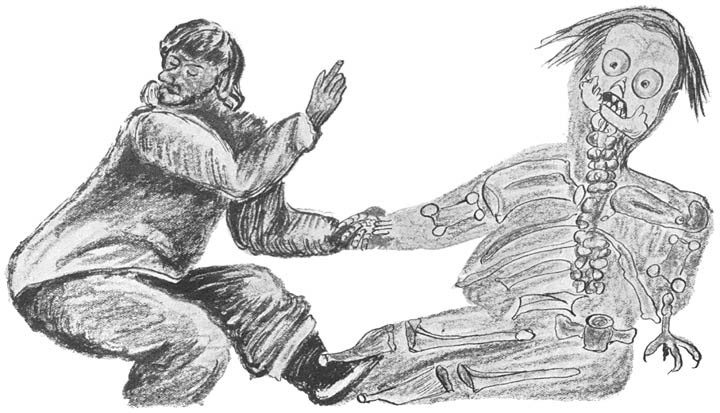
A maker beside a composite skeletal tupilak in the 1921 Greenlandic illustration
The original caption identifies a tupilak being brought to life from bones of several animals. Worster states that the drawings illustrate general themes rather than particular story episodes; this skeletal form does not supply the unspecified anatomy of Nukunguasik’s adversary.
Overview
Nukunguasik visits an unfamiliar island and finds one of a neighbouring group of brothers secretly commanding a created being to bite him to death. He interrupts by touching the maker and revealing himself. The startled man dies, while the tupilak continues sniffing. Nukunguasik leaves without attacking it. The narrative does not provide the being's exact anatomy or a complete construction procedure.
When the brothers search for their missing relative, Nukunguasik guides them to the island. They find the creature nibbling the corpse and condemn the dead man's undertaking. They bury him under stones and return home; Nukunguasik later dies old. The printed episode therefore ends with survival of the intended victim, not his death or the monster's destruction. Its particular outcome should remain distinct from other tupilak tales or modern carved representations.
A longer Godthaab account in Qujavarssuk gives the creature a different course. An offended guest creates a tupilak after receiving hospitality but disliking the food and a correction about how to eat it. The intended victim repeatedly disappears when entering his kayak. A shore becomes an impassable cliff, a falling stone breaks the creature’s rib, the house floor prevents entry from below and a large black bird bites it when it tries another approach.
Hungry and wounded, this tupilak decides to attack the man who burdened it with the task. It eats its maker in his kayak and initially feels restored. Afterwards it imagines other tupilaks condemning that act and withdraws permanently to the open sea in shame. The story grants the being frustrated expectations, reasoning and a sense of disgrace; its maker’s death is deliberate retaliation here, unlike Nukunguasik’s frightened maker dying before the later nibbling. The complete Qujavarssuk narrative continues through the hunter’s successful stay at Amerdloq and return home.
Origins & earliest records
The volume's final source list assigns this narrative to South-East Greenland. Knud Rasmussen collected the material; W. Worster edited and translated the1921 English selection. No individual storyteller is named for this episode. Worster explicitly states that he selected clear versions and omitted or edited passages, so this is not an unabridged oral-performance transcript.
Records & interpretation
Complete selected narrative and regional source-list entry read. Nukunguasik, who escaped from the Tupilak, begins printed p.18. The introduction's colonial classifications and comparative theories are not adopted as universal descriptions of Inuit cultures. The complete Qujavarssuk tale adds a separately situated Godthaab tupilak sequence; its repeated failures, retaliation and shame ending remain distinct.
Selected bibliography
Documented works and useful reading. This is not a list of every appearance.
- 01
Eskimo Folk-Tales
Nukunguasik, who escaped from the Tupilak, begins printed p.18. Complete selected episode; regional attribution checked against final source list. Historical title retained. Qujavarssuk, pp.20–37, complete narrative independently read; final source list assigns it to Godthaab.
Family & connections
A source-supported family tree or inspiration record has not yet been compiled for this profile. Related reading below indicates a connection in subject matter, not a proven lineage or creative influence.
References
Sources supporting this profile. Linked pages have their own scope and editorial standards.
- Primary textRasmussen/Worster1921: Nukunguasik, who escaped from the Tupilak, begins printed p.18.Research access: 2026-10-05
Image credits
Historical illustrationA maker beside a composite skeletal tupilak in the 1921 Greenlandic illustration
The original caption identifies a tupilak being brought to life from bones of several animals. Worster states that the drawings illustrate general themes rather than particular story episodes; this skeletal form does not supply the unspecified anatomy of Nukunguasik’s adversary.