
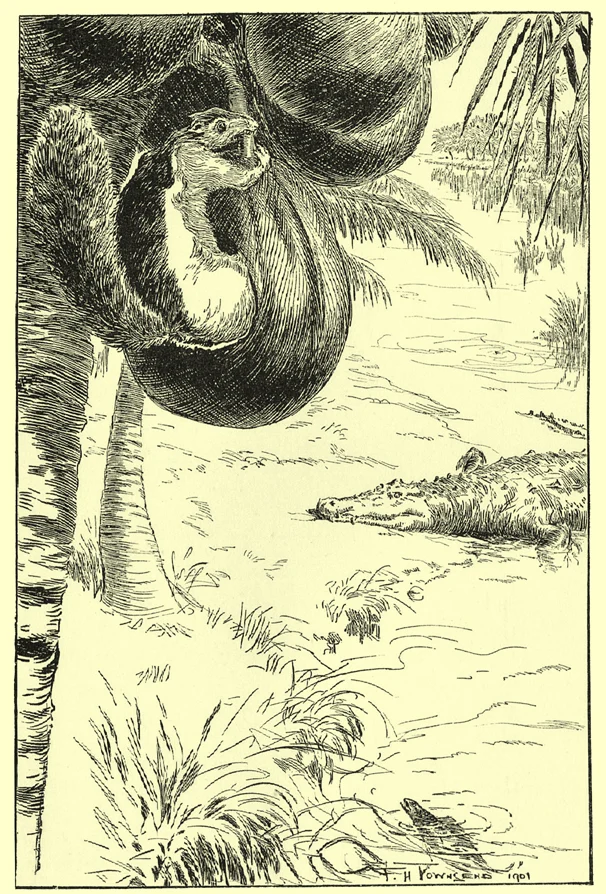
Townsend’s Tūpai the squirrel inside a coconut over a crocodile
The squirrel gnaws at the stalk of a coconut above the river before entering the crocodile inside it. This is the tale’s second act of reciprocal assistance; the egg theft by Rūan belongs to the earlier episode. The illustrated behaviour is specific to the fable.
Overview
Tūpai’s sick wife recovers after his friend Rūan obtains an egg for her. When Rūan’s wife later needs a crocodile’s heart, Tūpai hollows a coconut on an overhanging palm, gets inside and gnaws through the stalk. Swallowed with the nut, he emerges inside the crocodile and bites out its heart. The animal reaches shore and dies; Tūpai escapes through its jaws and brings the heart to his friend, whose wife recovers. Skeat records this as an example of devoted friendship, not a feasible remedy or ordinary squirrel behaviour, and tentatively supplies zoological context for the speaking animal.
Origins & earliest records
Malay Peninsula; Siong River village, interior Kedah; unnamed local Malay teller
Records & interpretation
Complete relevant tale and attached scholarly notes directly read.
Selected bibliography
Documented works and useful reading. This is not a list of every appearance.
- 01
Fables & Folk-Tales from an Eastern Forest
VI, The Friendship of Tūpai the Squirrel and Rūan the Creeping Fish, pp. 16–17; notes pp. 77–78
- 02
Fables & Folk-Tales from an Eastern Forest — VI The Friendship of the Squirrel and the Creeping Fish
Fables & Folk-Tales from an Eastern Forest, collected and translated Walter Skeat, Cambridge: University Press,1901. Original title leaf13 visually checked; selected complete tales and all accompanying notes read from historical transcription. Introduction states1899 Cambridge expedition collection and limitation of phraseology, not verbatim unedited speech. Original quoted folios visually checked in Archive fablesfolktalesf00skearich; IIIF canvas positions omit initial leaves, so exact original leaf number matched from image identifier, not array index.
Family & connections
A source-supported family tree or inspiration record has not yet been compiled for this profile. Related reading below indicates a connection in subject matter, not a proven lineage or creative influence.
Primary records and illustrations
Walter Skeat, Fables & Folk-Tales from an Eastern Forest (Cambridge: University Press, 1901)
VI, The Friendship of Tūpai the Squirrel and Rūan the Creeping Fish. VI, The Friendship of Tūpai the Squirrel and Rūan the Creeping Fish, pp. 16–17; notes pp. 77–78
Complete tale and associated notes directly read. Regional spellings and differing accounts retained; commentary does not establish present-day practice or biological facts. Teller attribution retained where stated: Che Busu for I/II; unnamed Siong River villager for VI.
Located primary passages
Specific passages supporting details in this entry, grouped by their published witness.
Fables & Folk-Tales from an Eastern Forest
Fables & Folk-Tales from an Eastern Forest, collected and translated Walter Skeat, Cambridge: University Press,1901. Original title leaf13 visually checked; selected complete tales and all accompanying notes read from historical transcription. Introduction states1899 Cambridge expedition collection and limitation of phraseology, not verbatim unedited speech. Original quoted folios visually checked in Archive fablesfolktalesf00skearich; IIIF canvas positions omit initial leaves, so exact original leaf number matched from image identifier, not array index. These four tales’ host page labels have not been individually scan-collated; original title and other selected folios checked separately.
- Tūpai and Rūan are close friends. When Tūpai’s wife becomes ill, a medicine-man demands a hen’s egg. Rūan enters a woman’s bamboo water tube at the river, is carried home, emerges at evening to steal an egg and returns in the tube next morning. Tūpai’s wife receives the egg and recovers. Later Rūan’s wife needs a crocodile’s heart. Tūpai hollows a coconut, enters it and bites through its stalk so it falls into the river. A crocodile swallows it. The squirrel leaves the shell inside the stomach and bites out the heart; the dying crocodile reaches shore, allowing Tūpai to escape through its jaws. Rūan receives the heart and his wife recovers. Skeat credits an unnamed local Malay at a Siong River village in Kedah.
CompleteVI16–17 and all notes77–78 read. Recovery is a narrative claim, not medical guidance. Coconut protects entry, not a transformation into fruit. Tūpai is not born from a crocodile. Notes’ historical species names and walking mechanism not adopted as modern taxonomy.
References
Sources supporting this profile. Linked pages have their own scope and editorial standards.
- Historical collected narrative with locality and editorial notesSkeat, Fables & Folk-Tales (Cambridge University Press, 1901), VI, The Friendship of Tūpai the Squirrel and Rūan the Creeping Fish, pp. 16–17; notes pp. 77–78Research access: 2026-10-05
Image credits
Historical illustrationTownsend’s Tūpai the squirrel inside a coconut over a crocodile
The squirrel gnaws at the stalk of a coconut above the river before entering the crocodile inside it. This is the tale’s second act of reciprocal assistance; the egg theft by Rūan belongs to the earlier episode. The illustrated behaviour is specific to the fable.