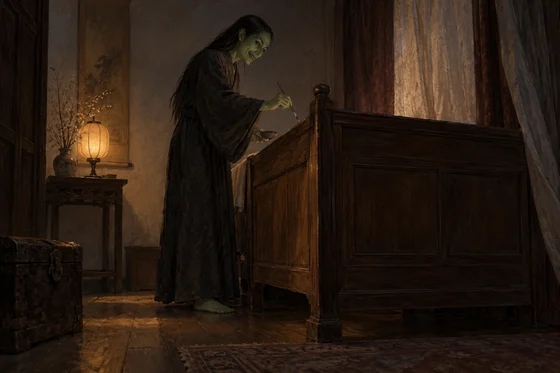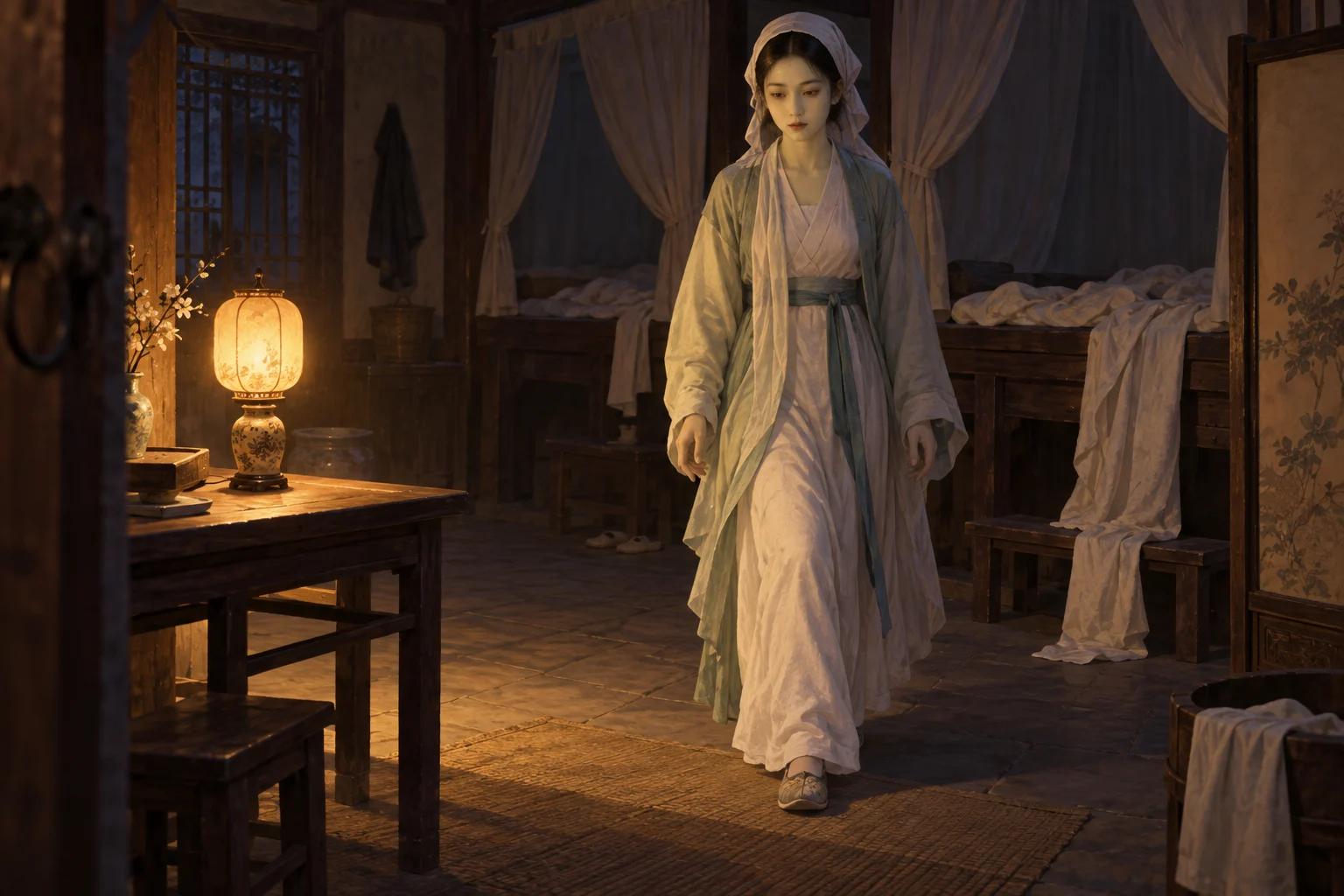
Pale-faced woman with a head kerchief walks away from a covered trestle in a lamplit room.
AI-generated interpretation of the dead daughter-in-law advancing after leaving her trestles, before reaching the travellers. Her light-yellow face, silk head kerchief, trestles, paper coverings and table lamp are textual. Clothing, pose, texture and placement of the pushed-back coverings, room and lighting are artistic choices, not an authenticated funeral ritual. Based on Pu Songling in Herbert A. Giles's 1880 English translation. Original prose-based composition, not historical artwork. Compressed for display.
Overview
Four travellers lodging at an overcrowded inn in Pu Songling’s story are placed near the body of the landlord’s newly dead daughter-in-law. One remains awake and sees her leave the trestles, with a yellowish face and silk kerchief around her head. She breathes on the sleeping men; he hides beneath his bedding and holds his breath when she approaches. After she returns to her resting place, his companions fail to respond to his attempts to wake them. The account is followed here in Giles’s1880 translation and does not supply a technical species name.
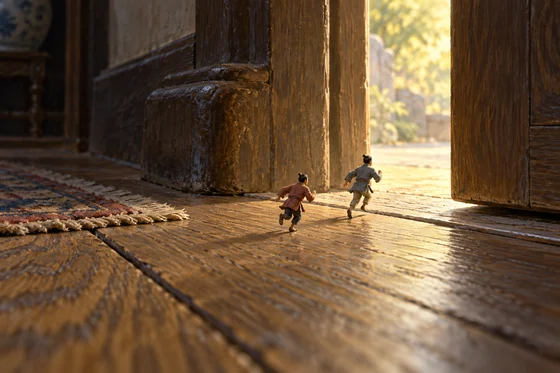
The survivor’s movement rouses her again. Eventually he escapes the room and runs towards a monastery, pursued closely by the corpse. Refused immediate entry, he dodges around a tree until she reaches around both sides to seize him. He falls backwards, escaping her grasp, while she becomes fixed to the trunk. The narrative describes running, repeated movements and grasping, without giving her fangs or a blood-drinking action.
The priest finds the man unconscious and takes him inside. At dawn the dead woman’s fingers are found sunk so deeply into the tree that her nails cannot be seen. Officials eventually remove her, and inquiries establish that the other three travellers died in their beds. Her family retrieves the body; the survivor receives a magistrate’s certificate to account for returning alone. The title’s “resuscitated” therefore does not mean a lasting restoration to ordinary life. The cause of her movement is left unexplained, and the certificate belongs to the story’s resolution rather than an independently located historical record.
Origins & earliest records
Pu Songling’s literary collection in Giles’s selected translation.
Records & interpretation
Complete account and attached notes read; full translator introduction and transcriber notice checked.
Selected bibliography
Documented works and useful reading. This is not a list of every appearance.
- 01
Strange Stories from a Chinese Studio
Volume II, pp.193–196; CVI, The Resuscitated Corpse; electronic notes529–531; complete account and notes read.
Family & connections
A source-supported family tree or inspiration record has not yet been compiled for this profile. Related reading below indicates a connection in subject matter, not a proven lineage or creative influence.
Primary records and illustrations
Strange Stories from a Chinese Studio
London: Thos. de la Rue,1880, two volumes. II, pp.193–196; CVI, The Resuscitated Corpse; electronic notes529–531
Cache giles-story-106.txt; master giles-studio-43629.html. Global research-name/motif dedup performed. Chinese text not collated; no independent historical verification of narrated incidents.
References
Sources supporting this profile. Linked pages have their own scope and editorial standards.
- Historical literary translationStrange Stories from a Chinese Studio — II, pp.193–196; CVI, The Resuscitated Corpse; electronic notes529–531Research access: 2026-10-05
Image credits
AI-generated interpretationPale-faced woman with a head kerchief walks away from a covered trestle in a lamplit room.
AI-generated interpretation of the dead daughter-in-law advancing after leaving her trestles, before reaching the travellers. Her light-yellow face, silk head kerchief, trestles, paper coverings and table lamp are textual. Clothing, pose, texture and placement of the pushed-back coverings, room and lighting are artistic choices, not an authenticated funeral ritual. Based on Pu Songling in Herbert A. Giles's 1880 English translation. Original prose-based composition, not historical artwork. Compressed for display.