
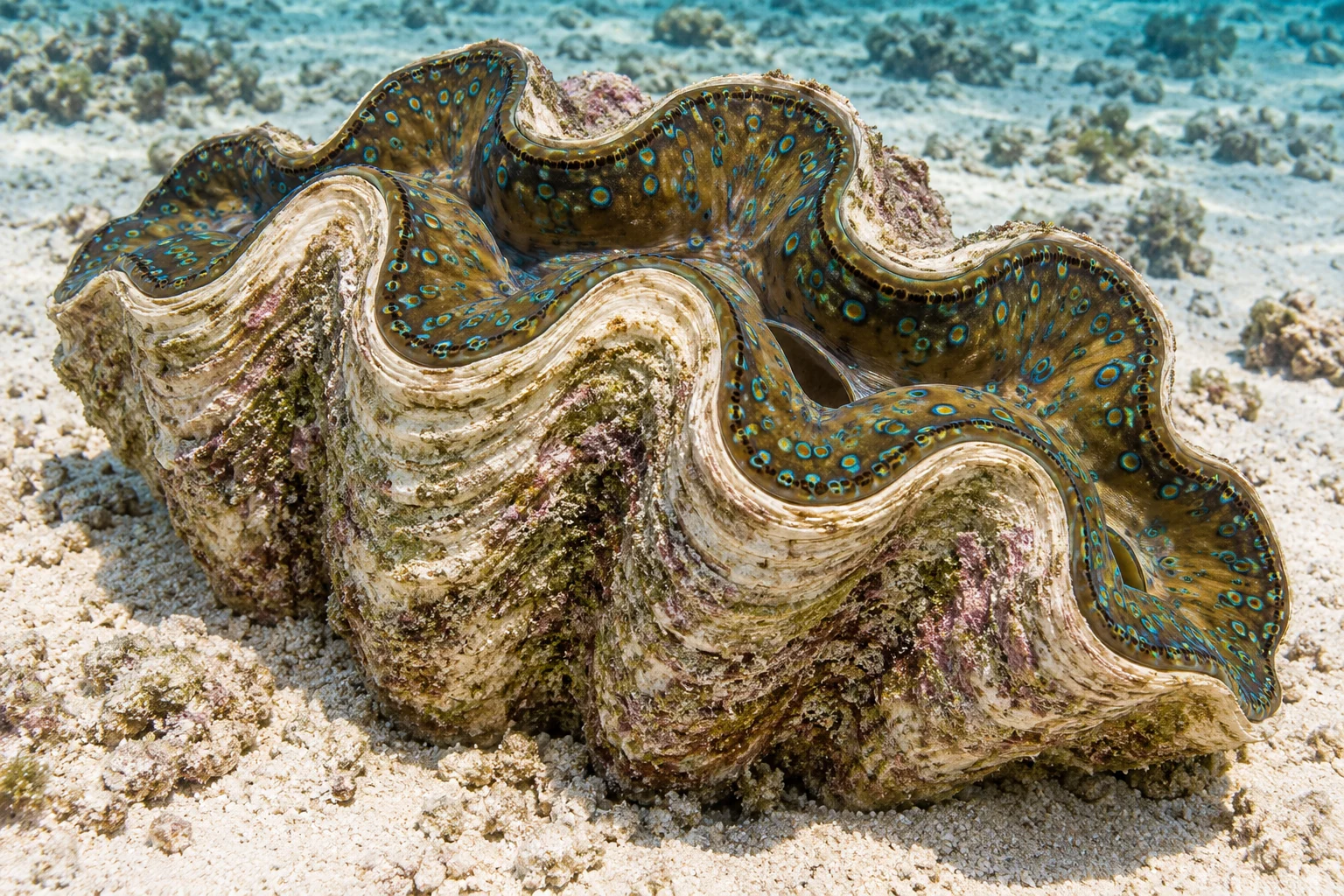
AI-generated whole exterior study.
Interpretation; hidden underside is not reconstructed.
Overview
The true giant clam inhabits shallow Indo-Pacific reef environments, including lagoons and sandy reef substrates. Its heavy shell has deep radial folds. Above the shell, the exposed mantle is often olive-green or yellowish-brown, marked with small blue-green rings that can be especially conspicuous toward its edges.
Adults remain fixed in place. They filter microscopic food from seawater while also receiving nutrition from algae living within their tissues. Reproduction releases eggs and sperm into the water; the resulting larvae swim and feed before settling onto a suitable substrate, beginning the sedentary adult phase of the life cycle.
Origins & earliest records
Marine reefs
Evidence & interpretation
Institutional accounts.
Selected bibliography
Documented works and useful reading. This is not a list of every appearance.
- 01
- 02
Family & connections
A source-supported family tree or inspiration record has not yet been compiled for this profile. Related reading below indicates a connection in subject matter, not a proven lineage or creative influence.
Look for a taxonomic record and classified relativesReferences
Sources supporting this profile. Linked pages have their own scope and editorial standards.
- Government species accountTrue Giant ClamResearch access: 2026-10-18
- University species accountTridacna gigasResearch access: 2026-10-18
Image credits
AI-generated illustrationAI-generated whole exterior study.
Interpretation; hidden underside is not reconstructed.