
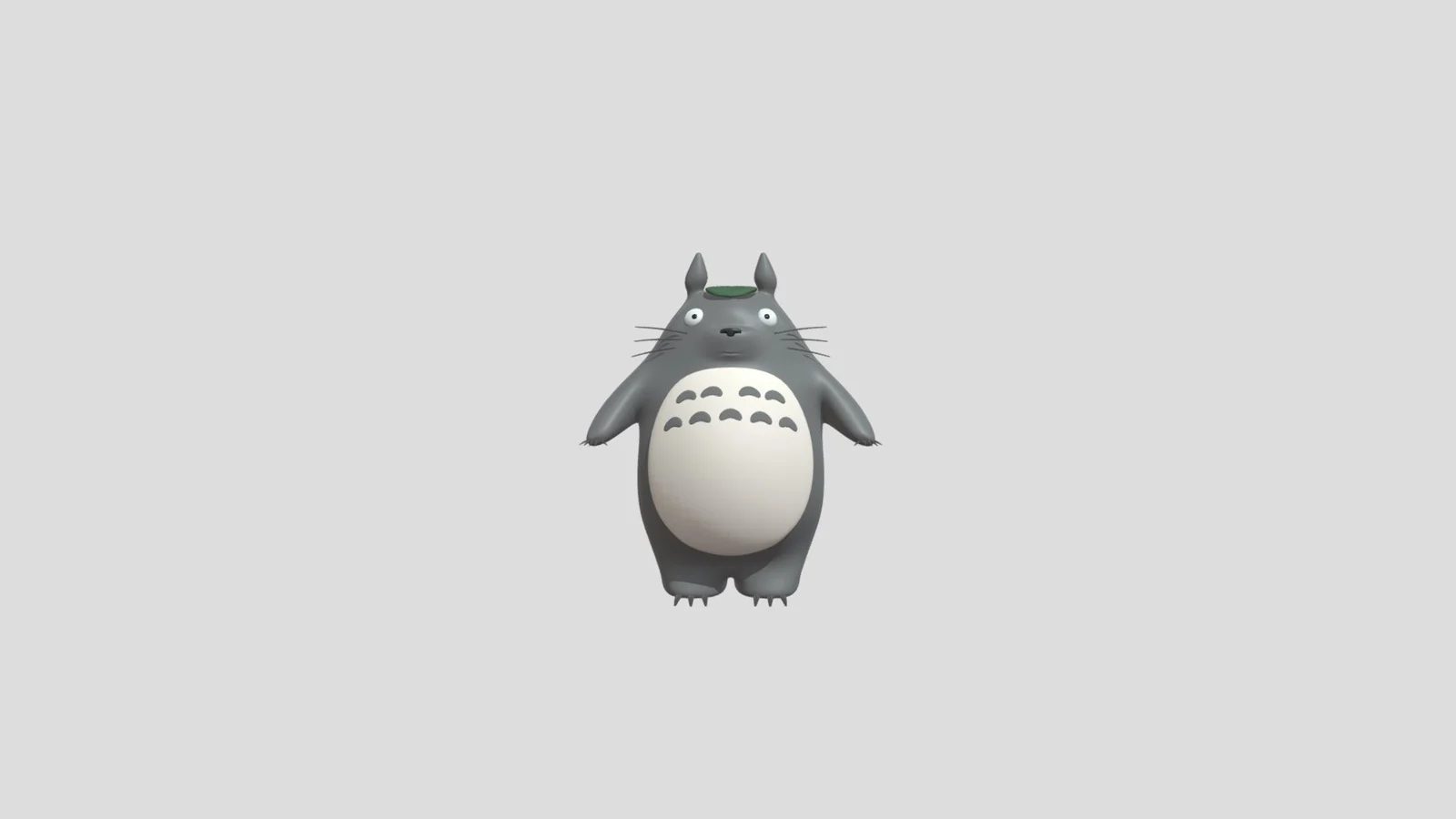
mich95’s Totoro fan model rendered front-on against pale grey, with pointed ears, whiskers, a green leaf on its head and dark arch markings across a pale rounded belly.
mich95’s 2024 fan model of Totoro, inspired by Miyazaki’s film. This is an independent three-dimensional interpretation.
Overview
Totoro has a broad, fur-covered body, upright ears and a pale belly patterned with dark markings. His size makes Mei’s first encounter physically imposing, yet the sleeping creature allows her to rest on him. GKIDS describes him as a forest spirit visible to children, while the film presents his nature through encounters rather than a systematic mythology. The smaller woodland creatures guide Mei toward him; their different sizes do not establish a documented developmental sequence. Their home connects the family’s new surroundings with a world the girls can discover before adults can explain it.
At a rainy bus stop, Satsuki shares an umbrella with Totoro, who becomes fascinated by the sound of falling drops. His gift of acorns links their meeting to later communal planting and an extraordinary nighttime growth sequence. The sisters subsequently travel with him on a spinning top. These experiences make him both an unusual neighbor and a participant in the children’s worries. When Mei disappears after setting out toward their hospitalized mother, Satsuki seeks his help and the Catbus becomes the means of searching for her. The selected novel and film-comic editions retell this family crisis; they are adaptations of the film’s story, rather than independent proof of a larger Totoro civilization.
First appearances & development
Hayao Miyazaki wrote and directed My Neighbor Totoro, released in Japan on April 16, 1988. The creature later became Studio Ghibli’s familiar emblem. The selected English novel was published in 2013, with Tsugiko Kubo adapting Miyazaki’s original story; that edition date is distinct from the film debut.
Canon & continuity
The studio’s film credits establish authorship and release. GKIDS supplies the child-visible woodland encounter, VIZ identifies the novel and lost-child plot, and the inspected specialist account provides the umbrella, acorn and flight scenes. No precise age, ancient extinction history or universal real-world folkloric ancestry is established by these witnesses.
Selected bibliography
Documented works and useful reading. This is not a list of every appearance.
- 01
My Neighbor Totoro
Original animated encounter and family story.
- 02
My Neighbor Totoro: The Novel
Selected English novel edition; adaptation rather than film debut.
- 03
My Neighbor Totoro Film Comics, Volume 4
Selected English adaptation volume covering Mei’s disappearance.
Family & connections
A source-supported family tree or inspiration record has not yet been compiled for this profile. Related reading below indicates a connection in subject matter, not a proven lineage or creative influence.
References
Sources supporting this profile. Linked pages have their own scope and editorial standards.
- OfficialStudio Ghibli: My Neighbor TotoroResearch access: 2026-10-05
- OfficialGKIDS: Totoro and Mononoke home-video announcementResearch access: 2026-10-05
- OfficialVIZ: My Neighbor Totoro novelResearch access: 2026-10-05
- OfficialVIZ: Totoro Film Comics Volume 4Research access: 2026-10-05
- ReferenceGhibli Wiki: TotoroResearch access: 2026-10-05
- OfficialStudio Ghibli historyResearch access: 2026-10-05
Image credits
Static render of a creator-made Totoro fan modelmich95’s Totoro fan model rendered front-on against pale grey, with pointed ears, whiskers, a green leaf on its head and dark arch markings across a pale rounded belly.
mich95’s 2024 fan model of Totoro, inspired by Miyazaki’s film. This is an independent three-dimensional interpretation.