
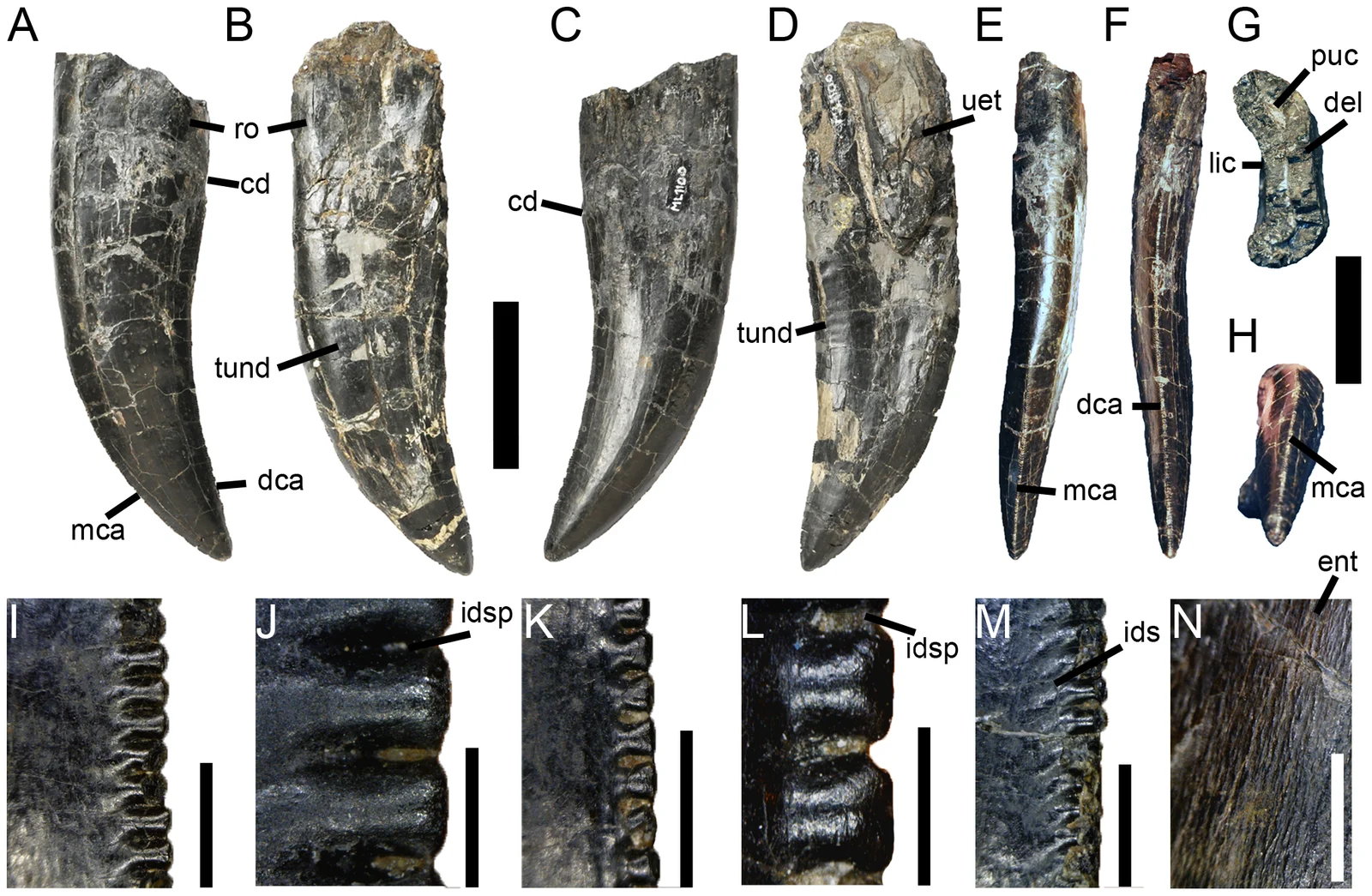
Whole plate of erupted and replacement teeth from holotype ML 1100, including serration details.
Whole figure; holotype teeth only; no reconstruction. Compressed for display.
Overview
Named in 2014, this theropod is based on ML 1100, an incomplete upper jaw with an erupted and an unerupted tooth and a partial tail vertebra. The Portuguese fossils are late Kimmeridgian; geological age differs from the naming date.
Fused interdental plates have a straight lower margin, unlike the broad V-shaped points diagnosed for American Torvosaurus tanneri. The analysis recovered them as sister taxa; it did not identify either as the other’s ancestor.
Co-author Mateus, quoted by NOVA in 2014, linked divergence to isolation when the Atlantic was already well formed. Body-size and largest-predator statements are historical interpretations, not present-day rankings or direct complete-skeleton measurements.
Origins & earliest records
Biological origin undated.
Evidence & interpretation
Fossils.
Selected bibliography
Documented works and useful reading. This is not a list of every appearance.
- 01
Torvosaurus gurneyi n. sp.
Selected evidence.
- 02
Ciência na Nova
Selected evidence.
Family, evolution & connections
Taxonomic classification
A hierarchy of classified groups, not a chain of direct ancestors.
Source note: GBIF ranks; intermediate clades omitted.
- kingdomAnimalia
- phylumChordata
- familyMegalosauridae
- genusTorvosaurus
- speciesTorvosaurus gurneyi
References
Sources supporting this profile. Linked pages have their own scope and editorial standards.
- Primary researchTorvosaurus gurneyi n. sp.Research access: 2026-10-07
- Institutional accountCiência na NovaResearch access: 2026-10-07
- Institutional taxonomyGBIF taxonomic matchResearch access: 2026-10-07
Image credits
Scientific specimen plateWhole plate of erupted and replacement teeth from holotype ML 1100, including serration details.
Whole figure; holotype teeth only; no reconstruction. Compressed for display.