
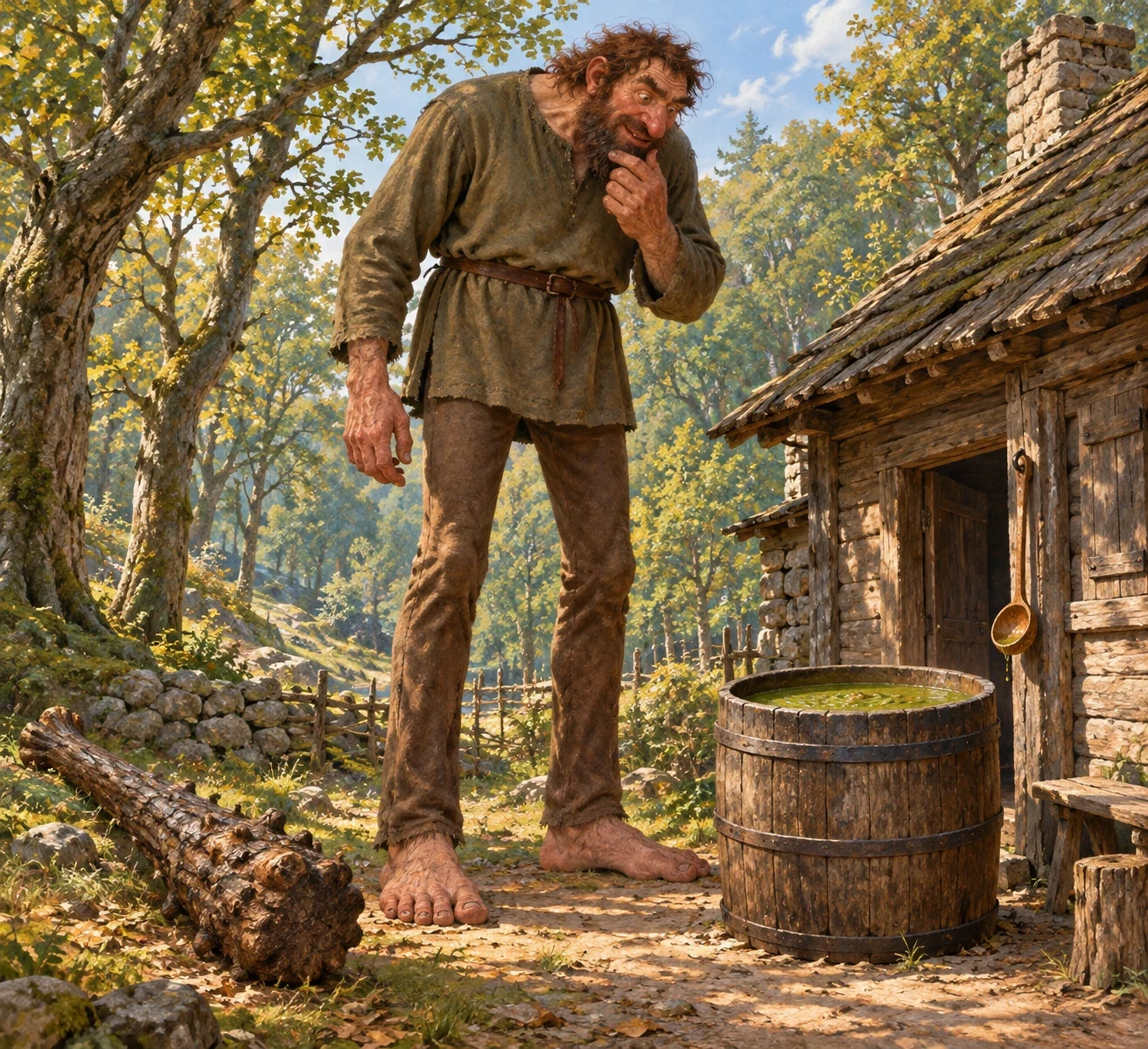
Toover Hek approaching the offered pea soup; appearance and farm setting interpreted from Griffis’s literary version.
Original narrative illustration of Griffis’s literary version; unspecified visual details remain imagined, not authenticated ethnography.
Overview
Toover Hek waits where paths meet in the hazel forest and carries off travellers to a cave shared with his wife. His height and exceptionally long legs give him the children’s nickname Long Man; the narrator also writes Lounge Man. Heinrich and Grietje build a farm in the forest and fear that the giant will eat them and their animals. Heinrich has seen him carrying an enormous club made from a fir tree. Reasoning that his appetite can distract him, the couple plan to leave hot, thick pea soup outside their house while locking themselves and the livestock safely away. When the ogre approaches, Grietje prepares the soup, bolts the divided door and watches through the keyhole. He lays down his club, ignores the ladle and lifts the entire barrel with both hands, swallowing its contents before departing without harm.
The visits become daily, and the couple cannot keep supplying such quantities of peas. The ogre’s wife is angry that he neither brings people home nor saves soup for her. Just as the last peas are used, an unnamed knight arrives after making a vow to the Holy Virgin. He waits until the fed giant is slow and sleepy, avoids the club and attacks his knees before killing him. The ending describes the display and later reuse of the head, while Heinrich turns the abandoned club into a winter’s supply of firewood. The survivors establish a woodland shrine; the narrator connects its fame with Hasselt’s growth and a seven-year celebration. The tale closes by admitting that the ogre’s wife’s fate is unknown. These are the story’s linked explanations, not independently verified accounts of the shrine’s origin or the town’s founding.
Origins & earliest records
Chapter V, The Ogre in the Forest of Hazel Nuts, links Toover Hek with Hasselt and a shrine called Virga Jesse. Griffis places the tale in Limburg and Belgic land. The opening chapter presents his visits to Belgium as sources of seeds for bedtime stories, but does not identify an oral narrator for this episode. This entry follows that printed literary version, without claiming that its wording, etymologies or events are a documented historical account.
Records & interpretation
Complete chapter V, original printed pp.44–55, including the household plan, repeated feeding, knight’s intervention and shrine-and-festival ending; complete chapter I, A Story for a Preface; native original title and copyright pages.
Selected bibliography
Documented works and useful reading. This is not a list of every appearance.
- 01
Belgian Fairy Tales
New York: Thomas Y. Crowell Company. Original English literary treatment; chapter V, The Ogre in the Forest of Hazel Nuts.
Family & connections
A source-supported family tree or inspiration record has not yet been compiled for this profile. Related reading below indicates a connection in subject matter, not a proven lineage or creative influence.
References
Sources supporting this profile. Linked pages have their own scope and editorial standards.
- Historical primary literary treatment of a local legendGriffis1919 — original chapter V and opening narrative contextResearch access: 2026-10-18
- Original edition witnessOriginal1919 printed edition, University of California scanResearch access: 2026-10-18
Image credits
AI-generatedToover Hek approaching the offered pea soup; appearance and farm setting interpreted from Griffis’s literary version.
Original narrative illustration of Griffis’s literary version; unspecified visual details remain imagined, not authenticated ethnography.