
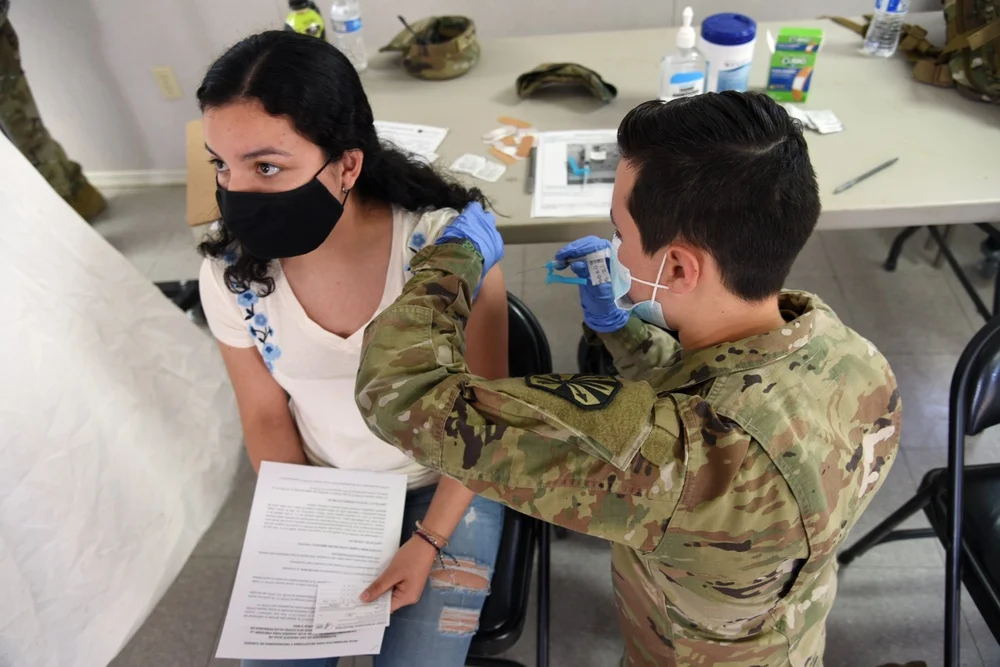
A Tohono O’odham Nation member receiving a vaccination from an Arizona National Guard medic in Why, Arizona, on May 11, 2021
Pvt. Alyssa Hovland administers a vaccination during an Arizona National Guard partnership with the Tohono O’odham Nation in Why, Arizona, in May 2021. This is one documented health-service event, rather than a representative appearance of all community members. The appearance of U.S. Department of War (DoW) visual information does not imply or constitute DoW endorsement.
Overview
The Tohono O’odham Nation locates its peoplehood in the Sonoran Desert and presents environmental knowledge as an active inheritance. Its public history describes agriculture, water management and seasonal movement, while explicitly identifying contemporary O’odham life. The same account treats the international border as a division imposed across an existing homeland, with consequences for family relationships and cultural activities. These are the Nation’s stated historical perspectives; the page is not a current border-crossing guide. It also distinguishes the Tohono O’odham Nation from other O’odham political communities. Shared language and historical connections do not make their governments interchangeable. The page’s identification of Hohokam predecessors is a community account of heritage, rather than proof that every archaeological category maps neatly onto one modern citizenship.
The Nation’s education department describes services for members from early childhood through adulthood. Its listed programmes include Head Start, childcare, vocational rehabilitation, higher-education assistance, the youth council and Venito Garcia Library. The department situates this work within himdag and the responsibilities of the Nation’s executive administration. This institutional breadth matters: contemporary cultural continuity includes education, employment preparation and access to libraries, as well as practices more frequently displayed in heritage accounts. Programme listings establish a stated scope, without demonstrating attendance or outcomes for every member.
A separate language-teacher certification description recognizes expertise acquired outside degree programmes. It describes a proficiency assessment covering speaking, reading, writing and teaching, followed by a tribal language certificate for successful candidates and an opportunity to apply for Arizona’s Native Language Teacher Certificate. Tribal assessment and state certification are distinct steps. The description supports a route for language specialists into classrooms; it does not establish that every fluent speaker is a certified teacher or that certification guarantees employment.
Ofelia Zepeda’s university biography identifies her as Tohono O’odham and describes work in linguistics, language revitalization and poetry in O’odham and English. It also records her co-founding role in the American Indian Language Development Institute. The publisher dates Ocean Power: Poems from the Desert to March 1995 and presents it as a personal collection shaped by family experience, desert weather and contemporary womanhood. That framing keeps an individual author’s perspective visible. The bibliography here identifies the collection; its poems have not been independently read, quoted or treated as statements held uniformly throughout the Nation.
History & identity
Community homeland and heritage account, without equating archaeological labels with modern citizenship.
Sources & representation
Complete selected history, education and certification bodies, university biography and publisher description read; literary collection unexamined.
Selected bibliography
Documented works and useful reading. This is not a list of every appearance.
- 01
Ocean Power: Poems from the Desert
Publisher metadata and description only; poems unexamined.
Language & cultural connections
These connections link languages or specific cultural works and institutions; they do not establish biological ancestry or ethnic identity.
Tohono O'odham Nation Department of Education
The Nation places this department under its Executive Branch. Listed programmes include language-teacher certification and the Venito Garcia Library, alongside services for children and adults. This is an institutional relationship.
References
Sources supporting this profile. Linked pages have their own scope and editorial standards.
- Tribal historyTohono O’odham Nation: History & CultureResearch access: 2026-10-05
- Tribal educationTohono O’odham Nation: EducationResearch access: 2026-10-05
- Tribal programmeTohono O’odham Nation: Teacher CertificationResearch access: 2026-10-05
- University biographyUniversity of Arizona: Ofelia ZepedaResearch access: 2026-10-05
- PublisherUniversity of Arizona Press: Ocean PowerResearch access: 2026-10-05
Image credits
Contextual community health-service photographA Tohono O’odham Nation member receiving a vaccination from an Arizona National Guard medic in Why, Arizona, on May 11, 2021
Pvt. Alyssa Hovland administers a vaccination during an Arizona National Guard partnership with the Tohono O’odham Nation in Why, Arizona, in May 2021. This is one documented health-service event, rather than a representative appearance of all community members. The appearance of U.S. Department of War (DoW) visual information does not imply or constitute DoW endorsement.