
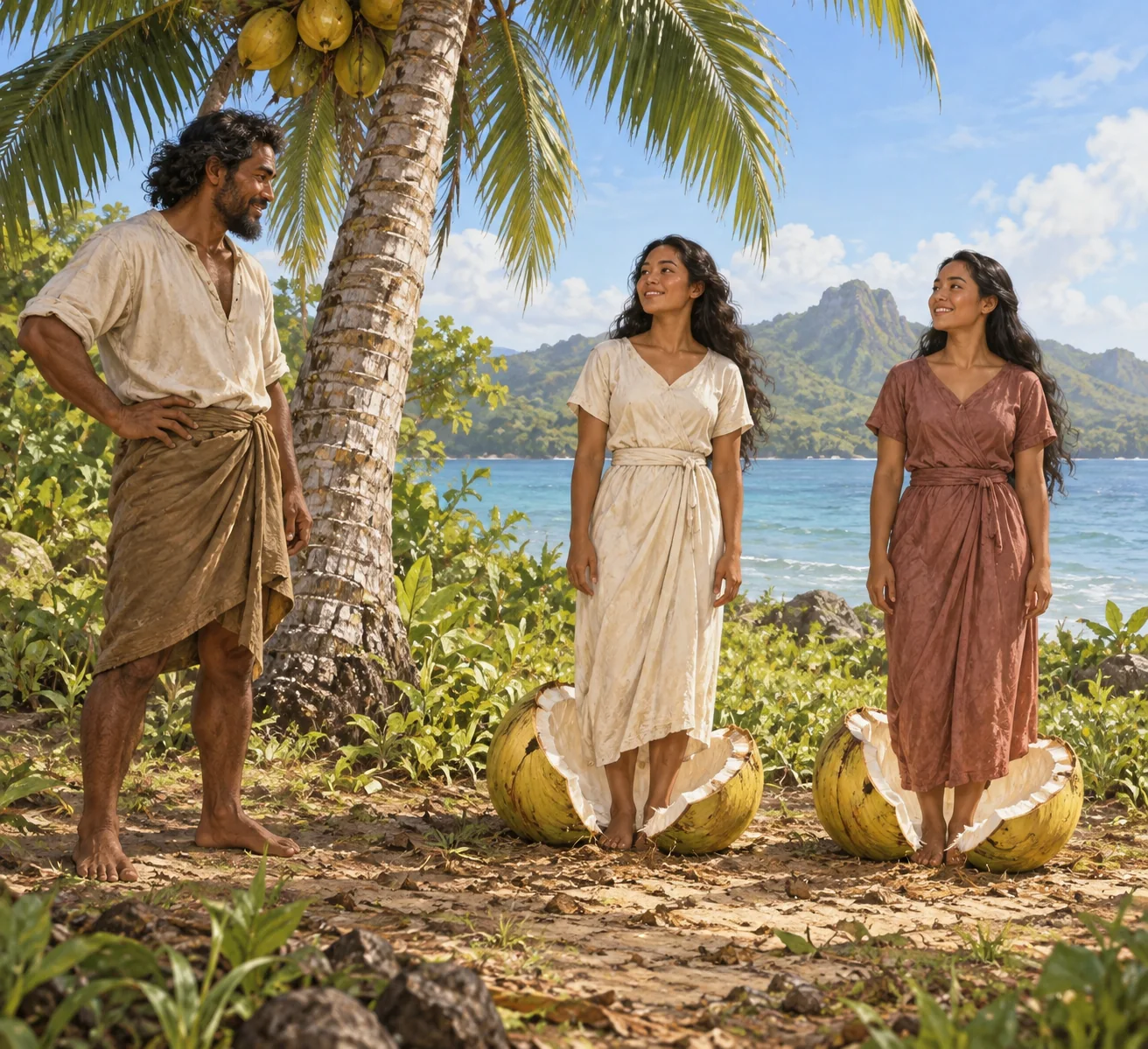
AI imagined coconut transformation in ToPuia’s Tolai account.
Invented landscape and figures; not community portraits or ritual evidence.
Overview
Gideon Kakabin’s post attributes this account to ToPuia of Rakunai. ToKaia covers two blood-wetted drawings with leaves; they become To Kabinana and To Karvuvu. Kabinana drops young yellow coconuts, which become women. Karvuvu imitates him, but their downward-pointing ends produce battered noses. He then demands one of Kabinana’s women. Kabinana condemns that breach of kinship.
Alphonse Aime separately discusses a canoe-making narrative reported through Fischer’s citation of Meier: Karvuvu makes a slit-drum instead, associated with announcing deaths. Aime’s own Tolai-elder interviews distinguish message-bearing garamut from a generic musical category. This is contextual scholarship, not direct inspection of Meier’s original. His Kayan fieldwork concerns another community and is not assigned to Tolai.
Origins & earliest records
A named local telling, alongside a distinct published comparison.
Records & interpretation
Posted narrative attribution and university research; older intermediary editions uninspected.
Selected bibliography
Documented works and useful reading. This is not a list of every appearance.
- 01
Tolai Myths of Origin
Public post.
- 02
Unwrapping garamut meaning
DWU journal 25, pp.54–58; Tolai context only.
Family & connections
A source-supported family tree or inspiration record has not yet been compiled for this profile. Related reading below indicates a connection in subject matter, not a proven lineage or creative influence.
References
Sources supporting this profile. Linked pages have their own scope and editorial standards.
- Public attributed retellingToPuia accountResearch access: 2026-10-11
- Research articleGaramut researchResearch access: 2026-10-11
Image credits
AI narrative interpretationAI imagined coconut transformation in ToPuia’s Tolai account.
Invented landscape and figures; not community portraits or ritual evidence.