
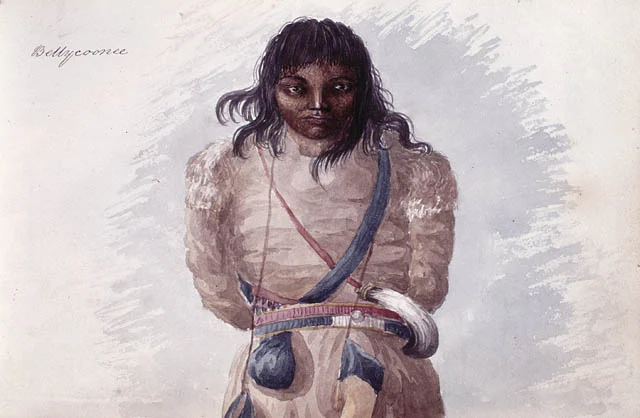
George Back’s painted portrait of Bellycoonee, shown frontally with long dark hair, crossed straps and a belt; the sitter’s name is handwritten at upper left.
Bellycoonee, portrayed by George Back in 1825–1826. Library and Archives Canada identifies the named sitter as Tlicho in its catalogue. The image is a historical artist’s representation of one person, rather than a contemporary or universal community appearance.
Overview
Tłı̨chǫ community institutions serve Behchokǫ̀, Whatì, Gamètì and Wekweètì in Canada’s Northwest Territories. Their history project traces a political sequence from Chief Monfwi’s signing of Treaty 11 in 1921 to the Tłı̨chǫ Agreement, signed in 2003 and effective on 4 August 2005. These dates identify treaty and governmental changes, not the beginning of the people. The project presents oral records, community memories and documentary milestones together, making its own historical priorities visible rather than treating an outside chronological outline as the only record.
The project’s introduction to Trails of Our Ancestors describes travel through the homeland as a way to learn history, law and responsibility. Families’ seasonal journeys between caribou country and winter places below the treeline connected practical knowledge with language and stories. The canoe program begun in the mid-1990s renewed travel between the four communities with elders and young people. Journeys also brought participants to witness agreement-related events. This account relates land-based teaching to political preparation; it does not claim that every present-day household follows an identical seasonal livelihood or that a canoe route is a biological migration tree.
Community education also includes selecting and presenting written resources. The history project introduces A Collection of Tłı̨chǫ Stories from Long Ago as stories chosen by elders from all four communities through a Community Services Agency project. That documented selection matters: a published collection has contributors and an educational purpose, and should not be assumed to contain every story or to authorize every possible use of traditional knowledge. The catalogue is a route into community literature; its introductory page alone is not a reading of the complete linked volume.
The Tłı̨chǫ Community Services Agency combines education, health and social services and locates its mission in returning control to communities. Its account traces institutional predecessors before its establishment in 2005, avoiding the impression that organized education began only with the Agreement. It attributes a bilingual and bicultural educational vision to Chief Jimmy Bruneau’s 1971 school-opening address and records Elizabeth Mackenzie’s later interpretation in 1991. The resulting educational ideal joins inherited knowledge with the skills needed in contemporary life. The Agency serves people in its communities; that service role should not be confused with a definition of political citizenship or with a claim that all residents share identical identities.
John B. Zoe’s opening chapter gives the canoe programme a history of setbacks as well as renewal. Funding enabled its first journey in 1995. After sponsor communication failed in 1997, the Council kept the programme alive with four canoes and eight places, leaving students unable to participate. A new funding partnership in 1998 supported its revival. This account shows the organizational work behind intergenerational teaching, rather than presenting cultural continuity as effortless or uninterrupted.
History & identity
Community accounts connect longstanding knowledge of the homeland with documented treaty, educational and self-government history. Institutional effective dates do not date ethnic origins.
Sources & representation
Complete introductory history, learning-resource, Trails of Our Ancestors and Community Services Agency mission pages read. Linked book and full agreement texts were not independently collated for this profile.
Selected bibliography
Documented works and useful reading. This is not a list of every appearance.
- 01
A Collection of Tłı̨chǫ Stories from Long Ago
Resource identified by the community history catalogue; complete book not inspected.
- 02
Trails of Our Ancestors: Building a Nation
Public introduction read; the catalogue labels its timeline entry 2002, not independently verified here as the linked volume’s publication date. Selected PDF: preface, Chapter1 pp.3–11 and endnote53 read; contains2007 material, publication year unverified.
Language & cultural connections
These connections link languages or specific cultural works and institutions; they do not establish biological ancestry or ethnic identity.
Dene-Athabaskan languages
Northwest Territories language resources classify Tłı̨chǫ Yatıì within Dene-Athabaskan. This concerns language relationships, not biological descent of the people.
Located primary passages
Specific passages supporting details in this entry, grouped by their published witness.
Primary source witness
Selected PDF.
- Zoe links canoe journeys, intergenerational language teaching and self-government negotiations; dated trip history remains source-specific.
Other chapters uninspected; website2002 label is not publication.
References
Sources supporting this profile. Linked pages have their own scope and editorial standards.
- Community-authoredTłı̨chǫ History Project introductionResearch access: 2026-10-05
- Community-authoredCommunity learning resourcesResearch access: 2026-10-05
- Community-authoredTrails of Our Ancestors introductionResearch access: 2026-10-05
- Community-authoredCommunity Services Agency mission, vision and goalsResearch access: 2026-10-05
- Community-authoredTrails of Our Ancestors: Building a NationResearch access: 2026-10-05
Image credits
Historical artist’s portrait of a specifically named Tłı̨chǫ sitterGeorge Back’s painted portrait of Bellycoonee, shown frontally with long dark hair, crossed straps and a belt; the sitter’s name is handwritten at upper left.
Bellycoonee, portrayed by George Back in 1825–1826. Library and Archives Canada identifies the named sitter as Tlicho in its catalogue. The image is a historical artist’s representation of one person, rather than a contemporary or universal community appearance.