
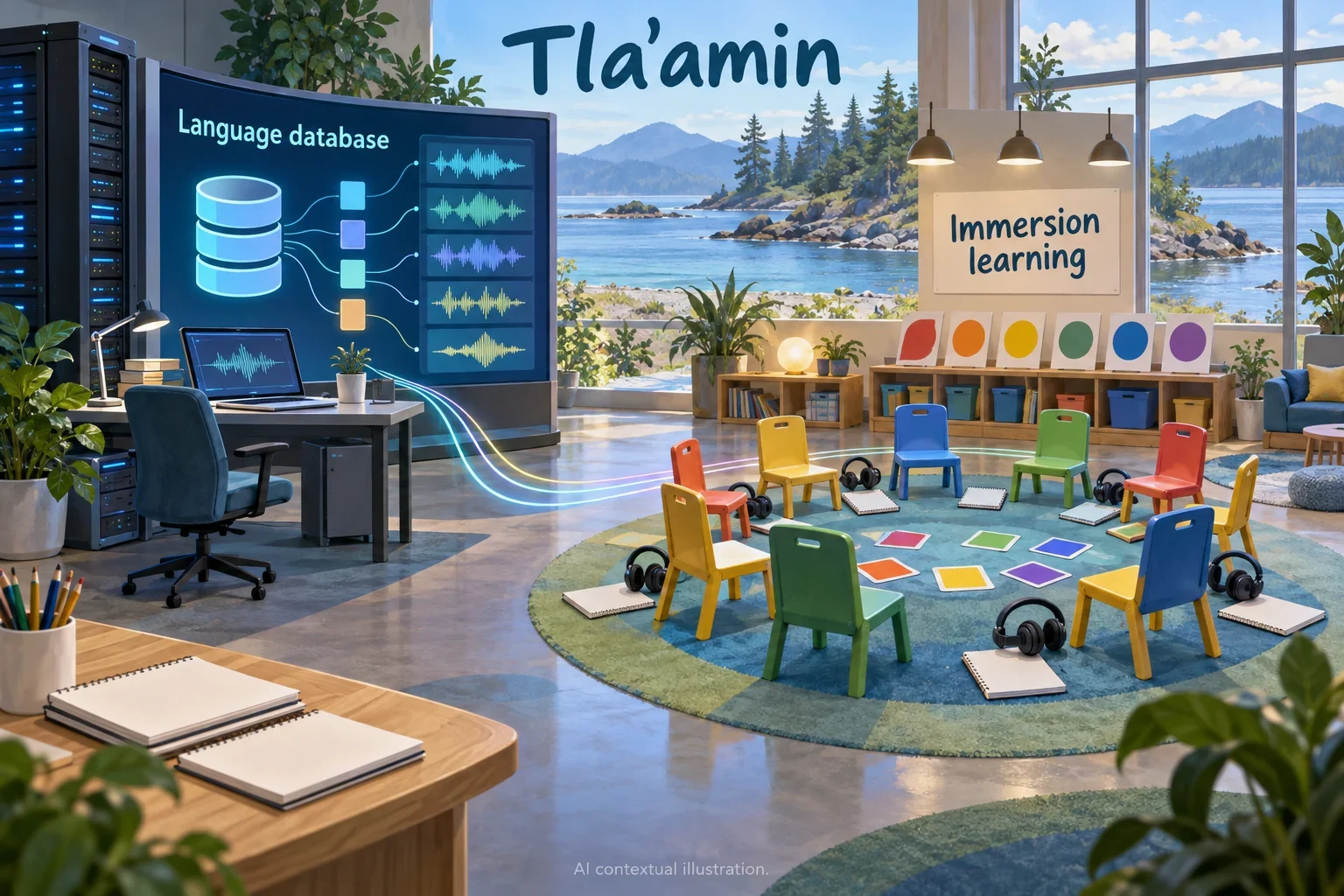
AI concept of Tla’amin language documentation and immersion learning.
Setting, tools and layout imagined; not ethnographic evidence.
Overview
Tla’amin’s modern treaty came into effect in 2016, restoring authorities over lands, laws and governance. Its elected Legislature and administration serve citizens living both on and off Nation lands. The Nation describes ancestral teachings and Elders’ knowledge as continuing foundations for family care, stewardship and relationships with neighbours; 2016 marks institutional change, not the people’s beginning.
The ancestral language, ʔayʔaǰuθəm, also called Ayajuthem, carries knowledge and relationships beyond direct English translation. Tla’amin reports a dictionary exceeding 6,000 entries and children’s immersion classes. Its language account recognises different valid family and community ways of speaking among Tla’amin, Klahoose, Homalco and K’ómoks, while advocating shared resources, teacher training and an expanding digital database.
History & identity
Ancestral continuity informs modern self-government and language revitalization.
Sources & representation
Selected native community passages retained.
Selected bibliography
Documented works and useful reading. This is not a list of every appearance.
- 01
- 02
Language & cultural connections
Source-supported language and cultural connections have not yet been compiled for this profile.
References
Sources supporting this profile. Linked pages have their own scope and editorial standards.
- Community institutional accountWho We AreResearch access: 2026-10-11
- Community institutional accountOur LanguageResearch access: 2026-10-11
Image credits
AI contextual interpretationAI concept of Tla’amin language documentation and immersion learning.
Setting, tools and layout imagined; not ethnographic evidence.