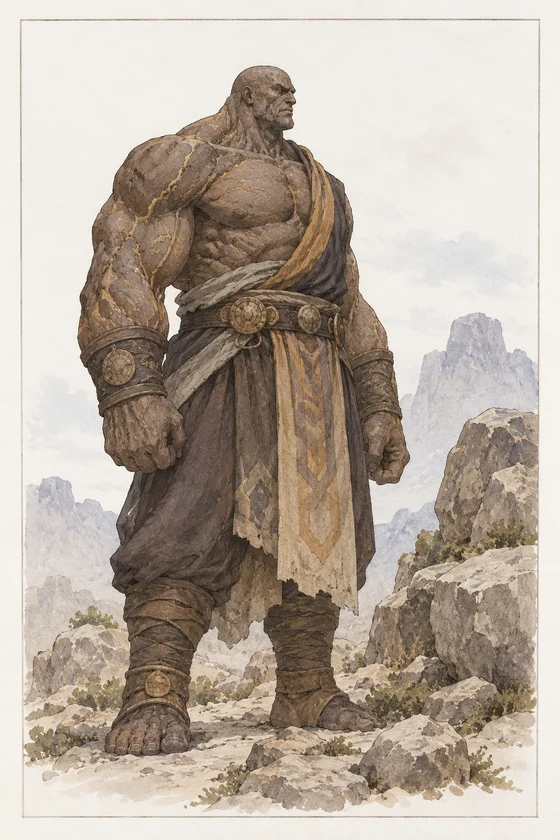
AI-generated interpretation of the Titans; undescribed details are imagined.
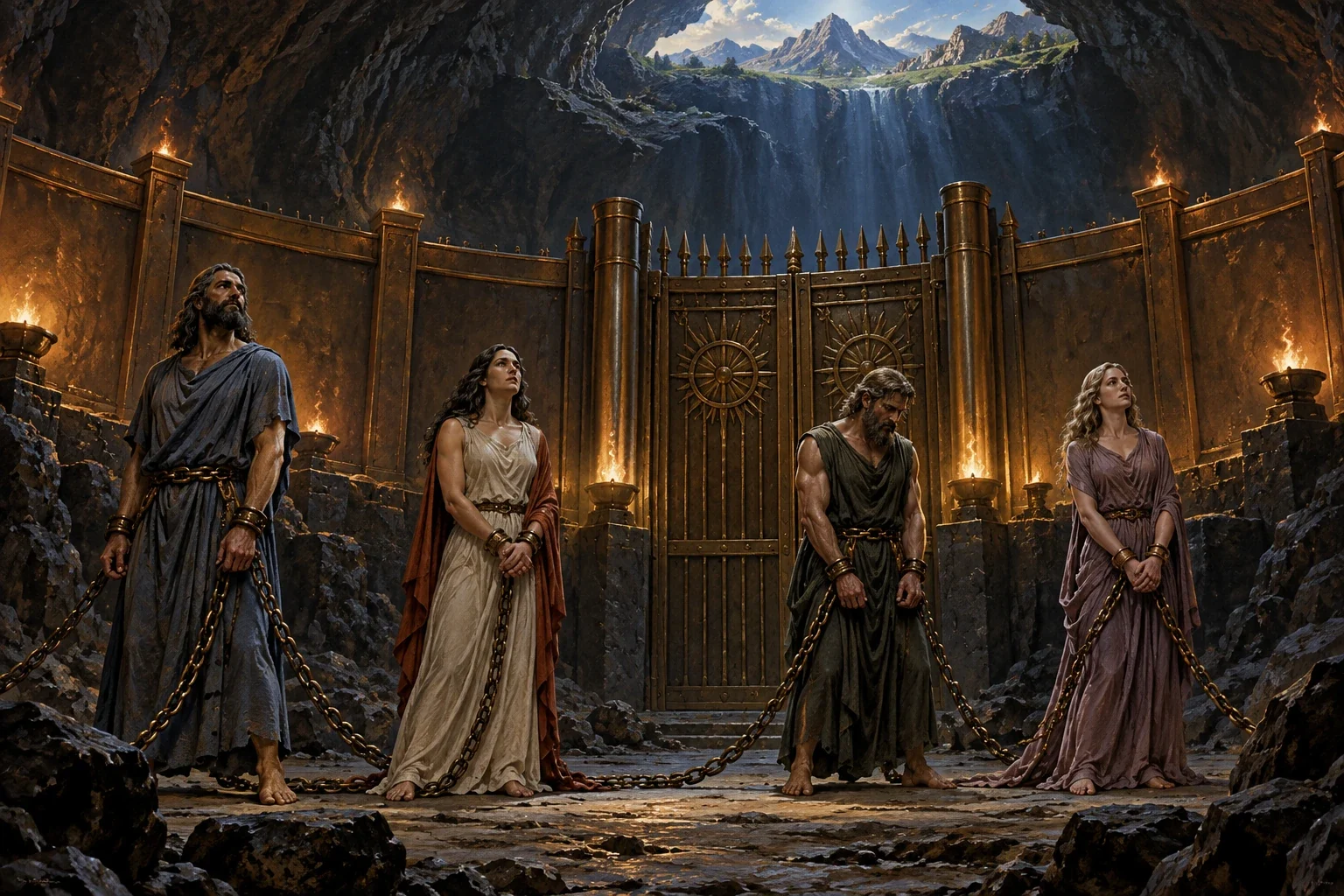
Original modern interpretation of Hesiod’s defeated Titan host. Faces, robes, number depicted, architecture and lighting are imagined; not ancient artwork or portraits of named ancestors. Full frame preserved; WebP compression only. The opening vista is also imagined.
Overview
Hesiod places the Titans within the genealogy and struggles of the gods. Earth and Heaven produce Oceanus, Coeus, Crius, Hyperion, Iapetus, Theia, Rhea, Themis, Mnemosyne, Phoebe, Tethys and finally Cronos. This is a named divine generation, not a single stone-bodied creature. Heaven later calls his sons Titans in reproach, interpreting their action as an overreaching deed for which punishment will follow. The poem’s explanation belongs to its narrative and does not establish a secure historical derivation of the word.
The extended war account opposes the Titan gods at Othrys to the children of Cronos at Olympus. Their struggle lasts ten years without either side winning. Earth advises the Olympians to release Cottus, Briareos and Gyes from their father’s underground imprisonment, because their strength can decide the conflict. Zeus restores them with nectar and ambrosia and asks them to remember the rescue. Cottus answers with a deliberate promise of military assistance. Their hundred arms and fifty heads describe these allies, not the Titans they fight.
Both armies renew the battle, shaking the sea, earth and heaven with their force. Zeus unleashes lightning and heat; the released allies launch three hundred rocks, overwhelm the Titans and bind them beneath the earth. The poem measures Tartarus through the imagined fall of a bronze anvil, placing it far below the inhabited world. Bronze gates fixed by Poseidon and a surrounding wall prevent escape, while the former prisoners become Zeus’s trusted warders. Liberation for one group therefore leads to imprisonment for the defeated host.
After the conflict over divine honours, the gods ask Zeus to rule, prompted by Earth, and he distributes their dignities. The result establishes an order of authority rather than merely ending a fight between large monsters. This profile follows the poem’s collective war narrative without claiming that every named child of Earth takes the same side or receives the same individual fate. It also keeps the Titans separate from the distinctive bodies of the hundred-handed allies and from later fictional beings that reuse the name.
Origins & earliest records
The selected written witness is Hesiod’s Theogony, presented through H. G. Evelyn-White’s 1914 English translation. The account locates the Titans in divine genealogy and narrates their conflict with Zeus’s allies; it does not establish a universal Greek canon or the first oral telling.
Records & interpretation
Complete selected passages inspected: Theogony 134–138, 207–210, 617–735 and 881–885. The hundred-handed allies’ anatomy is explicitly separated from that of their Titan opponents. The selected war narrative is not converted into an individual fate for every genealogically named Titan.
Selected bibliography
Documented works and useful reading. This is not a list of every appearance.
- 01
Theogony 134–138; 207–210; 617–735; 881–885
Hesiod, Homeric Hymns, Epic Cycle, Homerica, Loeb Classical Library 57, London: William Heinemann. Complete selected genealogy, naming notice, war and aftermath.
Family, evolution & connections
Titan (Final Fantasy)
Final Fantasy XVI uses Titan as the name of one Eikon; Hesiod’s Theogony uses the Titans for a divine generation and their conflict with Zeus. The resemblance lies in the name and immense supernatural power. The game figure is not a faithful account of Greek genealogy, and the sources do not identify the original naming process.
References
Sources supporting this profile. Linked pages have their own scope and editorial standards.
- Historical primary-text translationHesiod: Theogony, H. G. Evelyn-White translation 1914Research access: 2026-10-24
Image credits
AI-generated modern interpretationAI-generated interpretation of the Titans; undescribed details are imagined.
Original modern interpretation of Hesiod’s defeated Titan host. Faces, robes, number depicted, architecture and lighting are imagined; not ancient artwork or portraits of named ancestors. Full frame preserved; WebP compression only. The opening vista is also imagined.