
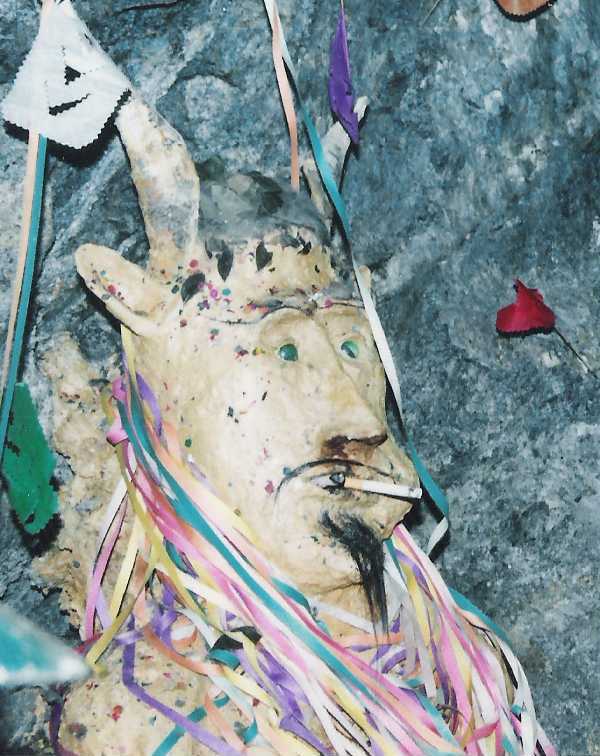
Tío
Image associated with the exact linked encyclopedia article; consult credited file description for its interpretation.
Overview
The Tío inhabits the religious world of Bolivian mines, where mineral discovery and survival require negotiation with an underground power. Michèle Cros and Daniel Dory describe statues receiving coca, alcohol and lit cigarettes, with offerings intended to obtain good veins and avert accidents. Horns and prominent sexual attributes connect danger with the ability to generate mineral abundance. These are situated ritual relationships, not simply a horror story about a hostile cave creature.
Pascale Absi's study of Potosí treats mining divinities and ritual as part of workers' social and productive lives. Colonial Christian demon imagery helped shape representations of the Tío, but an exclusively evil Lucifer does not adequately describe a being who can reward and protect as well as harm. Related Peruvian Muki traditions deserve their own treatment rather than being declared interchangeable names.
Enrique Orche García’s 2024 synthesis adds distinctions between individual mine images. They may be named after their maker or their location within the mine, and mineral-bearing clay can surround a piece of valuable ore. He also describes representations resembling foreign supervisors, with boots and a cowboy hat. These forms connect the deity with particular working relationships rather than requiring every image to share one horned appearance.
The same study records encounters in which a seemingly ordinary helmeted worker is recognised afterwards through goat-like or rooster-like tracks. Unexplained underground work sounds provide another sign. When output declines, accounts may describe the Tío as old, tired or absent. These are the author’s collected interpretations of mining experience, not verified causes of accidents or lost ore. His broad synthesis does not name a narrator for each encounter.
Origins & earliest records
Present-day Tío imagery emerged through Andean religious histories and colonial Christian demonisation of underground powers. Absi's 2003 study provides a modern ethnographic account of Potosí, not a creation date for the divinity. The precise development of names, statues and practices must be studied separately in particular mining communities.
Records & interpretation
Cros and Dory document offerings and explicitly describe the Tío as capable of beneficial and harmful action. Absi's publisher preview explains the negotiated roles of mine divinities and ritual in production. These studies support cultural practices and meanings; they neither establish supernatural causation for accidents nor represent every Bolivian miner's beliefs. Orche García (2024), section 8, adds image naming, supervisor forms and encounter traditions; its full section text inspected.
Selected bibliography
Documented works and useful reading. This is not a list of every appearance.
- 01
Les ministres du diable: le travail et ses représentations dans les mines de Potosí, Bolivie
Ethnographic monograph; publisher preview inspected, full IRD copy inaccessible locally.
- 02
Apprivoiser le marché: Éléments d'interprétation des alacitas en Bolivie
Journal des anthropologues 98–99, 171–201; discussion of underground powers and reciprocity.
- 03
El tío, Dios de los mineros Bolivianos
Revista de Medio Ambiente y Mineria 9(1), June; section 8. Article summarises the author’s 2023 book.
Family & connections
A source-supported family tree or inspiration record has not yet been compiled for this profile. Related reading below indicates a connection in subject matter, not a proven lineage or creative influence.
References
Sources supporting this profile. Linked pages have their own scope and editorial standards.
- ResearchAbsi: Les ministres du diable, publisher previewResearch access: 2026-10-05
- ResearchCros and Dory: Tío offerings and reciprocity, paragraph 36–37Research access: 2026-10-05
- ResearchOrche García 2024: mine-specific images and encountersResearch access: 2026-10-05
Image credits
Reference illustrationTío
Image associated with the exact linked encyclopedia article; consult credited file description for its interpretation.