
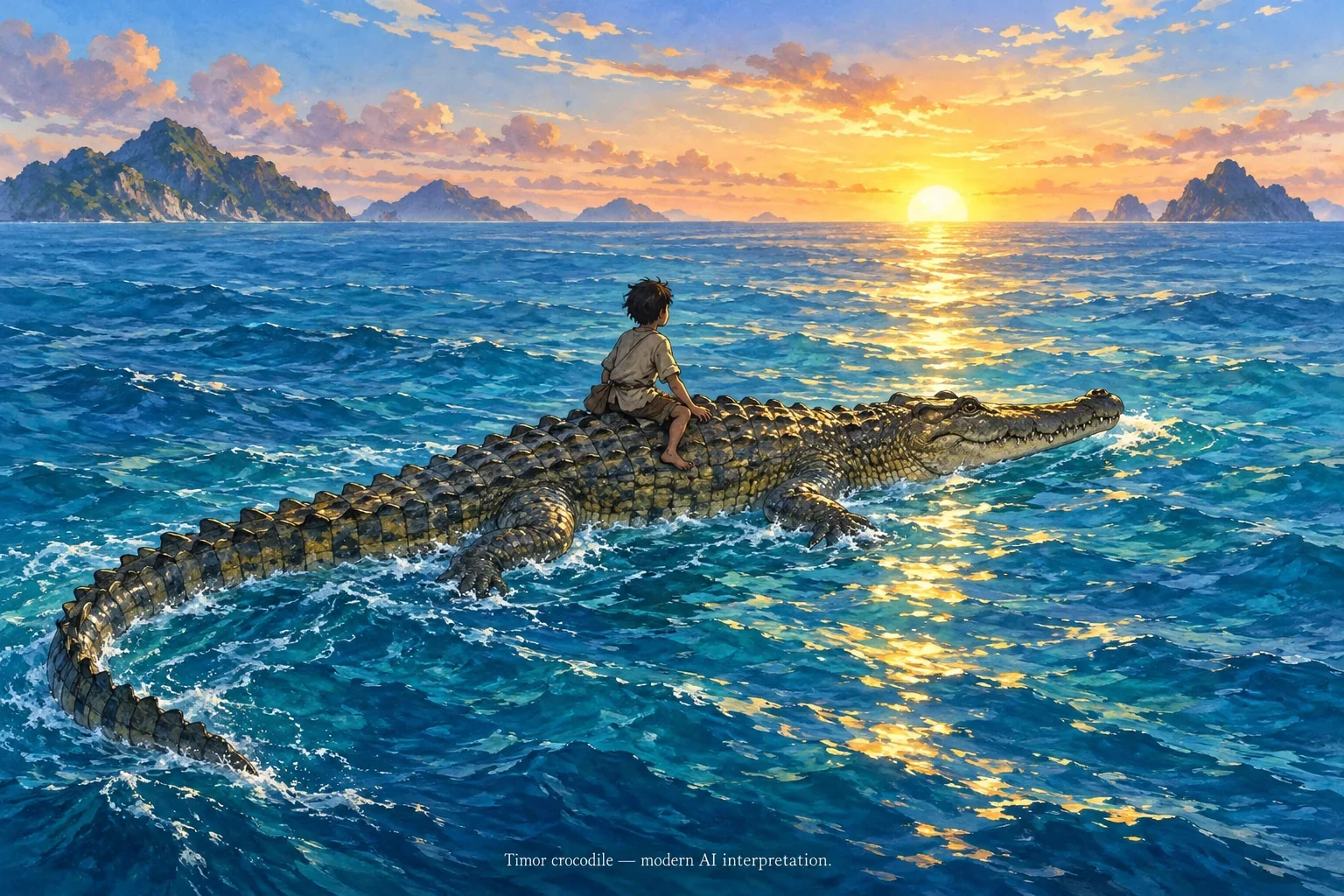
AI imagined boy riding a crocodile across the ocean.
Imagined rider, clothing and seascape; narrative travel phase, not ethnographic evidence.
Overview
The official Timor-Leste tourism account begins with a small crocodile too weak to reach the sea. A boy carries it to the water, earning rides across the ocean. When the animal grows old, it promises a home for the boy’s descendants. Its body becomes Timor: the ridged back corresponds to mountains, its legs to peninsulas and its tail to the eastern tip. These are narrative correspondences, not geological explanations.
ETAN publishes a version attributed to the East Timor Independence Day Committee. Scarce food and drying heat precede the rescue; years later the boy asks to see the world and directs their journey eastward after the sun. At death, the animal’s back becomes mountains and its scales hills. A closing appeal to kinship addresses crocodiles before entering the sea. The two witnesses share reciprocal kindness but differ in detail; neither represents every Timorese community.
Origins & earliest records
The witnesses do not date the tradition’s beginning. The story concerns Timor island, whose communities extend beyond the modern political border.
Records & interpretation
Complete public retellings inspected; no source illustration reused.
Selected bibliography
Documented works and useful reading. This is not a list of every appearance.
- 01
- 02
Family & connections
A source-supported family tree or inspiration record has not yet been compiled for this profile. Related reading below indicates a connection in subject matter, not a proven lineage or creative influence.
References
Sources supporting this profile. Linked pages have their own scope and editorial standards.
- Institutional public retellingOfficial tourism accountResearch access: 2026-10-11
- Public attributed retellingCommittee-attributed versionResearch access: 2026-10-11
Image credits
AI-generated interpretationAI imagined boy riding a crocodile across the ocean.
Imagined rider, clothing and seascape; narrative travel phase, not ethnographic evidence.