
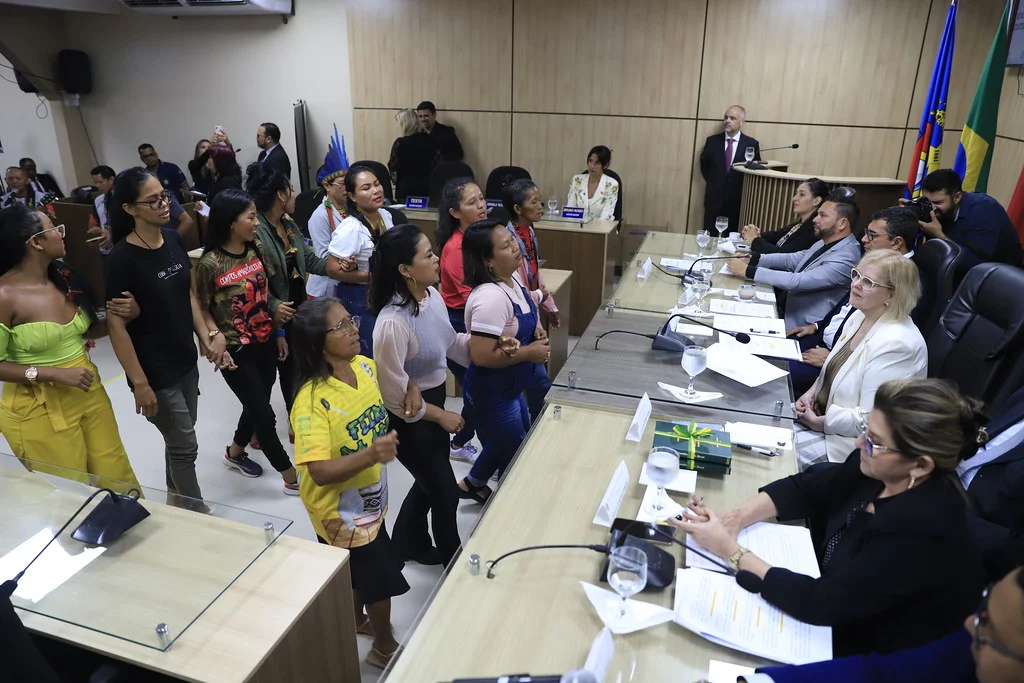
Participants and officials at a 2023 Tabatinga event introducing custody-hearing information in Tikuna, Marubo, Kanamari and Matis languages
This Tabatinga event introduced information about custody hearings and detainees’ rights in Tikuna, Marubo, Kanamari and Matis. It is a shared multilingual legal-access setting, rather than a portrait of all Tikuna people. The source does not identify the language or community affiliation of each participant.
Overview
Tikuna, also written Ticuna, communities live across Brazil, Colombia and Peru, with a major presence along the upper Solimões and neighbouring waterways. The Instituto Socioambiental account records Magüta as a self-designation associated with Yo’i’s fishing of people in oral tradition. This account of origins retains its cultural and narrative character; it is not a demographic date or an archaeological identification. The same regional source describes a tonal language, movement between villages and cities, and differing pressures on language use. Neither state citizenship nor residence in a city fully defines a person’s cultural identity. Its historical overview also records coercive rubber extraction and subsequent collective struggles for land recognition.
One particularly situated witness is the testimony of Orcinda Ïpüna, published with contextual commentary by anthropologist Patrícia C. Rosa. Collected in July 2016 in conversation with Ïpüna and her daughter Josiane Tutchiauna, the account was translated by Rosa together with Tutchiauna. Ïpüna argues that difficulty using Portuguese should never be confused with a lack of intelligence or knowledge. She emphasizes women teaching and encouraging each other and transmitting skills to younger generations. The accompanying account identifies weaving, women’s associations and participation in political debate as interconnected parts of these women’s lives in Bom Jardim. Their testimony documents both knowledge and struggles over authority; it is not presented as the unanimous voice of every Tikuna woman.
Community educational publishing provides another substantial witness. O livro das árvores was coordinated by the Organização Geral dos Professores Ticuna Bilíngües and organized by Jussara Gomes Gruber. The inspected copy is the 1998 second edition, while its copyright and catalogue information retain 1997. Gruber’s complete presentation explains that teachers researched regional plants and animals for a project begun in 1987. The book brings practical knowledge, symbolic meanings and artistic expression together in environmental education. It distinguishes predominantly individual drawings from collectively produced texts. This credit matters: neither the outside organizer nor an anonymous collective alone accounts for the whole work. The presentation addresses Tikuna pupils while also inviting other children to learn from its authors. The selected reading establishes the project’s method and authorship, rather than claiming to cover every tree account or story in the volume.
Museum work provides another setting for community interpretation. A 2021 Funai report describes Museu Magüta in Benjamin Constant as directed by leaders associated with the Conselho Geral da Tribo Ticuna. Its account emphasizes Indigenous exhibition planning as well as documentation of regional history and political organization. It reports municipal heritage protection and public-utility recognition in December 2018; those institutional measures do not define the whole people or replace community authority. A separate digital catalogue makes a named curator’s contribution visible: Salomão Inácio Clemente’s June 2025 commentary identifies a spindle and its fibre as tucum, whereas the accompanying collection metadata lists cotton. This difference is retained as a distinction between attributed commentary and catalogue fields, not silently resolved. The record concerns one object held in Paris, not every Tikuna textile practice. Its image and the underlying foreign collection have not been independently inspected here.
History & identity
Magüta origin tradition is attributed as oral history, distinct from external colonial documentation and modern national borders.
Sources & representation
ISA selected identity/geography/language/contact sections; complete Ïpüna testimony and contextual translation credits; actual1998 title, credits and complete presentation p7 of O livro das árvores. No whole-book claim. Complete Funai report and digital object record read; object image uninspected.
Selected bibliography
Documented works and useful reading. This is not a list of every appearance.
- 01
O livro das árvores
Inspected second edition, title1998; copyright/catalogue1997. Complete presentation p7 read; later contents not fully inspected.
Language & cultural connections
Source-supported language and cultural connections have not yet been compiled for this profile.
References
Sources supporting this profile. Linked pages have their own scope and editorial standards.
- Research organizationInstituto Socioambiental: TicunaResearch access: 2026-10-05
- Named community testimony and translationOrcinda Ïpüna testimony with Patrícia C. Rosa commentary, collected2016Research access: 2026-10-05
- Community educational publicationOGPTB: O livro das árvores, second editionResearch access: 2026-10-05
- Institutional report,2021; updated2022Funai: Museu MagütaResearch access: 2026-10-06
- Object record with named Indigenous curatorEtno Museu Digital: spindle71.1881.34.165Research access: 2026-10-06
Image credits
Contextual multilingual legal-access event photographParticipants and officials at a 2023 Tabatinga event introducing custody-hearing information in Tikuna, Marubo, Kanamari and Matis languages
This Tabatinga event introduced information about custody hearings and detainees’ rights in Tikuna, Marubo, Kanamari and Matis. It is a shared multilingual legal-access setting, rather than a portrait of all Tikuna people. The source does not identify the language or community affiliation of each participant.