
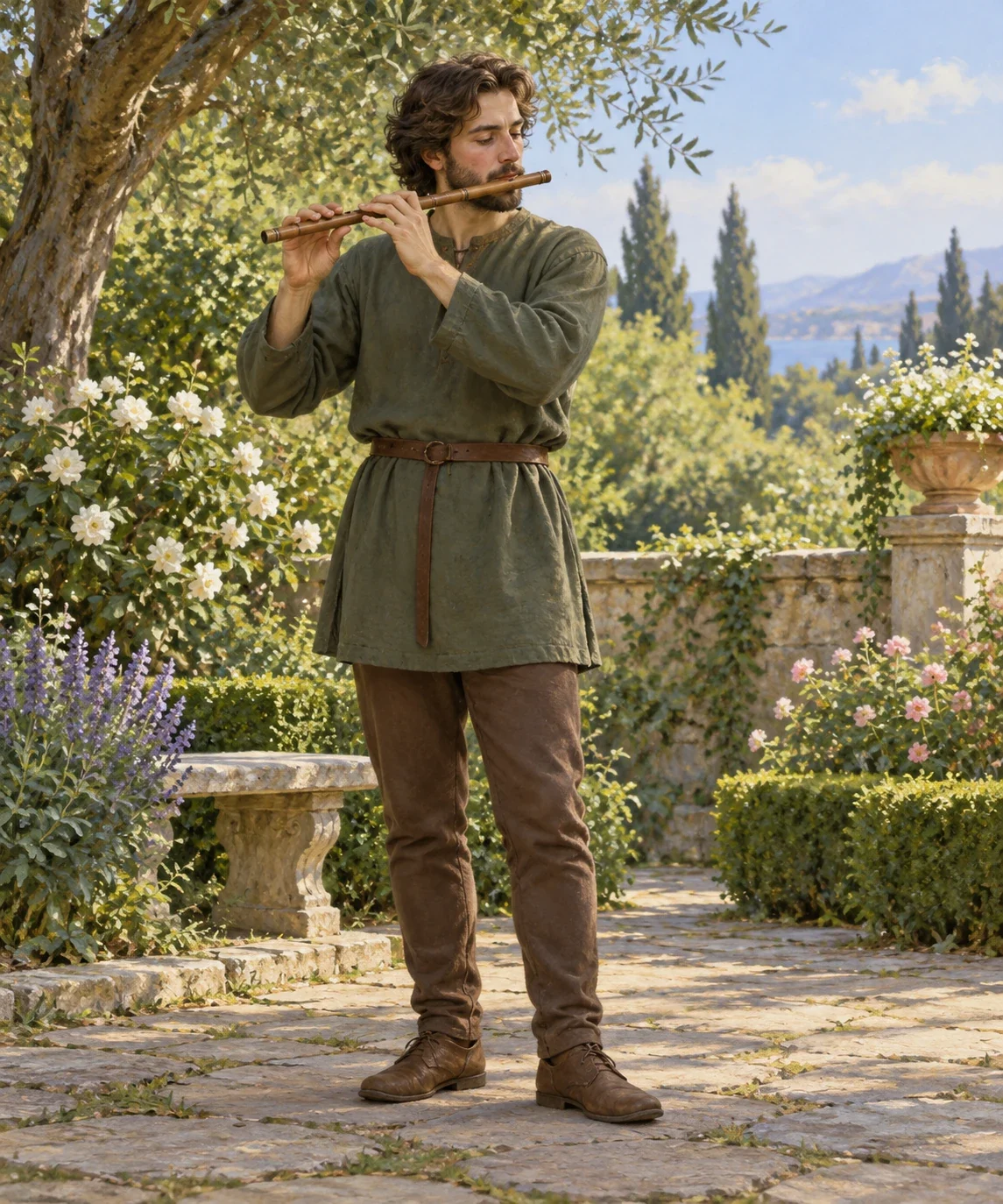
AI interpretation of adult Tiidu playing a flute in a garden.
Overview
Tiidu begins as a poor family’s idle son, playing a willow-pipe instead of working. A passing old man advises him to turn his musical gift into a livelihood and earn enough for a better instrument. He becomes a successful flute-player, but dissatisfaction and reports of Kungla’s riches draw him abroad. At Narva, a sailor helps him gain a free passage through a staged rescue at sea. In Kungla he becomes a kitchen-boy despite the prosperous musical career he has left behind. The same old adviser finds him there, makes him fetch his flute and teaches him how to earn by playing; Tiidu grows wealthy.
His homeward ship is wrecked, and he reaches an uninhabited island without his treasures. He regrets abandoning his parents. Red apples make his nose grow enormously; nuts restore it. He gathers both, and after the old man appears in a dream and gives him another flute, a passing ship rescues him. Returning to Kungla, he sells the apples at the palace in one disguise and appears in another as a foreign physician to cure the royal family’s resulting affliction. The king rewards him beyond his request. Tiidu pays the rescuing captain, returns home and purchases an estate where his surviving relatives can live, keeping his father in his own house. After he marries a dowerless woman, the lost treasures reappear with a message connecting their restoration to care for parents and relatives. The narrative leaves his aged protector unexplained.
Origins & earliest records
Tiidu the Flute-Player, volume I, pp.303–308 of The Hero of Esthonia (1895). Kirby explicitly supplies an abstract of a longer narrative.
Records & interpretation
W. F. Kirby’s 1895 English compilation draws on Esthonian and German publications. Its prose-source introduction identifies Kreutzwald’s 1866 collection and F. Löwe’s 1869 German translation; neither underlying edition was independently consulted here. The selected literary witness is not a verbatim oral performance or a modern community survey.
Selected bibliography
Documented works and useful reading. This is not a list of every appearance.
- 01
The Hero of Esthonia and Other Studies in the Romantic Literature of That Country
Volume I, pp.303–308: complete Tiidu abstract and framing; notes154–155. Longer original not independently consulted.
Family & connections
A source-supported family tree or inspiration record has not yet been compiled for this profile. Related reading below indicates a connection in subject matter, not a proven lineage or creative influence.
References
Sources supporting this profile. Linked pages have their own scope and editorial standards.
- Historical authored English abstract of a folk narrativeKirby1895 — Tiidu: complete published abstract, framing and notes154–155Research access: 2026-10-23
Image credits
AI-generated literary folklore interpretationAI interpretation of adult Tiidu playing a flute in a garden.