
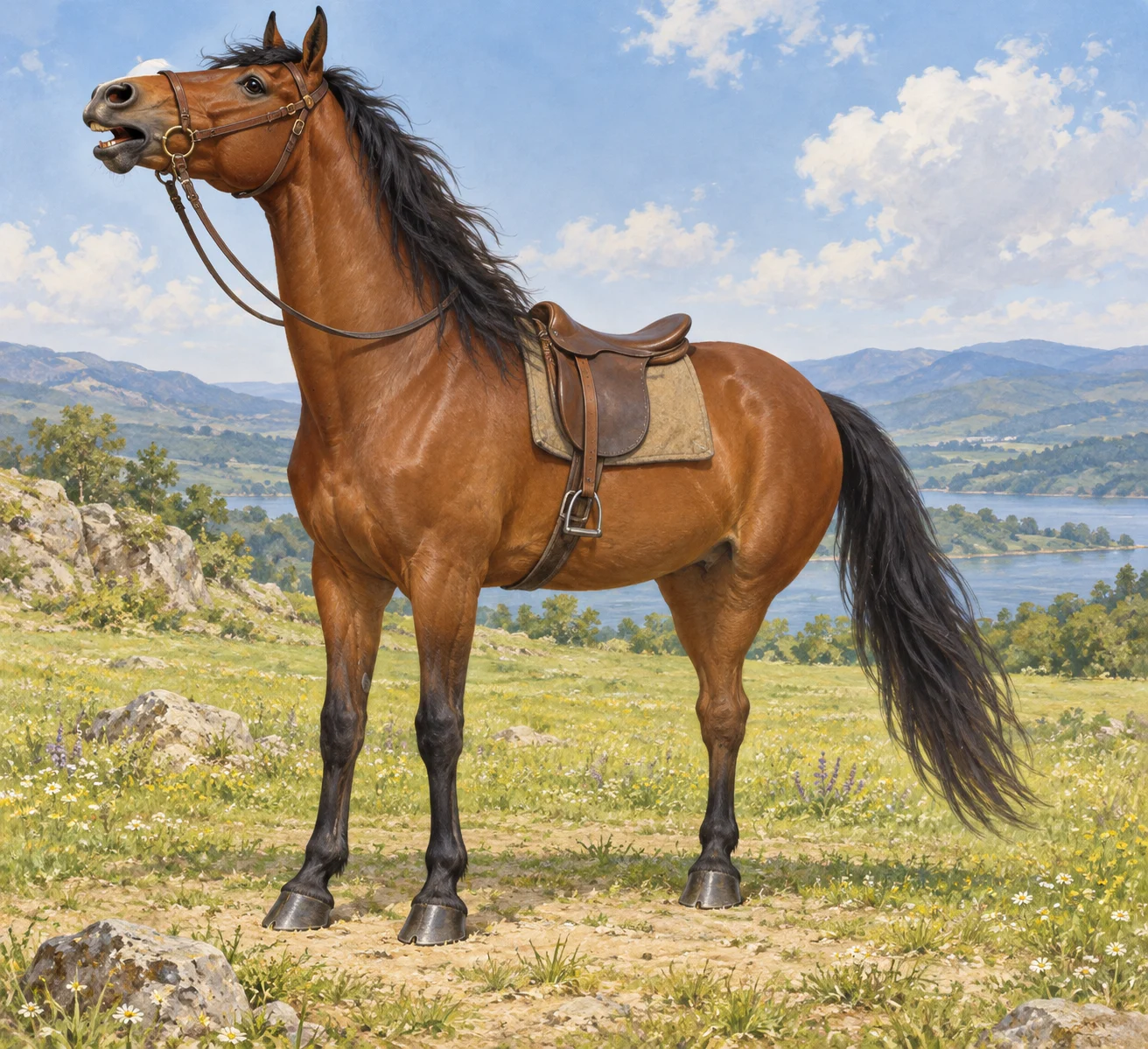
AI-generated reconstruction of the three-legged helper horse in Kazha-ndii.
Original text-led interpretation. Three legs, speech and an answering neigh come from the tale; exact limb arrangement, bay coat, anatomy, tack, pose and meadow are imagined. No injury is implied.
Overview
This horse enters near the end of Kazha-ndii, after the prince’s first rescue attempt has failed. The prince has found his sisters living with three demi brothers, who receive him kindly. They tell him that Kazha-Ndii-Kerkun carried a golden-haired woman through the air, and the prince recognises a lock of her hair as his wife’s. The brothers first provide a horse whose leg count is unspecified, together with a little dog. Those helpers must be distinguished from the explicitly three-legged horse lent later; the text does not say that the first mount secretly had the same form.
On the first attempt, the prince reaches the captive princess while Kazha-Ndii is away and puts her on his horse. The gate cries out, the abductor follows, and his mount’s neigh halts the escaping horse. Kazha-Ndii kills the prince and takes the princess back. The little dog gathers the prince’s remains into a bag, secures it to the saddle and brings the body to the demi brothers. Their youngest brother restores the prince to life by blowing his soul back into the pieces. This revival is the demi’s act; the later horse is not credited with resurrecting its rider.
When the revived prince prepares to try again, the youngest demi gives him his three-legged horse and says that, if this mount cannot help him, there is no further help to hope for. The prince rides back, recovers the princess and is again pursued after the gate sounds an alarm. Kazha-Ndii’s horse neighs, and the three-legged horse begins to slacken. Asked why, it replies that a fourth leg might make it victorious. Yet the three-legged mount then gives such a powerful neigh of its own that it stops the pursuer’s horse. The prince can approach and kill Kazha-Ndii with his sword. The couple visit the friendly demis before returning home.
The tale gives the helper speech, three legs and an effective answering cry. It does not identify which limb is absent, describe a wound, supply a coat colour or equip this horse with wings. The abductor carries the princess through the air, but that earlier action is not evidence that the helper horse flies. A note compares the three-legged horse and faithful dog in the following Geria story. That parallel has been read in full: Geria’s horse comes from a Rokapi and gives different advice, so its history and actions are not silently transferred to this individual.
Origins & earliest records
Wardrop includes Kazha-ndii in PartII, the Mingrelian tales she attributes to Tsagareli’s Mingrelskie Etyudy1880. Her preface says the stories were collected in1876–79, chiefly in Sachichuo and Salipartiano. The English translation is the consulted witness; no individual teller or precise collection site is assigned to this tale.
Records & interpretation
Complete selected tale, its ending and notes, and the translator’s complete preface are preserved. This is evidence for a printed narrative version, not a biological or universal community claim.
Selected bibliography
Documented works and useful reading. This is not a list of every appearance.
- 01
Georgian Folk Tales
Selected historical English translation; prior Georgian, Mingrelian and Russian source editions are reported by its preface, not directly consulted here.
Family & connections
A source-supported family tree or inspiration record has not yet been compiled for this profile. Related reading below indicates a connection in subject matter, not a proven lineage or creative influence.
References
Sources supporting this profile. Linked pages have their own scope and editorial standards.
- Primary historical folklore translationGeorgian Folk Tales — original1894 English translationResearch access: 2026-10-18
Image credits
AI-generatedAI-generated reconstruction of the three-legged helper horse in Kazha-ndii.
Original text-led interpretation. Three legs, speech and an answering neigh come from the tale; exact limb arrangement, bay coat, anatomy, tack, pose and meadow are imagined. No injury is implied.