
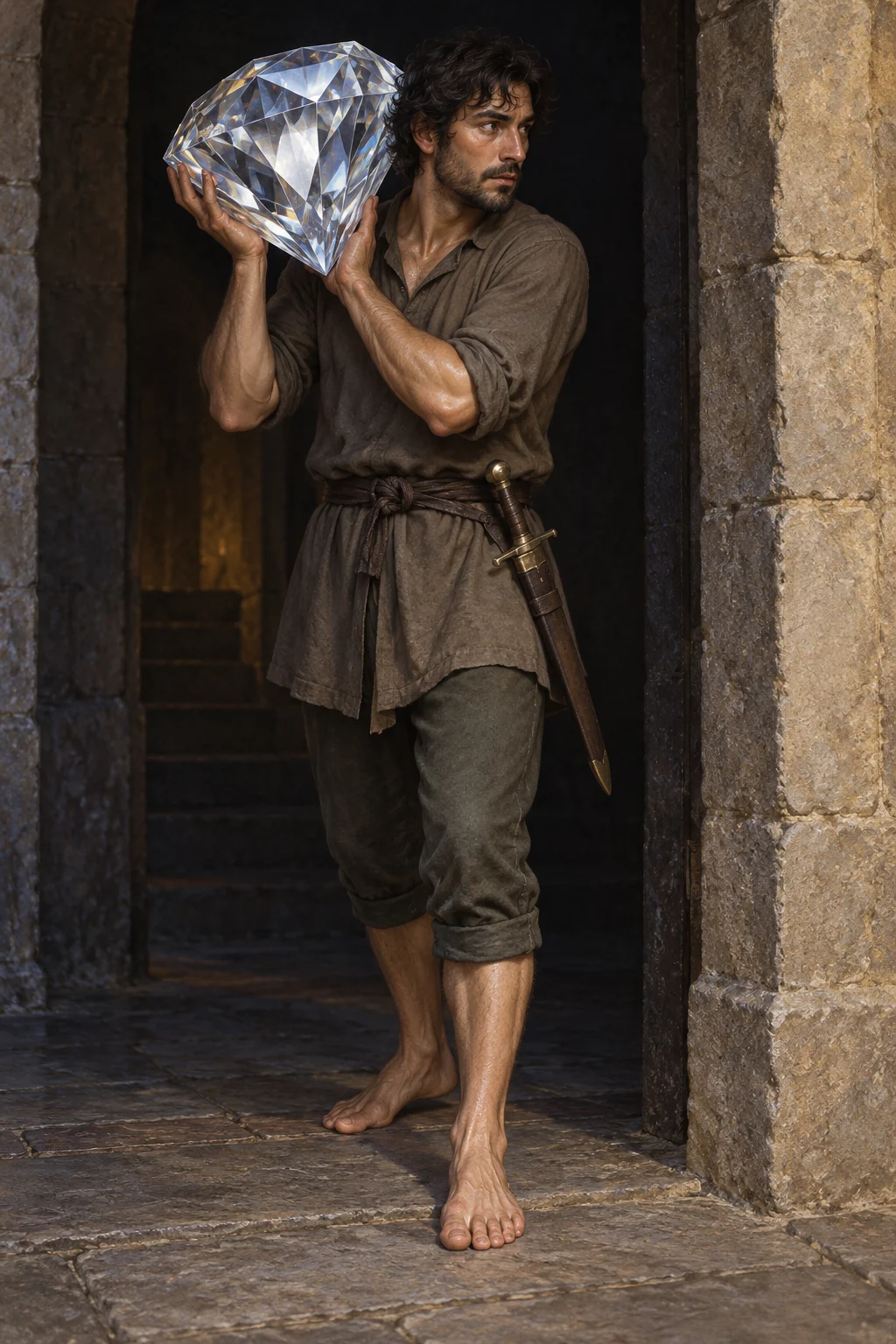
An imagined barefoot human thief supporting a huge diamond at his shoulder, with a sheathed sword.
Overview
Thangobrind combines the trades of jeweller and thief, serving wealthy patrons while limiting his thefts to rubies, diamonds, emeralds and sapphires. A Merchant Prince commissions him to steal Dead Man’s Diamond, a stone larger than a human head, from the lap of the spider-idol Hlo-hlo. The proposed price is the merchant’s daughter’s soul. Thangobrind knows of her confinement and suffering, but the narrator’s repeated language of business exposes his indifference. He oils his body, travels by night and carries his swift sword, Mouse. Bare feet and an ability to exploit shadows help him escape watchers. On his journey he deceives archers by dragging stones behind him and recognizes trapped emeralds that would bring weights down upon a thief.
Inside the temple at Moung-ga-ling, Thangobrind offers drugged honey. When the priests consume it and collapse, he shoulders the enormous diamond and leaves, while Hlo-hlo quietly laughs. Taking a different return route does not free him from pursuit: soft footsteps follow him toward the narrow way beside the house called Night. An ominous cough from its grim woman makes him turn and confront the spider-idol. He puts down the diamond and fights with Mouse, repeatedly wounding Hlo-hlo, yet the pursuer’s persistent laughter breaks his nerve. Exhausted, he falls at Night’s door and is carried away to replace one of the two men hanging in another house. The final paragraph turns satirically to the merchant’s daughter, who escapes the bargain and becomes militantly respectable. The tale’s supernatural geography and grotesque punishment belong to authored fantasy, not to documented local religion or an account of real criminal practice.
First appearances & development
Lord Dunsany’s authored English fantasy in The Book of Wonder. The retained title and complete selected tale establish authorship and narrative scope; the consulted electronic body does not identify its exact historical print edition.
Canon & continuity
The complete eight-paragraph tale establishes the commission, theft, pursuit, combat, punishment and final satirical account of the merchant’s daughter. The opening cough is explained by the return to the narrow way near the ending.
Selected bibliography
Documented works and useful reading. This is not a list of every appearance.
- 01
Family & connections
A source-supported family tree or inspiration record has not yet been compiled for this profile. Related reading below indicates a connection in subject matter, not a proven lineage or creative influence.
References
Sources supporting this profile. Linked pages have their own scope and editorial standards.
- Primary historical authored fictionThe Book of Wonder — complete selected tale and framingResearch access: 2026-10-18
- Bibliographic search evidence onlyNational Library of Ireland catalogue search witness; direct record access heldResearch access: 2026-10-18
Image credits
AI-generatedAn imagined barefoot human thief supporting a huge diamond at his shoulder, with a sheathed sword.