
Generated contextual interpretation of a historical published tool, not an authenticated specimen or exact replica. Colour and surface appearance are interpretive.
Overview
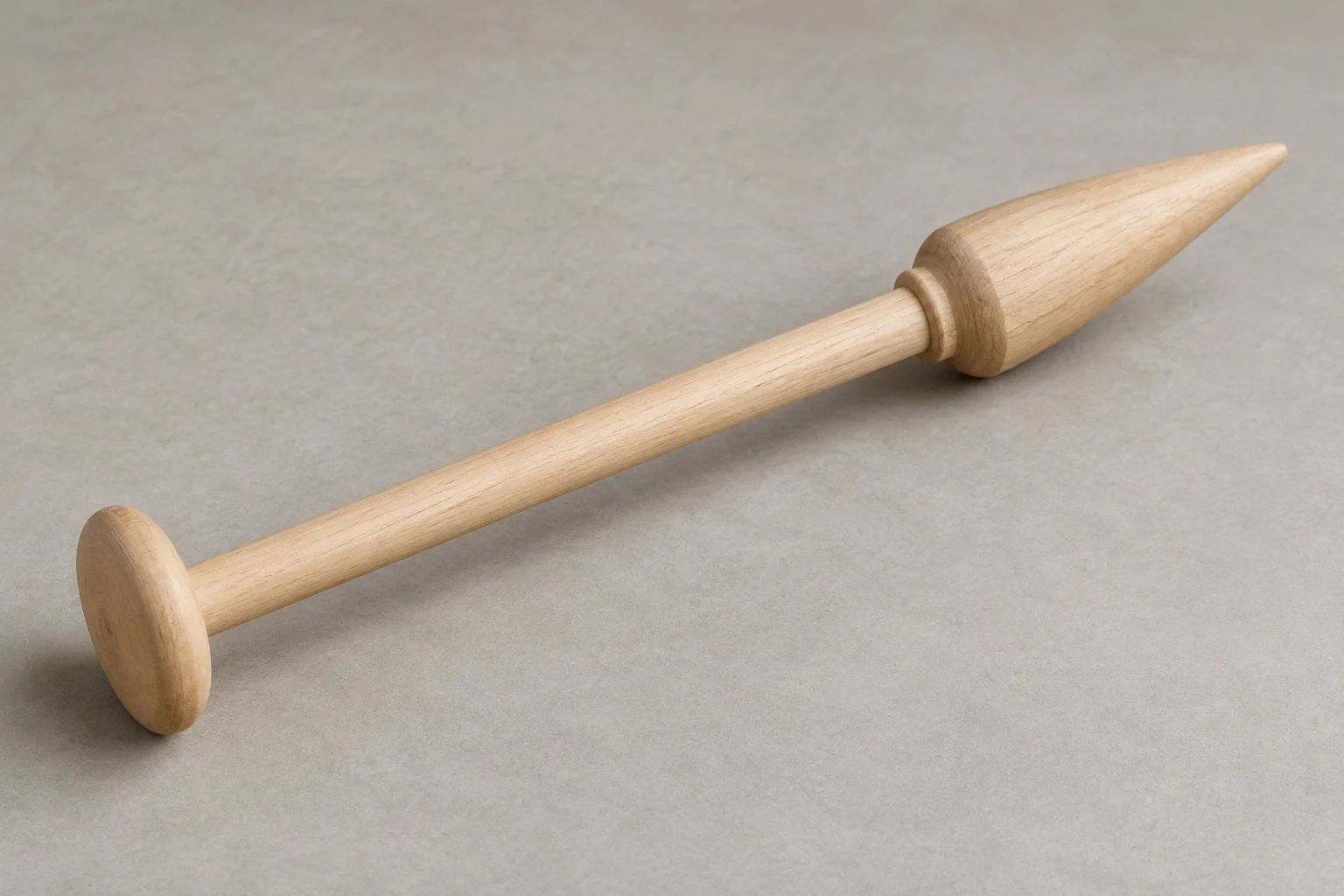
In the tapestry-equipment chapter, Christie describes a wooden bobbin or shuttle for carrying the thread that forms the weft. Figure 174 shows a long narrow shaft between a short rounded terminal flange and a longer conical pointed head. The transitions are simple, without hooks, a fork or projecting fittings. The author stresses that sharp angles could catch in the warp as the bobbin passes through it, and notes that the pointed end may also help to place and press down the weft. The drawing presents the tool without a wound supply of thread, establishing its outline rather than a specific loading arrangement or decorative finish.
The account links the bobbin with choices made while weaving a pattern. A fresh bobbin is used for each colour, and several fine strands may be wound together to obtain the required colour and texture. Christie also describes combining different shades, or silk and wool, rather than treating every bobbin as the carrier of a single uniform thread. For a small quantity of one colour, she says that a large blunt needle may take its place. These alternatives explain the bobbin’s role within the working system. They do not establish a particular wood species, workshop origin or surviving object corresponding to the published illustration.
History & identity
The title presents Mrs. Archibald H. Christie as author, while the author’s preface is signed Grace Christie. Embroidery and Tapestry Weaving was issued in the Artistic Crafts Series edited by W. R. Lethaby. The retained imprint names John Hogg, London, 1912; both prefaces are dated September 1906. The preliminary notices describe revised second and third editions as reprints. These publication details do not establish where an illustrated tool was made.
Sources & representation
The numbered drawing is explicitly bound to the tool in the accompanying equipment account. The image supports the visible form; hidden fittings and precise manufacturing details are not reconstructed.
Selected bibliography
Documented works and useful reading. This is not a list of every appearance.
- 01
Embroidery and Tapestry Weaving: A Practical Text-Book of Design and Workmanship
Retained London imprint 1912, with prefaces dated September 1906 and revised-edition reprint notices. Complete selected equipment chapters retained.
Language & cultural connections
Source-supported language and cultural connections have not yet been compiled for this profile.
References
Sources supporting this profile. Linked pages have their own scope and editorial standards.
- Period practical textile-craft manual with tool drawingsEmbroidery and Tapestry Weaving, retained 1912 printingResearch access: 2026-10-18
Image credits
AI-generatedGenerated contextual interpretation of a historical published tool, not an authenticated specimen or exact replica. Colour and surface appearance are interpretive.