
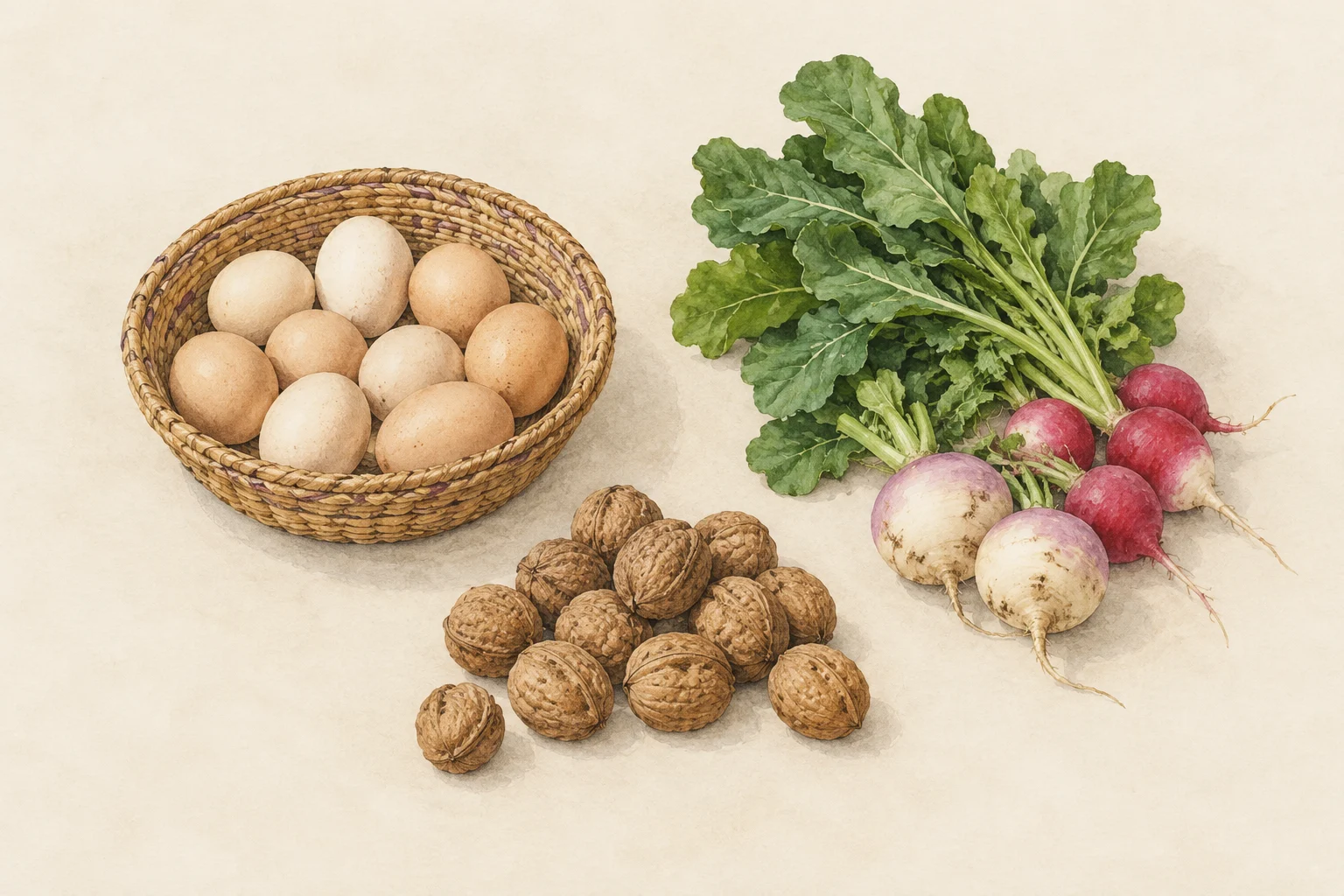
Generated explanatory study of goods mentioned in Meakin’s dated Tangier market sketch. Basket shape, vegetable forms and arrangement are interpretive; this is not a historical photograph or a precise market plan.
Generated explanatory study of goods mentioned in Meakin’s dated Tangier market sketch. Basket shape, vegetable forms and arrangement are interpretive; this is not a historical photograph or a precise market plan.
Overview
Meakin’s market sketch begins outside Báb el Fahs in Tangier, where he says buyers and sellers gathered on Sundays and Thursdays when the weather was fine. Country sellers arrive with goods and animals, while townspeople come to purchase. His route crosses several connected spaces rather than one uniform enclosure: the press through the gate gives way to a vegetable market and then a broad outer trading area. Women selling eggs, milk, walnuts, vegetables and fruit appear alongside repairers, pottery sellers and other traders. This variety links produce from outside the town with services and imported goods within it. The narrative is a selective visitor’s walk, not a count of traders or proof that every transaction followed a common pattern.
The account gives trading a material setting. Eggs lie in baskets or in heaps, milk is kept in red jars, and fruit and vegetables are sold beneath low booths of branches and canes. Pack animals move goods through the crowded approaches, while small shops offer both local products and imported articles. Meakin repeatedly frames these activities through disgust, exoticism and class judgments; those assessments are his, not descriptions adopted here. The accompanying photograph, credited to Cavilla in Tangier, shows a densely occupied open market but cannot verify each narrated sale. The contextual illustration therefore isolates a few text-supported goods in an invented arrangement. Its basket shapes and placement are illustrative, without presenting a staged scene as a historical photograph or a precise market plan.
History & identity
Life in Morocco and Glimpses Beyond names Budgett Meakin as author and Chatto & Windus, London, as publisher, dated 1905. Its foreword presents collected sketches and acknowledges earlier periodical publication, unnamed correspondents and photographic contributors. The selected Chapter XV is a narrated market walk, rather than an individually documented transaction or a community-authored account.
Sources & representation
A complete captioned photographic print corroborates a crowded market setting, not every narrated episode or individual commodity. Its foreground figures and animals are partly cut by the original frame. The proposed goods-only illustration is expressly interpretive and does not reconstruct the photograph.
Selected bibliography
Documented works and useful reading. This is not a list of every appearance.
- 01
Life in Morocco and Glimpses Beyond
Complete foreword and Chapter XV, A Sunday Market; photograph captioned The Sunday Market, Tangier, credited to Cavilla, Photo., Tangier.
Language & cultural connections
Source-supported language and cultural connections have not yet been compiled for this profile.
References
Sources supporting this profile. Linked pages have their own scope and editorial standards.
- Historical travel sketch with credited photograph; outsider mediationMeakin 1905, Chapter XV and forewordResearch access: 2026-10-18
Image credits
AI-generatedGenerated explanatory study of goods mentioned in Meakin’s dated Tangier market sketch. Basket shape, vegetable forms and arrangement are interpretive; this is not a historical photograph or a precise market plan.
Generated explanatory study of goods mentioned in Meakin’s dated Tangier market sketch. Basket shape, vegetable forms and arrangement are interpretive; this is not a historical photograph or a precise market plan.