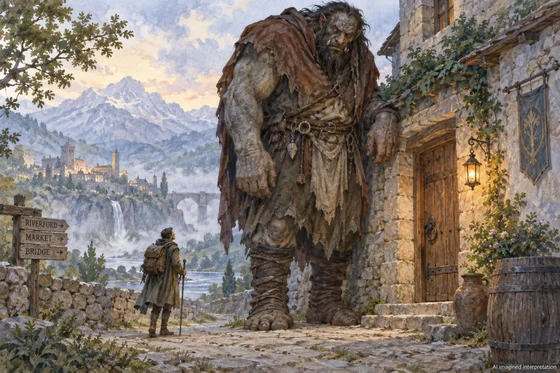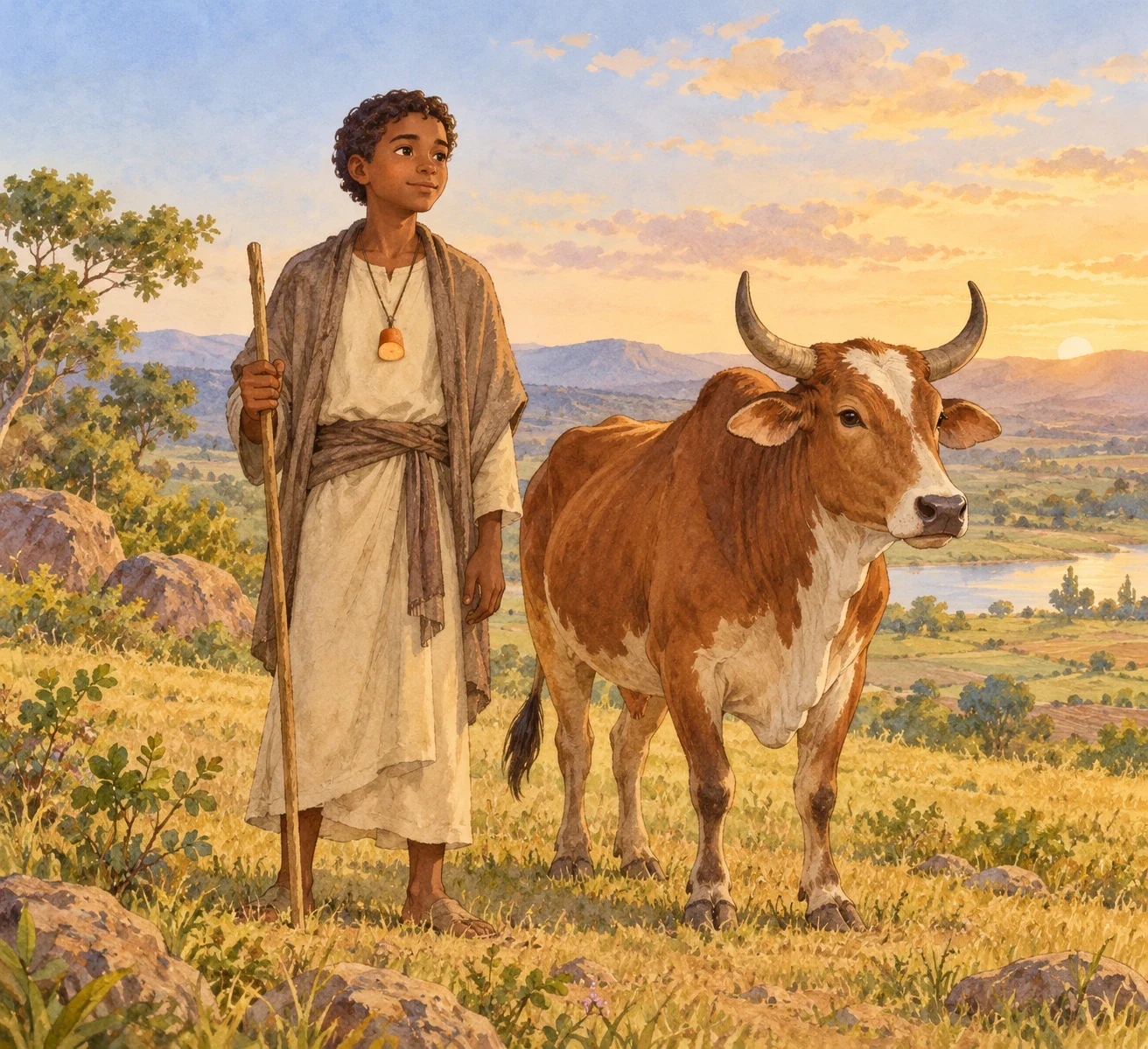
AI-generated literary interpretation of Takinga in the early cattle-herding episode recorded by Ferrand.
The neck token interprets the tale’s cassava identification device. Age, face, clothing, colouring, staff, ox and setting are imagined.
Overview
Takinga is the eldest of seven cattle-herding sons in Ferrand’s tale XXIII. He initially harms his younger brothers rather than rescuing them. Allowed to return home first for food, he repeatedly reappears before their mother and eats several portions, leaving the youngest two hungry. He also takes their meat by cooking his chosen piece of hide on top of it, then claiming that the missing food has burned away. His parents eventually decide to sell him to a stranger for forty piastres. Takinga overhears the transaction and defeats attempts to identify him: he tells every brother to answer to his name and later gives them all pieces of cassava like the identifying piece tied around his own neck.
After a further mark finally distinguishes him, Takinga leaves with the buyer. Obtaining permission to return briefly to his parents, he steals the purchase money from its hiding place and uses it to buy his freedom with the buyer’s consent. This episode belongs to the tale’s account of sale and captivity; the narration does not make the original transaction a harmless adoption or imply that every captive could simply choose release. Ferrand’s footnote expressly makes the buyer’s agreement necessary.
Takinga then encounters Trimobe while stealing food from the monster’s gardens. He repeatedly escapes onto a smooth, slippery rock that Trimobe cannot climb. When captured, he persuades the ogre to delay eating him and place him in a basket, which he tears open. Later, carried in a basket full of stones, he drops stones as signs that he is still inside and then jumps free without alerting his carrier. A final capture produces his false claim that cooking will turn him into two people. The tale gives him no actual power of duplication. Instead, he kills the ogre’s two children, and the deceived father eats them believing that the promised multiplication has occurred.
While bathing, Takinga reveals the deception, then flees to the smooth rock when Trimobe pursues him. He then offers to haul Trimobe upward, but lets him fall after a renewed threat. A second ascent ends with the ogre’s death on pointed stakes below the rock. Takinga acquires his possessions and becomes rich. This ending records success through deception and violence, without turning Takinga into an uncomplicated moral exemplar. The protagonist remains human; the animal body and human face described in Ferrand’s footnote belong to Trimobe, not to him.
Ferrand identifies the dictated witness as Antambahoaka and locates its unnamed contributor at Mananjary. The printed version is French, not a published Malagasy transcript. His preface distinguishes his collected texts from tales translated through earlier books and includes XXIII among the Antambahoaka material. The same preface contains sweeping colonial claims about Malagasy character and belief that this profile does not adopt. Takinga is the subject here; the already represented Itrimobe is acknowledged as his distinct opponent. No face, precise age, traditional clothing or ancestral identity for Takinga is documented by the narrative.
Origins & earliest records
Ferrand’s Contes populaires malgaches (1893), XXIII Takinga, pp.69–76; attributed to dictation by an unnamed Antambahoaka contributor from Mananjary.
Records & interpretation
Complete French tale pp.69–76, including identification, sale, escape, ogre episodes, fatal ending and footnotes; Mananjary/Antambahoaka contributor attribution at 69.
Selected bibliography
Documented works and useful reading. This is not a list of every appearance.
- 01
Contes populaires malgaches: recueillis, traduits et annotés — XXIII Takinga
Complete French tale pp.69–76, all footnotes, complete preface i–xii and title/imprint read; native printed tale pages inspected.
Family & connections
A source-supported family tree or inspiration record has not yet been compiled for this profile. Related reading below indicates a connection in subject matter, not a proven lineage or creative influence.
References
Sources supporting this profile. Linked pages have their own scope and editorial standards.
- Primary translated narrativeFerrand 1893, XXIII Takinga, complete original French publicationResearch access: 2026-10-21
Image credits
AI-generatedAI-generated literary interpretation of Takinga in the early cattle-herding episode recorded by Ferrand.
The neck token interprets the tale’s cassava identification device. Age, face, clothing, colouring, staff, ox and setting are imagined.