
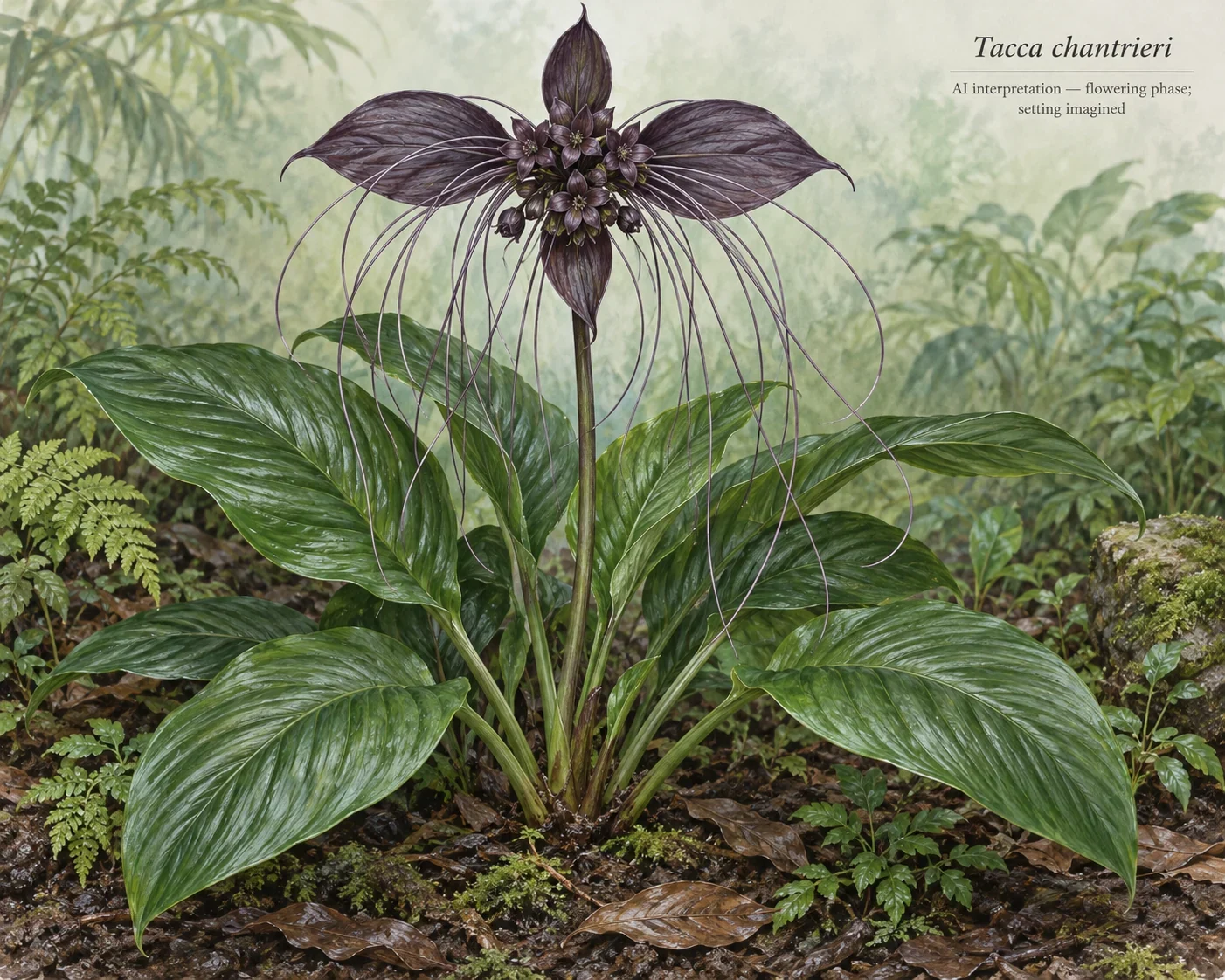
AI dark bracted bat flower with threadlike bracteoles.
AI interpretation of a flowering black bat flower; setting imagined.
Overview
NParks describes a rosette of broad green leaves beneath an elevated flower cluster. Two pairs of bracts surround it: the larger inner pair spreads sideways, while the outer pair points vertically. Long threadlike bracteoles produce the whiskered appearance; these structures are not animal wings or antennae.
Zhang and colleagues tested the presumed fly-pollination syndrome in southwestern Chinese populations. Visits were infrequent, and bagged flowers produced abundant seeds. Removing bracts and bracteoles did not significantly reduce seed set at the tested sites.
Allozyme estimates in four populations indicated high selfing, averaging 0.86. The study demonstrates why showy appearance alone cannot establish a mating system. Its population results complement the institutional placement in Dioscoreaceae, without supplying a complete species phylogeny.
Origins & earliest records
A botanical diagnosis is paired with a 2005 mating-system experiment.
Evidence & interpretation
Primary field manipulations and genetic estimates distinguish visual pollination assumptions from measured reproduction.
Selected bibliography
Documented works and useful reading. This is not a list of every appearance.
- 01
- 02
Family, evolution & connections
Taxonomic classification
A hierarchy of classified groups, not a chain of direct ancestors.
Source note: Current institutional family placement differs from the study title’s older Taccaceae usage.
- FamilyDioscoreaceae
- GenusTacca
References
Sources supporting this profile. Linked pages have their own scope and editorial standards.
- Government botanical accountFlora and Fauna WebResearch access: 2026-10-11
- Retained primary abstractPollination and mating studyResearch access: 2026-10-11
Image credits
AI-generated interpretationAI dark bracted bat flower with threadlike bracteoles.
AI interpretation of a flowering black bat flower; setting imagined.