
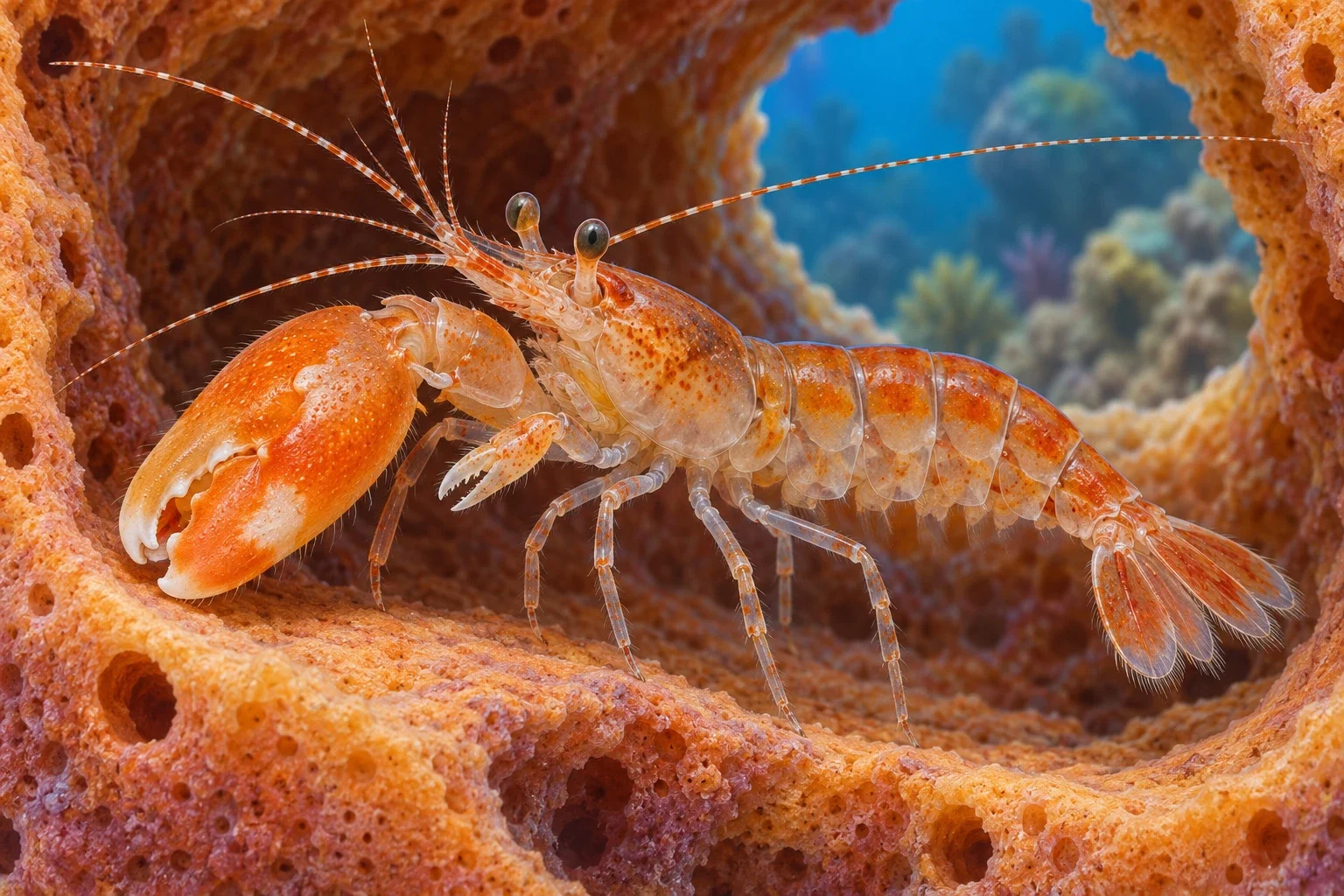
Synalpheus regalis - AI-generated scientific interpretation.
Modern AI-generated scientific illustration. Diagnostic anatomy follows selected research; colour, pose and unpreserved external detail are interpretive. Not fossil or photographic evidence.
Overview
Synalpheus regalis lives in colonies within coral-reef sponges. Duffy reported colonies of more than three hundred individuals with a single reproductive female. Young developed directly and remained in the natal sponge, so generations overlapped in a protected shared habitat.
The 1996 study combined observations, genetic markers and laboratory intrusion experiments. Allozyme comparisons suggested that many members were close relatives; larger colony members defended their sponge against shrimp of other species. These observations supported eusociality through reproductive division of labour, overlapping generations and cooperation.
A later investigation of other Synalpheus species showed why this finding should not be treated as an isolated social miracle or generalized to every snapping shrimp. Similar colony structures motivated comparative work, while some species had different reproductive arrangements. Calling a female a queen describes reproductive skew; it does not imply a humanlike monarchy or permanent destiny established for every juvenile.
Origins & earliest records
The marine eusociality account was published in 1996. This date identifies a scientific report, rather than when cooperation or sponge association first evolved.
Evidence & interpretation
Colony censuses, allozyme data and controlled intruder tests support the selected account. Genetic relatedness was inferred with the available markers; observations of large colonies do not mean every colony contains the same number of animals.
Selected bibliography
Documented works and useful reading. This is not a list of every appearance.
- 01
Eusociality in a coral-reef shrimp
Selected bibliography; bounded source account, not exhaustive coverage.
- 02
On the frequency of eusociality in snapping shrimps, with description of a second eusocial species
Selected bibliography; bounded source account, not exhaustive coverage.
Family, evolution & connections
Taxonomic classification
A hierarchy of classified groups, not a chain of direct ancestors.
Source note: Selected shrimp ranks follow the cited taxonomic and social-biology work. Eusociality describes colony organization, not a taxonomic rank.
- kingdomAnimalia
- phylumArthropoda
- orderDecapoda
- familyAlpheidae
- genusSynalpheus
- speciesSynalpheus regalis
References
Sources supporting this profile. Linked pages have their own scope and editorial standards.
- ResearchEusociality in a coral-reef shrimpResearch access: 2026-10-10
- InstitutionalOn the frequency of eusociality in snapping shrimps, with description of a second eusocial speciesResearch access: 2026-10-10
Image credits
AI-generated scientific interpretationSynalpheus regalis - AI-generated scientific interpretation.
Modern AI-generated scientific illustration. Diagnostic anatomy follows selected research; colour, pose and unpreserved external detail are interpretive. Not fossil or photographic evidence.