
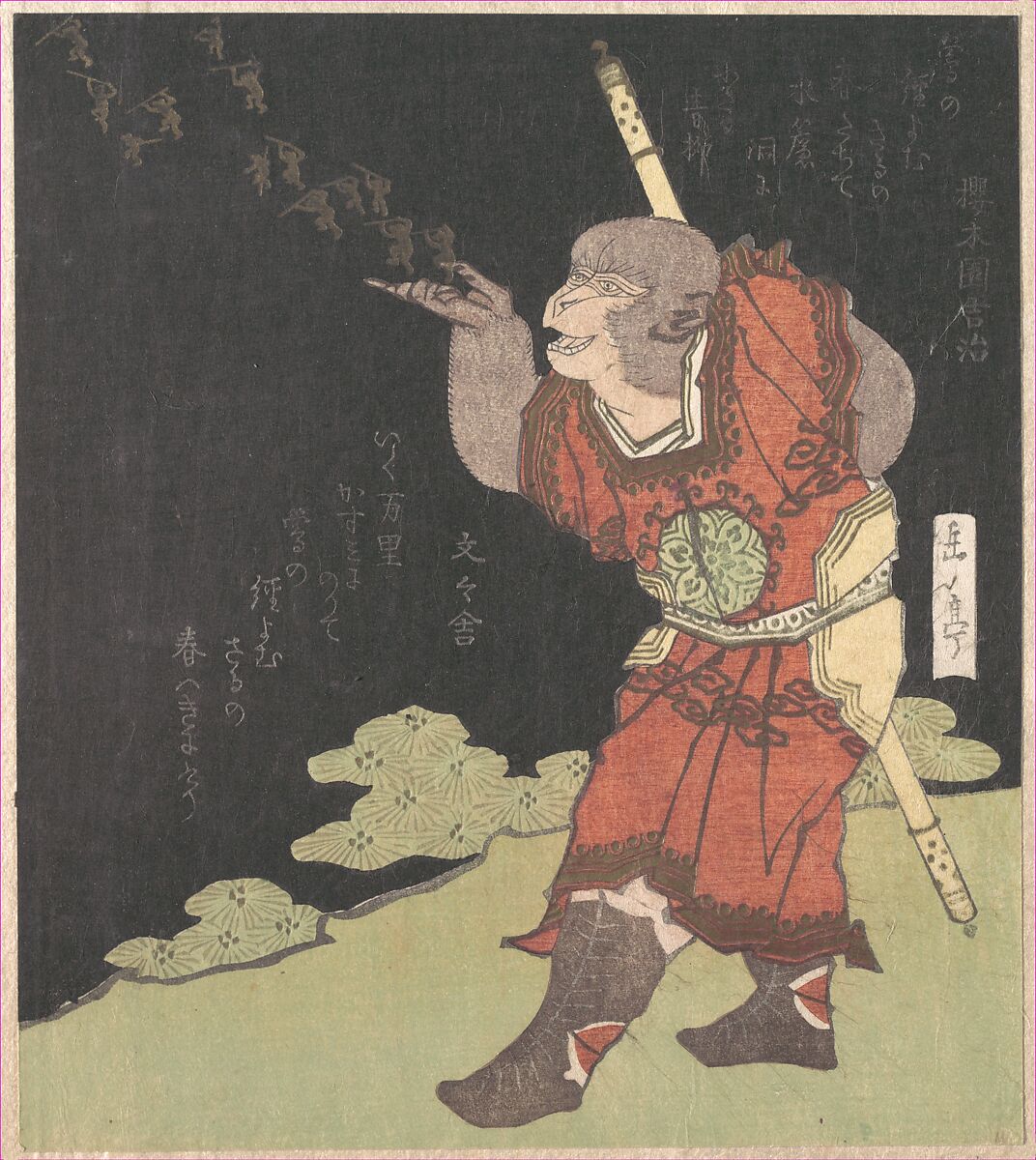
Sun Wukong (Songokū) in red robes with a staff, Yashima Gakutei, probably 1824
Gakutei portrays Sun Wukong under his Japanese name Songokū, in patterned red robes with his staff. This Japanese print, probably made in 1824, is a separate artistic witness to Journey to the West; its costume and pictorial treatment do not define every feature of Wilhelm and Martens’s 1921 retelling.
Overview
Sun Wukong, called Sun Wu Kung in Wilhelm and Martens’s 1921 English retelling, is the Monkey King: the same protagonist receives the titles Handsome King of the Apes, Great Saint Who Is Heaven’s Equal and, finally, the Wanderer. A rock on the Mountain of Flowers and Fruits absorbs cosmic powers, produces a stone egg and gives birth to him. He wins kingship by entering the cave behind a waterfall. After centuries of carefree rule, fear of death sends him abroad to seek immortality.
A master called the Discerner teaches him practices for eternal life, seventy-two transformations and cloud somersaults. The retelling gives each somersault a range of eighteen thousand miles. He is expelled for displaying his transformations to other pupils. Returning home, he defeats the Devil-King of Chaos and rescues captive monkeys. His hairs can become numerous helpers; he later uses them to seize weapons for his followers.
From the Eastern Sea Dragon-King he obtains the enormous iron measuring rod formerly used by the Great Yu. It grows or shrinks at command and can be stored in his ear. He also compels the dragon brothers to supply armour. Dragged into the Nether World in a dream, he fights his captors and strikes the monkey family from the Book of Life. The narrative says the monkeys on his mountain thereafter cease to die.
Heaven first appoints him keeper of its horses. Discovering the office’s low rank, he rebels; a second appointment grants his grand title without duties. Entrusted with the life-giving peach garden, he eats its fruit, disrupts the celestial banquet, drinks its nectar and steals Laotsze’s pills of life. Heavenly forces struggle to capture him. Yang Oerlang matches his transformations, while Laotsze’s thrown circlet and the heavenly hound help bring him down. Execution fails, and he survives forty-nine days in the alchemical oven before breaking out.
Buddha defeats him without matching his violence. Wukong wagers that he can leap beyond Buddha’s hand and mistakes the fingers for pillars at the world’s end. His inscription proves that he has never escaped the palm. Buddha confines him beneath a mountain formed from the five elements and secured by a sacred formula. After hundreds of years, he is released to accompany the Monk of the Yangtze-kiang in fetching scriptures from the West. A golden headband, tightened by a formula given to the monk, restrains disobedience.
This account follows the complete final chapter of The Chinese Fairy Book, including its short release-and-service ending; it is not a collation of the full Journey to the West. The chapter’s note interprets the ape allegorically as the human heart and compares him with Hanuman, but those are the editor’s interpretations rather than proof of identity or descent. Its individual measures, titles and transformation scenes belong to this translated witness and should remain distinguishable from other retellings.
Origins & earliest records
Chinese tales mediated by Richard Wilhelm and Frederick H. Martens
Records & interpretation
Complete tale and its attached source note read in the retained1921-edition transcription.
Selected bibliography
Documented works and useful reading. This is not a list of every appearance.
- 01
The Chinese Fairy Book
LXXIV, The Ape Sun Wu Kung, pp.292–329; complete retelling and explanatory note; New York, Frederick A. Stokes Company
Family & connections
A source-supported family tree or inspiration record has not yet been compiled for this profile. Related reading below indicates a connection in subject matter, not a proven lineage or creative influence.
Primary records and illustrations
Richard Wilhelm/Frederick H. Martens, The Chinese Fairy Book (Stokes1921)
Literary Fairy Tales. LXXIV, The Ape Sun Wu Kung, pp.292–329
Entire long chapter and explanatory note read in overlapping contiguous chunks through final monk-service ending; cache wilhelm-LXXIV.txt and29939.html. Full Journey to the West and earlier Chinese editions not independently collated. Aliases/titles one protagonist; editor Hanuman analogy not genealogy.
References
Sources supporting this profile. Linked pages have their own scope and editorial standards.
- Historical translated taleWilhelm/Martens, The Chinese Fairy Book, LXXIV, The Ape Sun Wu Kung, pp.292–329Research access: 2026-10-05
Image credits
Historical illustrationSun Wukong (Songokū) in red robes with a staff, Yashima Gakutei, probably 1824
Gakutei portrays Sun Wukong under his Japanese name Songokū, in patterned red robes with his staff. This Japanese print, probably made in 1824, is a separate artistic witness to Journey to the West; its costume and pictorial treatment do not define every feature of Wilhelm and Martens’s 1921 retelling.