
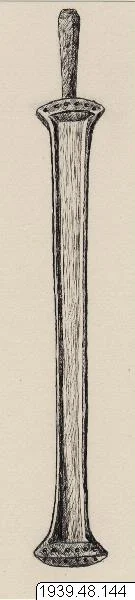
Monochrome drawing of a long narrow musical instrument with a projecting handle, shown complete with its inventory label.
Catalogue drawing of a wooden instrument attributed to Sukuma communities in Tanzania. The record says its strings are missing. Max F. Witte, a German colonial officer, collected it; the museum acquired it in 1939. Its creation date and individual maker are unspecified. Low-resolution historical source. Compressed for display.
Overview
A museum-hosted text credited to Mark and Aimee Bessire around 1995 locates Usukuma in Tanzania’s Lake Zone. It describes elders and younger artists sharing cultural learning and community collections.
The account records the centre’s foundation in 1954 and museum design in 1968. Royal families and dance societies donated objects for preservation.
The text lists Kisukuma, Kiswahili and English in museum practice and distinguishes Bagalu and Bagika dance societies. These are historical descriptions, not a present operating snapshot.
History & identity
No precise ancient origin is established here.
Sources & representation
Selected sourced accounts.
Selected bibliography
Documented works and useful reading. This is not a list of every appearance.
- 01
Profile and Mission Statement of the Sukuma Museum – Sukuma Museum
Selected bibliography.
Language & cultural connections
Source-supported language and cultural connections have not yet been compiled for this profile.
References
Sources supporting this profile. Linked pages have their own scope and editorial standards.
- Historical museum accountProfile and Mission Statement of the Sukuma Museum – Sukuma MuseumResearch access: 2026-10-07
Image credits
Historical catalogue drawing of an individual instrumentMonochrome drawing of a long narrow musical instrument with a projecting handle, shown complete with its inventory label.
Catalogue drawing of a wooden instrument attributed to Sukuma communities in Tanzania. The record says its strings are missing. Max F. Witte, a German colonial officer, collected it; the museum acquired it in 1939. Its creation date and individual maker are unspecified. Low-resolution historical source. Compressed for display.