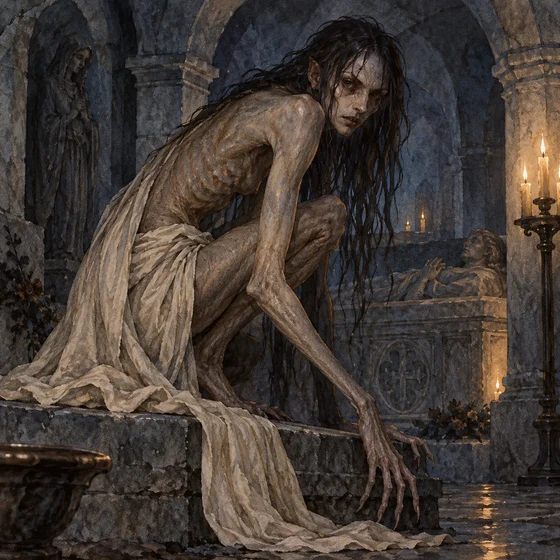
AI-generated interpretation of Ovid’s avian striges; exact species-like form, colour details and setting imagined. Petronius’s unseen strigae are a separate witness.
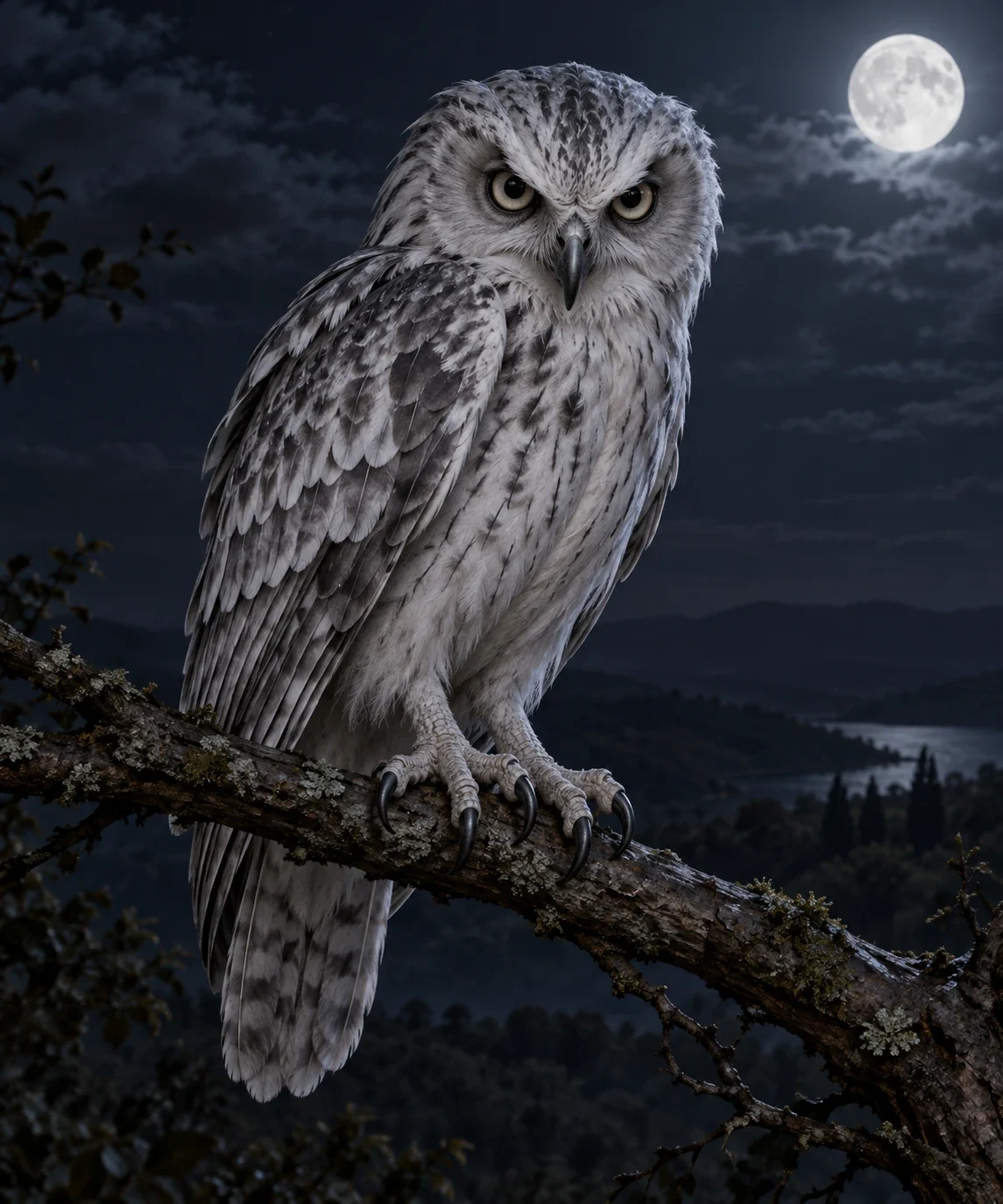
Ovid’s bird form only. Exact species-like silhouette, eye colour, scale, branch and landscape are imagined. Petronius’s unseen nocturnal women remain a separate witness. No game or source artwork used.
Overview
Ovid’s Fasti and Petronius’s Satiricon preserve two different Roman literary accounts of nocturnal beings named striges or strigae. In Fasti, the creatures enter the explanation of Carna’s protective powers. They are hungry birds with large heads, staring eyes, beaks suited to seizing prey, grey-white plumage and hooked claws. They fly at night and attack infants without a nurse beside them. Ovid does not settle whether they are born as birds or whether an incantation transforms old women into them. The uncertainty is part of his account, not a reason to assign every creature one fixed origin.
The particular victim is Proca, only five days old. His cries bring his nurse, who finds claw wounds on his cheeks and a sickly change in his colour. She appeals to Cranae, the earlier name used for the protecting figure within this narrative. The goddess touches the doorposts and threshold with arbutus, sprinkles the entrance with water and offers a young pig’s entrails in exchange for the child’s. A white-thorn branch associated with Janus is placed at the window. The episode ends with the birds no longer troubling the cradle and the child’s colour restored. These are actions inside the poem, not recommended medical or protective measures.
Petronius’s account belongs to Trimalchio’s banquet storytelling and gives the strigae a different presentation. A boy has already died when the mourners hear them outside. A strong Cappadocian rushes out with a sword and is said to strike a woman, but Trimalchio expressly says that those inside did not see the beings. The man returns bruised, later becomes delirious and dies. When the mother embraces her son, she finds a straw substitute instead of the body. Trimalchio attributes the substitution to knowledgeable nocturnal women, and the next sentence records the diners’ frightened belief and appeal to be left alone.
These witnesses support a comparison of night attack, bodily harm and uncertain supernatural appearance, while preserving a decisive difference between a rescued living infant and a stolen corpse. Petronius supplies no visible bird anatomy for his women. Neither selected account establishes a continuous line into every later striga tradition, a universal vampire species or a modern fictional curse. The Witcher’s cursed royal daughter is therefore compared separately, without claiming that its author or designers consulted either Roman work.
Origins & earliest records
Ovid, Fasti VI.101–182, including complete bird attack and protection episode VI.131–168; Petronius, Satiricon 63, with the first sentence of 64 for the diners’ response. Historical literary witnesses, not field transcripts or proof of supernatural events.
Records & interpretation
Complete selected original Latin accounts and the stated framing passages were read. The retained electronic-text witness includes Petronius’s editorial supplements; no manuscript collation or whole-work reading is claimed.
Selected bibliography
Documented works and useful reading. This is not a list of every appearance.
- 01
Fasti, bookVI, complete Carna passage101–182
Electronic LatinLibrary witness; printed critical edition not identified on selected page. Bird episode131–168. No manuscript collation claimed.
- 02
Satiricon, chapter63 and chapter 64 opening sentence
Electronic LatinLibrary witness; editorial supplements retained. Complete ghost story and narrowly selected reader response, not complete chapter 64 or whole novel.
Family, evolution & connections
Striga (The Witcher)
A striga in The Witcher is associated with a curse that transforms a human into a dangerous predatory being. Ovid’s striges are predatory night-birds; Petronius’s strigae are reported nocturnal women involved in replacing a dead boy with straw. This is a lexical and motif comparison across different portrayals, not a creator-source route or identical creature anatomy.
References
Sources supporting this profile. Linked pages have their own scope and editorial standards.
- Primary Roman literary witness; selected Latin retainedOvid, Fasti VI.101–182, original Latin tool-observed witnessResearch access: 2026-10-24
- Primary Roman literary witness; selected Latin retainedPetronius, Satiricon 63 and64 opening, original Latin tool-observed witnessResearch access: 2026-10-24
Image credits
AI-generated historical interpretationAI-generated interpretation of Ovid’s avian striges; exact species-like form, colour details and setting imagined. Petronius’s unseen strigae are a separate witness.
Ovid’s bird form only. Exact species-like silhouette, eye colour, scale, branch and landscape are imagined. Petronius’s unseen nocturnal women remain a separate witness. No game or source artwork used.