
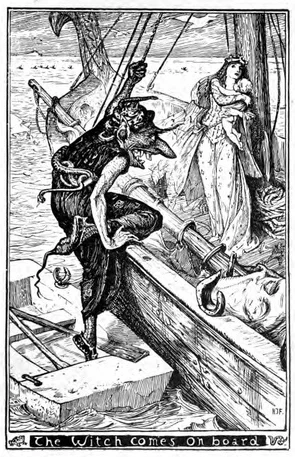
The stone-boat troll boards Sigurd’s ship before the queen and child, Henry Justice Ford, 1894
Ford shows the visitor boarding the ship before she steals the queen’s clothes and appearance. The exaggerated nose, pointed ears, coarse hair and clawed hands belong to this illustration; the tale does not prescribe a universal Icelandic troll body. The queen and child stand separately on the deck.
Overview
A boat approaching the becalmed royal ship carries a frightening visitor who boards while Sigurd and the crew sleep. She takes the queen’s child, strips the queen of her fine clothes, and puts those clothes on herself, assuming a human appearance. She sends the displaced queen away in the stone boat with a spell directing its uninterrupted course to her brother in the underworld. The child’s persistent crying and the apparent queen’s altered temper give the court warning signs, but neither immediately proves the substitution.
Two young chess players hear the impostor describe three degrees of yawning: a small yawn makes her a maiden, an intermediate one half a troll, and a full one entirely a troll. They then witness her transformation and a three-headed giant arriving through the floor with a trough of meat. He addresses her as his sister. She consumes the entire provision, explaining her small appetite at the public royal table, and resumes the queen’s form after he disappears below.
The true queen’s underground visits to her child ultimately reveal the fraud. Sigurd frees her by cutting the captor’s chain, and she explains the voyage and imprisonment. The chess players disclose their observations only after the impostor loses power; their earlier silence comes from fear. The narrative ends with the impostor executed, the real queen restored, and the observant nurse rewarded. The surviving text gives the visitor no personal name and no claim that all Icelandic trolls use this particular clothing or yawning mechanism.
Origins & earliest records
The Yellow Fairy Book (London: Longmans, Green, and Co., 1894), edited by Andrew Lang, prints The Witch in the Stone Boat with a footnote identifying it as from the Icelandic. The earlier Powell–Magnússon collection prints the related Troll in the Stone-craft in 1866; its available Google scan has cropped leaves, so this account follows the complete 1894 retelling.
Records & interpretation
The complete 1894 narrative distinguishes the queen impersonator from her three-headed brother. The title page identifies H. J. Ford as illustrator; images show the boarding and the chain-cutting encounter.
Selected bibliography
Documented works and useful reading. This is not a list of every appearance.
- 01
The Yellow Fairy Book: The Witch in the Stone Boat
Complete narrative, from Sigurd’s marriage and voyage through restoration of the queen and reward of the nurse. The text supplies no individual storyteller attribution.
Family & connections
A source-supported family tree or inspiration record has not yet been compiled for this profile. Related reading below indicates a connection in subject matter, not a proven lineage or creative influence.
References
Sources supporting this profile. Linked pages have their own scope and editorial standards.
- Primary literary retellingLang 1894: complete stone-boat narrativeResearch access: 2026-10-05
Image credits
Historical illustrationThe stone-boat troll boards Sigurd’s ship before the queen and child, Henry Justice Ford, 1894
Ford shows the visitor boarding the ship before she steals the queen’s clothes and appearance. The exaggerated nose, pointed ears, coarse hair and clawed hands belong to this illustration; the tale does not prescribe a universal Icelandic troll body. The queen and child stand separately on the deck.