
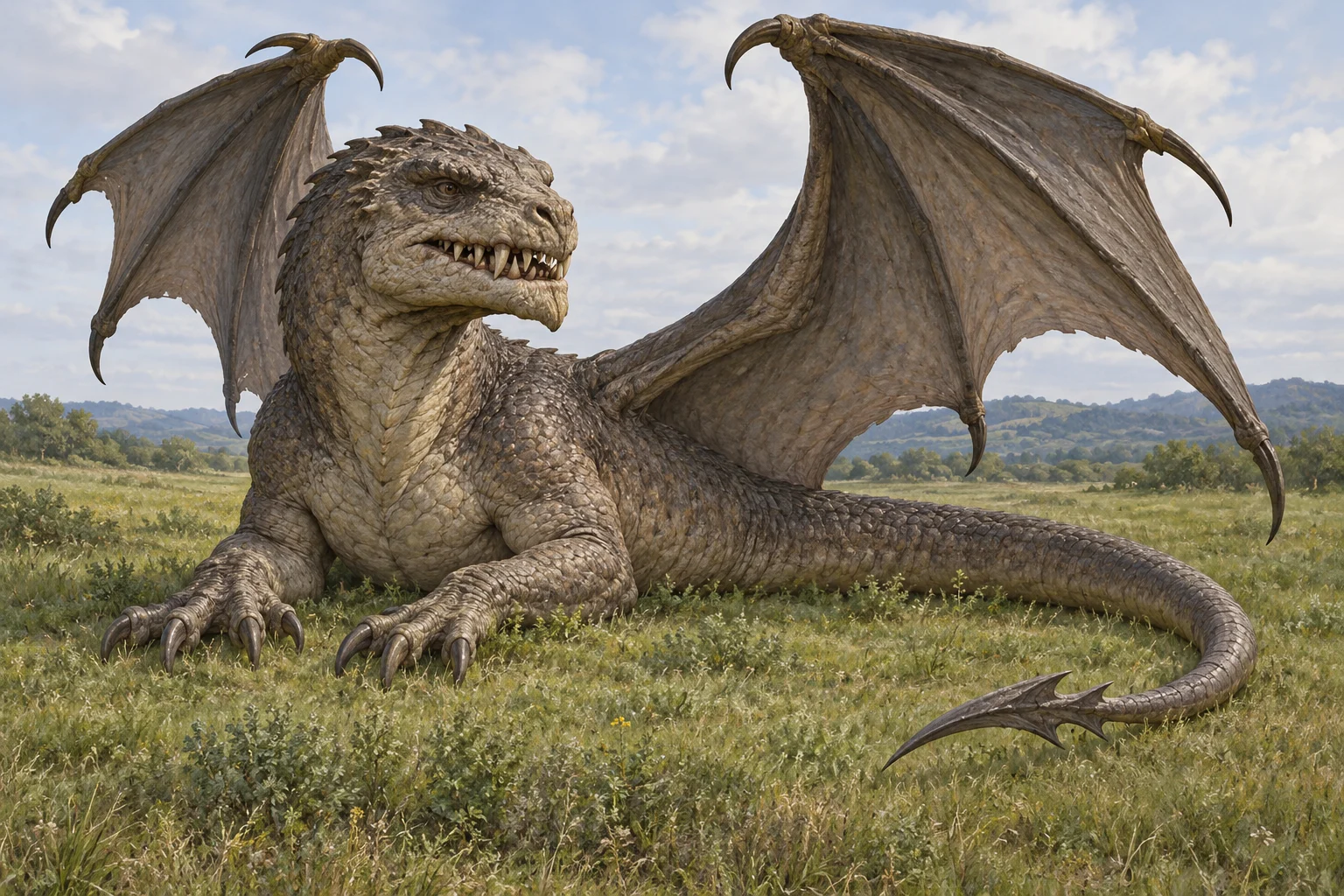
AI interpretation; independently composed.
Text-led interpretation; unspecified details imagined.
Overview
Stockton’s Griffin is an individual whose likeness has been carved above a church door. The sculpture has a large head, massive jaws, savage teeth, great wings armed with hooks and prongs, and two stout clawed forelegs. There are explicitly no hind legs: the body continues into a long powerful tail ending in a barb. The Minor Canon confirms that the living visitor looks exactly like the carving. This form differs from the familiar four-legged, eagle-headed griffin and should not be silently replaced by it.
Living far away in the dreadful wilds, the Griffin has never seen his own reflection and is said to be the last of his race, as far as anyone knows. He flies to the town to inspect the image. The frightened inhabitants send the Minor Canon to meet him; the young clergyman is himself afraid but accepts the responsibility. The Griffin repeatedly admires the carving and grows attached to his guide, accompanying him on charitable work and sharing knowledge gathered over centuries. His tail becomes red-hot with excitement or anger, and he cools it in a brook.
The Griffin says he eats only at the two equinoxes. As autumn approaches, the townspeople fear becoming his meal and force the Minor Canon to leave for the wilds, hoping the monster will follow. Instead, the Griffin remains and takes over the absent man’s school and visits to the sick. These scenes mix apparent public benefit with the fear that makes people obey him. When the townspeople offer food, he rejects them as cowardly and selfish, but admits that the brave, honest Minor Canon is the one person for whom he has an appetite. Friendship and predation remain entangled.
Learning that his friend was deliberately sent away, the Griffin denounces the town and orders its people to honour him. He carries the great stone likeness home, then finds the Minor Canon weak and nearly starved in the wilds, restores his strength and returns him to the town unseen. The clergyman eventually becomes a bishop, and the inhabitants learn genuine respect beyond their initial fear of vengeance. The Griffin stays by his image, takes no meal at the autumnal equinox, and declines and dies because he wants nothing else if he cannot have the Minor Canon. The ending does not turn their relationship into an uncomplicated rescue friendship.
First appearances & development
An individual creature in Stockton’s The Griffin and the Minor Canon.
Canon & continuity
Complete retained primary story, including the appetite admission, rescue and death; historical teaching notes remain separate commentary.
Selected bibliography
Documented works and useful reading. This is not a list of every appearance.
- 01
Family & connections
A source-supported family tree or inspiration record has not yet been compiled for this profile. Related reading below indicates a connection in subject matter, not a proven lineage or creative influence.
References
Sources supporting this profile. Linked pages have their own scope and editorial standards.
- Primary literary textFanciful Tales, retained illustrated schoolbook editionResearch access: 2026-10-18
Image credits
AI-generatedAI interpretation; independently composed.
Text-led interpretation; unspecified details imagined.