
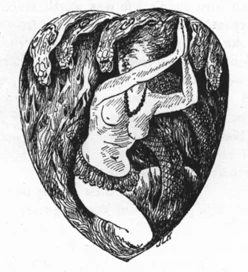
Kipling’s snake-woman illustration for King Ali Mardan’s tale, 1894
Kipling combines a woman’s upper body with winding serpents in this chapter ornament. Steel’s narrative instead describes a beautiful woman who changes into a snake; the hybrid composition is the illustrator’s interpretation.
Overview
In this Kashmir-set tale, Ali Mardan finds a weeping woman above Dal Lake and brings her to the Shalimar gardens. Her claim to be the Chinese emperor’s lost handmaiden is a disguise. A visiting Jôgi identifies her as a two-hundred-year-old snake capable of assuming a woman’s form; the king’s frightened appearance has alerted him to danger.
To test her, the king gives her salty food and pretends to sleep. Needing water, she leaves the room and must resume snake form when going out at night. He watches her drink from the fountains and bathe in Dal Lake. The Jôgi then helps him construct a chained oven of a hundred metals. Tricked into tending the bread, she is pushed inside and burned; her struggles would otherwise carry off the oven itself.
Her ashes contain a stone described as her essence, able to turn whatever it touches into gold. Ali Mardan rejects the treasure as a cause of envy and violence and throws it into the river. Temple records Lamiâ and Yahawwâ as names and says this tale calls her a Wâsdeo serpent. His comparative identification with classical serpent figures is commentary, not proof that she is those beings or the Greek Lamia. His note also distinguishes the historical governor Ali Mardan Khan from the story’s king.
Origins & earliest records
Kashmir narrative collected in Steel and Temple’s colonial-era anthology
Records & interpretation
Complete named tale and Temple’s corresponding notes read; university-hosted 1894 text compared in full.
Selected bibliography
Documented works and useful reading. This is not a list of every appearance.
- 01
Tales of the Punjab, Told by the People
The Snake-Woman and King Ali Mardan and corresponding Temple notes; illustrations J. Lockwood Kipling
Family & connections
A source-supported family tree or inspiration record has not yet been compiled for this profile. Related reading below indicates a connection in subject matter, not a proven lineage or creative influence.
Primary records and illustrations
Flora Annie Steel, Tales of the Punjab, Told by the People (Macmillan, 1894); R. C. Temple notes
The Snake-Woman and King Ali Mardan. Complete tale and titled notes; Gutenberg id00946/id01762; UPenn punjab-22
Full tale and corresponding notes read. Entire UPenn 1894 narrative compared with Gutenberg: over 98% token overlap; all remaining punctuation, OCR and illustration-caption differences inspected. Story action distinguished from characters’ inferences and Temple’s comparative interpretations.
References
Sources supporting this profile. Linked pages have their own scope and editorial standards.
- Historical collected folktaleSteel, The Snake-Woman and King Ali Mardan, complete narrativeResearch access: 2026-10-05
- Collector’s linguistic and comparative notesTemple, Notes to The Snake-Woman and King Ali MardanResearch access: 2026-10-05
- University-hosted historical primary textUniversity of Pennsylvania, 1894 edition transcriptionResearch access: 2026-10-05
Image credits
Historical illustrationKipling’s snake-woman illustration for King Ali Mardan’s tale, 1894
Kipling combines a woman’s upper body with winding serpents in this chapter ornament. Steel’s narrative instead describes a beautiful woman who changes into a snake; the hybrid composition is the illustrator’s interpretation.