
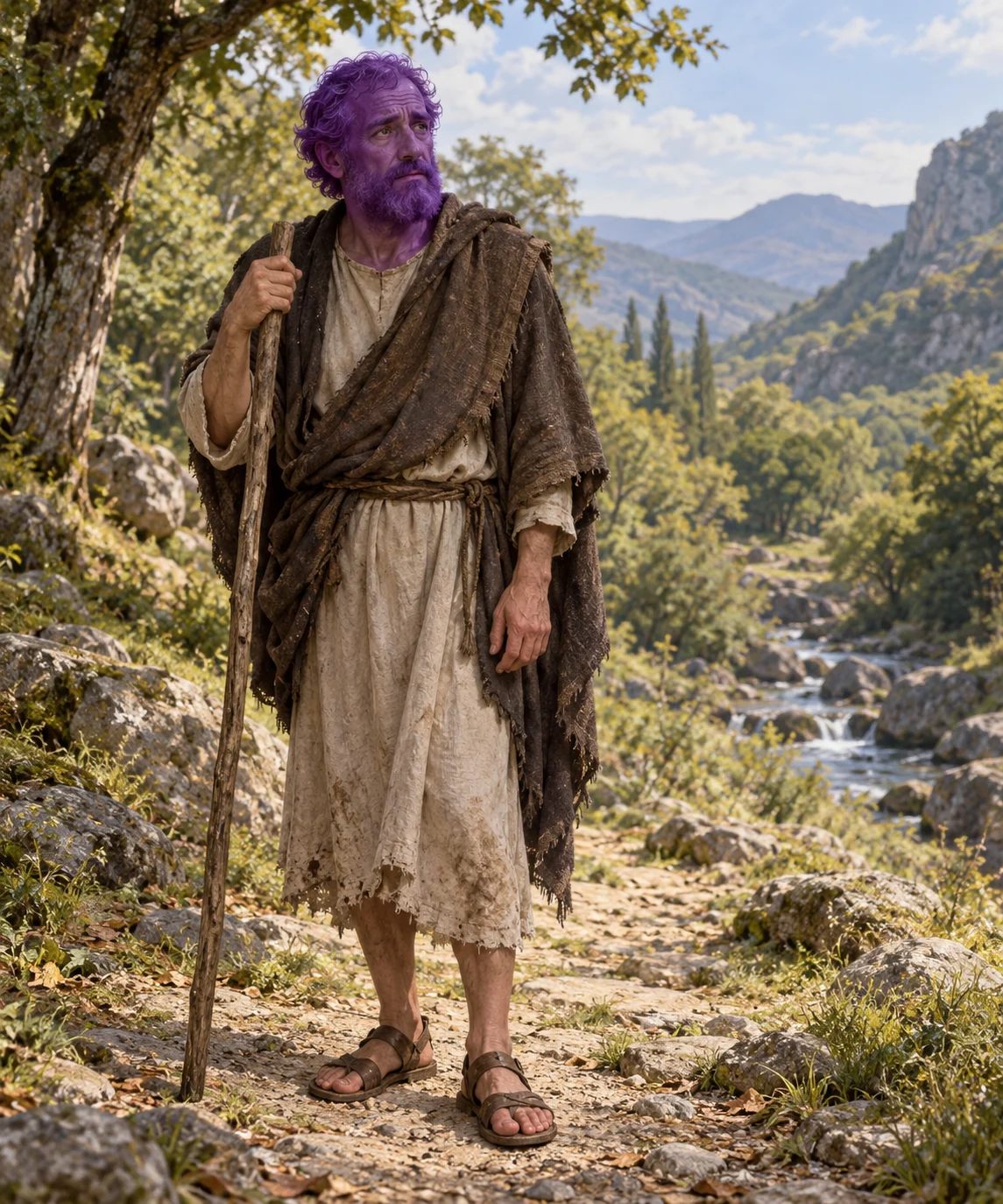
Purple extends onto the neck as an interpretive detail.
Overview
Sorianus is a young natural philosopher at Aurelian’s court when a Persian embassy presents a robe of exceptional purple. He challenges the implication that its dye is an ordinary Persian product and identifies its source as distant India. Aurelian sends him to obtain it, threatening death if he returns without it and taking charge of his property. About thirty years later Sorianus meets the exiled Persian sage Marcobad: both are poorly clothed and exhausted, but Sorianus moves painfully with a staff. He has acquired the dye after evading seven dragons and surviving a three-day ordeal of thirst, relying on his Stoic discipline. His small flask seems to promise an honoured teaching life in Athens.
Marcobad imagines a different reward, steals the flask and strikes Sorianus with it during the struggle. The crystal breaks and its contents saturate every hair and feature of Sorianus’s head with vivid, indelible purple. Washing and rubbing cannot remove it. Marcobad promises replacement dye and an antidote, then departs; Sorianus eventually continues his journey and is brought before the king of Ayodhya. The king claims that purple is a royal monopoly and therefore the philosopher’s head belongs to him. When Sorianus cannot offer useful courtly skills, the king has him beheaded, interrupting his hope for a world governed by knowledge rather than princely vanity. The purple loses its splendour after death, and the king orders head and body burned; the same ending shows Marcobad’s body contested by the dragons. Sorianus remains a human victim of satire, not a naturally purple being or an account of actual Indian law.
First appearances & development
Richard Garnett’s authored English collection The Twilight of the Gods, and Other Tales, retained title dated MDCCCCIII (1903). The author’s notes distinguish the first sixteen-tale edition of 1888 from the present impression with twelve additions. The selected narrative is literary satire, not a historical biography or a collected community account.
Canon & continuity
The complete three-part tale, its final execution and double ending, and the author’s notes establish the narrative scope. The note records publication in Fraser’s Magazine for August 1877 and cites earlier historical material; those upstream works were not independently consulted.
Selected bibliography
Documented works and useful reading. This is not a list of every appearance.
- 01
The Twilight of the Gods, and Other Tales
Retained title MDCCCCIII; selected tale The Purple Head.
Family & connections
A source-supported family tree or inspiration record has not yet been compiled for this profile. Related reading below indicates a connection in subject matter, not a proven lineage or creative influence.
References
Sources supporting this profile. Linked pages have their own scope and editorial standards.
- Primary historical authored fictionGarnett — dated title, complete selected tale and author’s notesResearch access: 2026-10-18
Image credits
AI-generatedPurple extends onto the neck as an interpretive detail.