
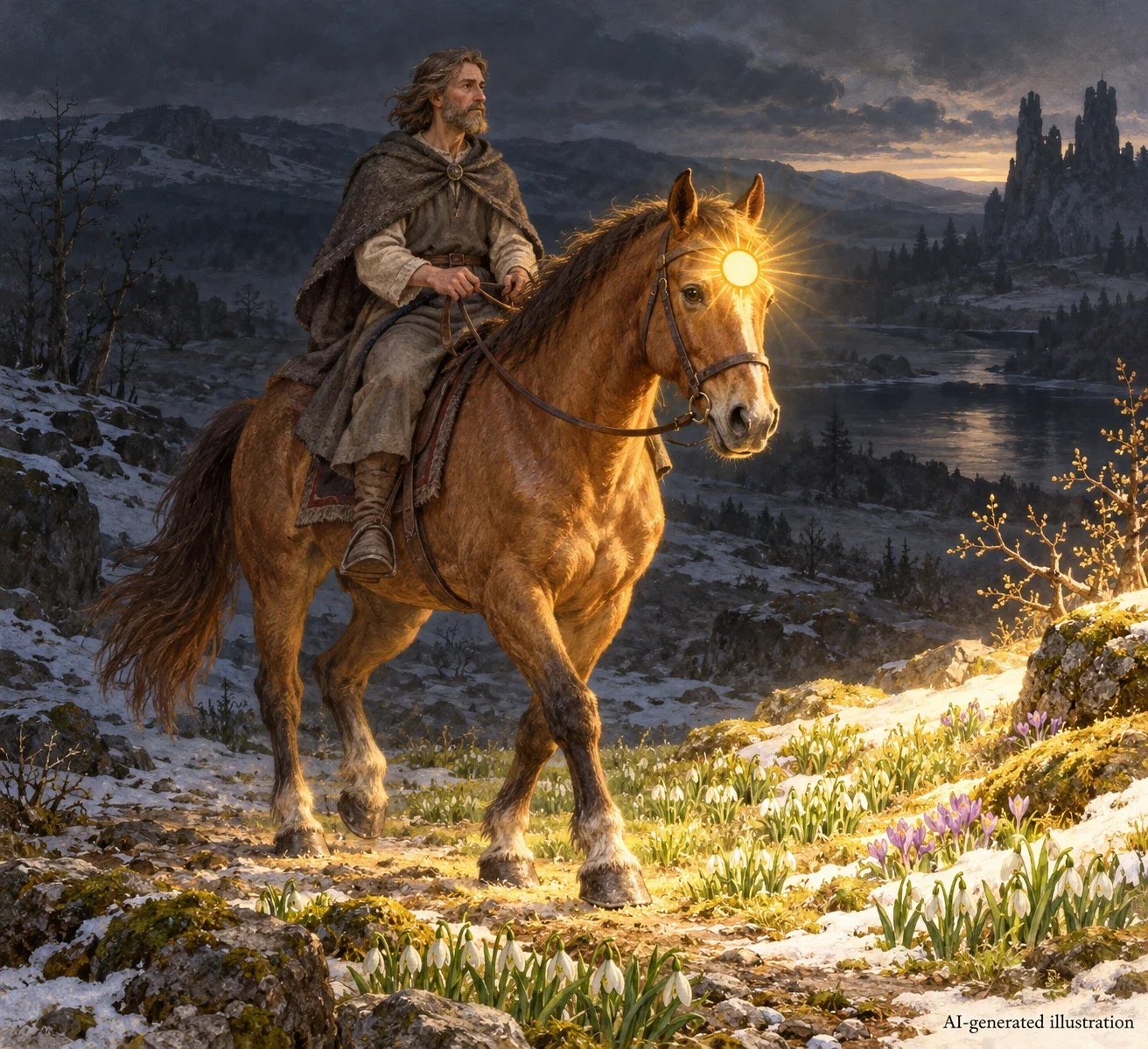
A mounted seer returns on a horse whose forehead sun illuminates dim ground and spring flowers.
The recovered Sun-Horse restores light at the dark realm’s frontier in Wratislaw’s selected tale. AI-generated illustration; garment, face and staging details are illustrative choices.
Overview
In the selected tale a king possesses a horse with a sun on its forehead. His country receives no ordinary sunlight, so the animal is led from end to end to make daily life possible. When it disappears, darkness interrupts work and threatens the realm. The king sets out with an army, but a peasant reading in an isolated cottage already knows his purpose. This seer asks for one servant, sends the king home and undertakes the recovery without demanding a reward. The pair pass through six countries before reaching a seventh, where three royal brothers have married three sisters whose mother is a witch.
The youngest brother rides the sun-horse. To learn when the brothers will return, the seer repeatedly becomes a green bird and visits their wives. He then waits at a bridge and kills the two elder kings on successive evenings. The youngest withstands him until their contest changes from swordplay to transformed wheels and then competing flames. A passing beggar extinguishes the youngest king’s bluish flame after the seer, in red-flame form, offers the larger payment. The seer resumes human form, takes the sun-horse by its bridle and mounts it. These transformations belong to the combatants; the horse is not described as a bird, wheel or flame.
The witch carries her daughters ahead to arrange revenge. An apple-tree, a spring and a rose-bush tempt the hungry and thirsty servant in sequence, but the seer strikes them with his sword and exposes the three queens through the blood that emerges. Continuing safely, the travellers cross the frontier of the dark realm. Flashes spread from the horse’s forehead, and the country comes alive and blossoms. The king offers half his kingdom, but the seer chooses to return to his cottage. The horse’s particular function is restored illumination; its coat, breed and the physical construction of its forehead sun are not specified.
Origins & earliest records
Wratislaw’s 1889 English translation, XI, pp. 75–82. Contents: J. Rimavski, Slovenish Stories, volume 1, p. 27; the preface identifies Erben’s 1865 Citanka as the intervening selection.
Records & interpretation
Complete continuous English chapter, contents, preface and Hungarian-Slovenish section introduction read. The preface explicitly glosses that heading as Slovak; the earlier Slovak publication and an oral informant have not been independently inspected.
Selected bibliography
Documented works and useful reading. This is not a list of every appearance.
- 01
Sixty Folk-Tales from Exclusively Slavonic Sources
London: Elliot Stock; XI, The Sun-Horse, pp. 75–82; contents cites J. Rimavski, Slovenish Stories, i. 27; preface pp. iii–vi and historical section introduction p. 62.
Family & connections
A source-supported family tree or inspiration record has not yet been compiled for this profile. Related reading below indicates a connection in subject matter, not a proven lineage or creative influence.
References
Sources supporting this profile. Linked pages have their own scope and editorial standards.
- Digitized historical translation and compiler’s source attributionWratislaw, original 1889 English translation: The Sun-HorseResearch access: 2026-10-17
Image credits
Imagined reconstruction of the final return; coat, tack and sun-disk form are interpretive.A mounted seer returns on a horse whose forehead sun illuminates dim ground and spring flowers.
The recovered Sun-Horse restores light at the dark realm’s frontier in Wratislaw’s selected tale. AI-generated illustration; garment, face and staging details are illustrative choices.