
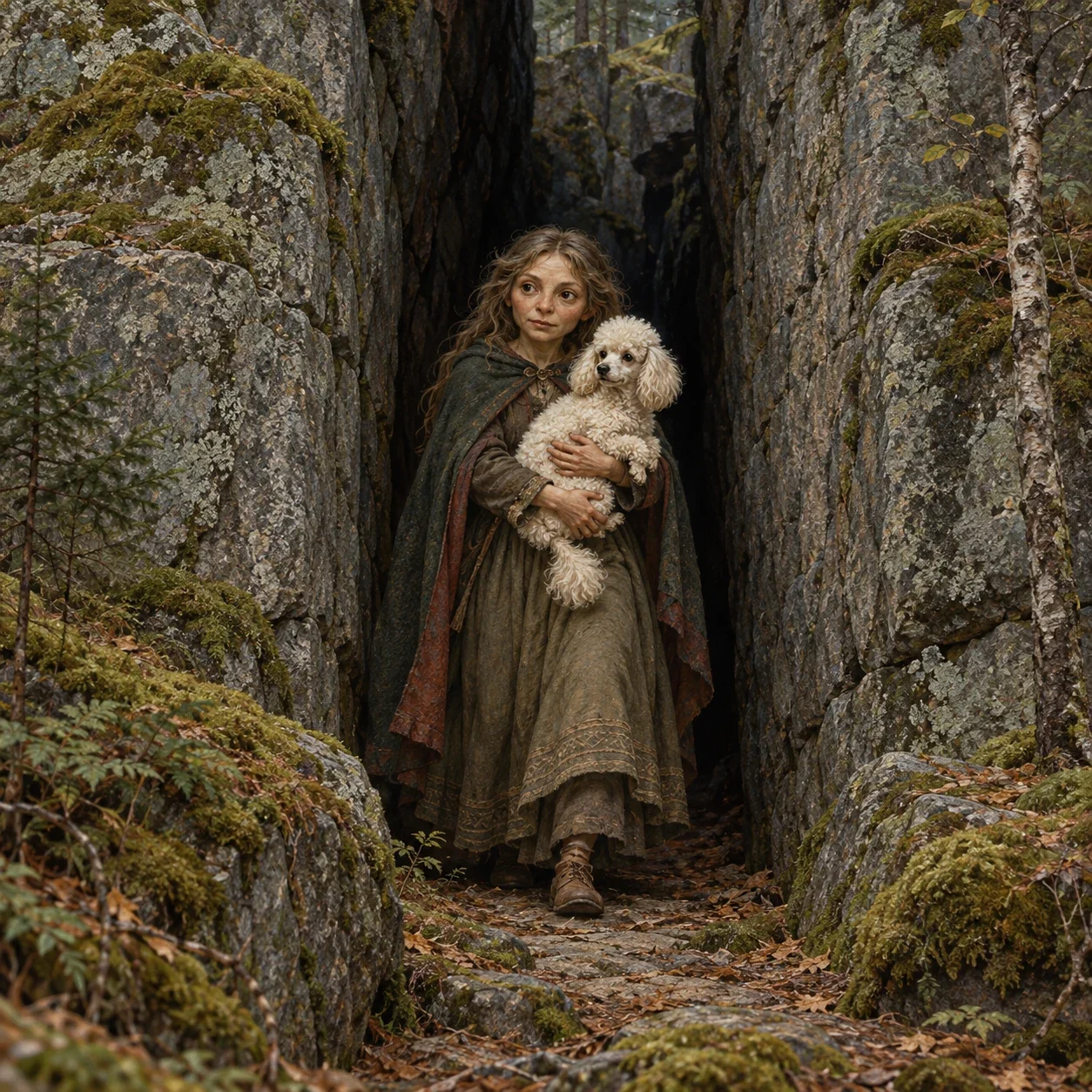
AI-generated interpretation of the initial Skurugata encounter: the small Troll messenger carries the apparent poodle emerging from the mountain cleft. Her face, clothing, precise stature, dog appearance and rock layout are artistic choices. The tale later reveals a child hidden in the dog’s skin; no injury is pictured and the image is not evidence of an actual being or animal.
AI-generated interpretation of the initial Skurugata encounter: the small Troll messenger carries the apparent poodle emerging from the mountain cleft. Her face, clothing, precise stature, dog appearance and rock layout are artistic choices. The tale later reveals a child hidden in the dog’s skin; no injury is pictured and the image is not evidence of an actual being or animal.
Overview
Hofberg’s chapter places Trolls in the mountain cleft of Skurugata after human settlement around Eksjö has driven them from an earlier home. Even there, marching troops, drums, horns and gunfire disturb them. The narrator questions whether any remain and describes former offerings at a nearby fountain through the assumptions of his own time. Those claims are a historical collection’s framing, not evidence of current ritual practice or a surveyed population. The chapter’s geography overlaps Dame Soåsan’s separate story, but its hunter, messenger, disguised child and returning payment form a different complete narrative.
Pelle Katt visits the cleft to hunt woodcock during the mating season, but the birds evade his gun. Believing Trolls responsible, he curses them. A woman of small stature and unusual features then emerges carrying a little poodle. She says that her mistress has sent greetings and wants him to shoot it. The chapter does not identify her as Dame Soåsan, reveal the mistress’s name or describe horns, wings or other fixed nonhuman anatomy. Her position is that of a messenger acting for an unseen mountain household.
Pelle tells her to tie the dog to a tree and fires at it. After the smoke clears, he sees his own child wrapped in a dog’s hide. The narrator does not explain how the child reached the cleft or give a technical account of the disguise. The Troll woman reappears, throws a dollar piece into his hand as his reward and carries the dead child away. The coin initially sticks to his hand, but he flings it after her and refuses payment. A rough laugh answers from the mountain. This is the tale’s devastating reversal of his boast, not a historical account of a real child’s death.
At home, Pelle finds the child missing and his wife grieving. He does not explain what happened and goes to the ale house without money. Searching his pocket, he discovers the same dollar piece he thought he had rejected. He spends it on drink and temporarily forgets his loss. When he becomes sober the coin is again in his pocket. Repeated attempts to throw it away fail, and the returning payment sustains increasing drinking until the story ends in his death. The source offers no later rescue, absolution, recovered child or broken enchantment.
The narrator had already characterized Pelle as drunken, quarrelsome and boastful about fearing neither God nor the devil. That moral frame shapes the story’s punishment, while the coin joins supernatural payment to self-destructive repetition. It does not establish a supernatural explanation for addiction in real life. The retained note describes Skurugata’s physical cleft and names nearby Skuruhatt and Sacristian, adding another reported association with old offerings. Those local details locate the published legend without independently confirming either its wonders or the compiler’s explanations.
The selected witness is Hofberg’s Swedish Fairy Tales in Myers’s1890 English edition, with copyright1888 on its preliminary page. Hofberg says he selected typical local traditions rather than every regional repetition. Myers explicitly says that he omitted some of the author’s notes and placed those retained after their tales. This profile follows the complete printed chapter and its surviving note, not an unexamined Swedish original or an independently recorded oral performance. No later fictional design is assigned this particular source without evidence.
Origins & earliest records
Herman Hofberg, Swedish Fairy Tales, translated by W. H. Myers, Chicago: Belford-Clarke Co.,1890, printed copyright1888. The Trolls of Skurugata, ch10, pp42–45, complete chapter and retained note.
Records & interpretation
Complete chapter, all narrative transitions through Pelle’s death, retained geographical note and both editorial prefaces read. Prior current DameSoasan geography match is distinguished from this narrative rather than treated as absence of the whole place.
Selected bibliography
Documented works and useful reading. This is not a list of every appearance.
- 01
Hofberg/Myers1890 ch10, pp42–45, full chapter and note; prefacespp3–4
Complete selected historical English unit and attached notes; upstream witnesses not independently collated.
Family & connections
A source-supported family tree or inspiration record has not yet been compiled for this profile. Related reading below indicates a connection in subject matter, not a proven lineage or creative influence.
References
Sources supporting this profile. Linked pages have their own scope and editorial standards.
- Historical English literary compilationHofberg/Myers1890 ch10, pp42–45, full chapter and note; prefacespp3–4Research access: 2026-10-27
Image credits
AI-generated illustrationAI-generated interpretation of the initial Skurugata encounter: the small Troll messenger carries the apparent poodle emerging from the mountain cleft. Her face, clothing, precise stature, dog appearance and rock layout are artistic choices. The tale later reveals a child hidden in the dog’s skin; no injury is pictured and the image is not evidence of an actual being or animal.
AI-generated interpretation of the initial Skurugata encounter: the small Troll messenger carries the apparent poodle emerging from the mountain cleft. Her face, clothing, precise stature, dog appearance and rock layout are artistic choices. The tale later reveals a child hidden in the dog’s skin; no injury is pictured and the image is not evidence of an actual being or animal.