
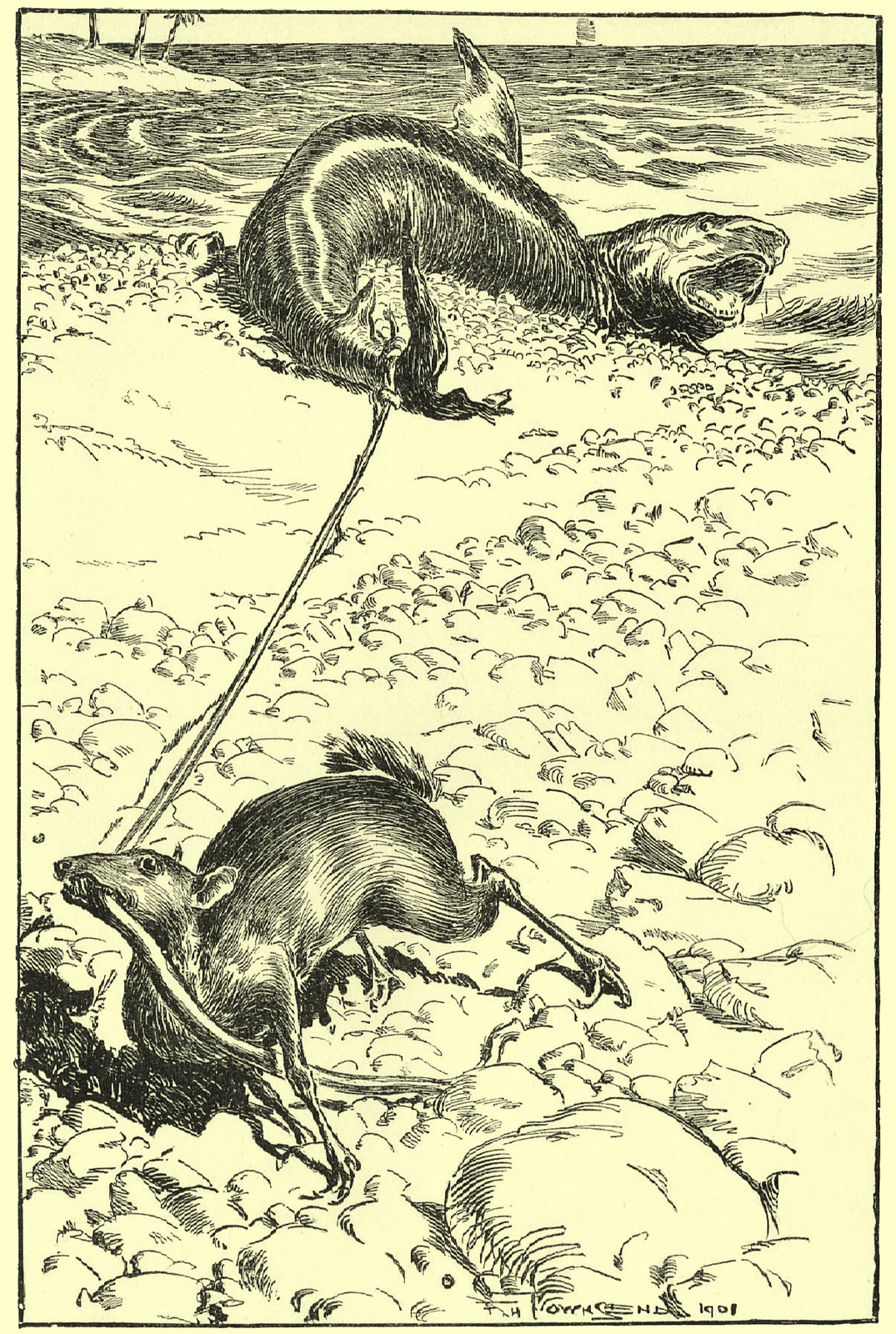
Townsend’s mouse-deer dragging a shark ashore by a cane tied to its tail
The mouse-deer pulls the shark onto the beach under the pretence of giving it magic ingredients. Townsend’s illustration belongs to Skeat’s Che Busu telling; it does not portray an ordinary zoological encounter.
Overview
Sailing for Java with a stump-tailed heron, the mouse-deer repeatedly falls asleep at the helm. The angry bird sinks their boat by pecking a hole and flies away. A young shark threatens the swimmer, but accepts a promise of food-procuring magic in exchange for a ride ashore. The mouse-deer ties its tail with cane under the pretence of supplying ingredients, drags it onto the beach and butchers it. A tiger then prepares the meat while the mouse-deer issues instructions; during a final water-fetching errand it carries the food into a tree and escapes. No promised magic is demonstrated, and the tiger’s threatened revenge does not occur within this tale. Skeat identifies the teller as Che Busu and leaves the heron’s precise species uncertain.
Origins & earliest records
Malay Peninsula; Malay narrative told by Che Busu
Records & interpretation
Complete relevant tale and attached scholarly notes directly read.
In the literature
“made butcher’s-meat of him.”
III The Mouse-deer’s Shipwreck, printed 7 · Walter William Skeat
Mouse-deer and a heron sail toward Java. After the mouse-deer repeatedly sleeps at the helm, the angry heron pecks a hole in the boat and flies away. A young shark threatens the struggling mouse-deer, which promises food-procuring magic in exchange for transport ashore. Once landed, it attaches a rattan to the shark’s tail under the pretence of preparing ingredients, drags it onto the beach and kills it. A tiger arrives hoping to eat the mouse-deer. Offered shark meat instead, it is repeatedly sent for cooking supplies. During its final errand the mouse-deer carries the meat up a she-oak. The cheated tiger returns and threatens future revenge; the tale ends there. Che Busu is the named narrator.
Selected bibliography
Documented works and useful reading. This is not a list of every appearance.
- 01
Fables & Folk-Tales from an Eastern Forest
III, The Mouse-deer’s Shipwreck, pp. 5–8; notes pp. 74–75
- 02
Fables & Folk-Tales from an Eastern Forest — III The Mouse-deer’s Shipwreck
Fables & Folk-Tales from an Eastern Forest, collected and translated Walter Skeat, Cambridge: University Press,1901. Original title leaf13 visually checked; selected complete tales and all accompanying notes read from historical transcription. Introduction states1899 Cambridge expedition collection and limitation of phraseology, not verbatim unedited speech. Original quoted folios visually checked in Archive fablesfolktalesf00skearich; IIIF canvas positions omit initial leaves, so exact original leaf number matched from image identifier, not array index.
Family & connections
A source-supported family tree or inspiration record has not yet been compiled for this profile. Related reading below indicates a connection in subject matter, not a proven lineage or creative influence.
Primary records and illustrations
Walter Skeat, Fables & Folk-Tales from an Eastern Forest (Cambridge: University Press, 1901)
III, The Mouse-deer’s Shipwreck. III, The Mouse-deer’s Shipwreck, pp. 5–8; notes pp. 74–75
Complete tale and associated notes directly read. Regional spellings and differing accounts retained; commentary does not establish present-day practice or biological facts. Individual teller not named here.
Located primary passages
Specific passages supporting details in this entry, grouped by their published witness.
Fables & Folk-Tales from an Eastern Forest
Fables & Folk-Tales from an Eastern Forest, collected and translated Walter Skeat, Cambridge: University Press,1901. Original title leaf13 visually checked; selected complete tales and all accompanying notes read from historical transcription. Introduction states1899 Cambridge expedition collection and limitation of phraseology, not verbatim unedited speech. Original quoted folios visually checked in Archive fablesfolktalesf00skearich; IIIF canvas positions omit initial leaves, so exact original leaf number matched from image identifier, not array index.
- Mouse-deer and a heron sail toward Java. After the mouse-deer repeatedly sleeps at the helm, the angry heron pecks a hole in the boat and flies away. A young shark threatens the struggling mouse-deer, which promises food-procuring magic in exchange for transport ashore. Once landed, it attaches a rattan to the shark’s tail under the pretence of preparing ingredients, drags it onto the beach and kills it. A tiger arrives hoping to eat the mouse-deer. Offered shark meat instead, it is repeatedly sent for cooking supplies. During its final errand the mouse-deer carries the meat up a she-oak. The cheated tiger returns and threatens future revenge; the tale ends there. Che Busu is the named narrator.
III The Mouse-deer’s Shipwreck, complete printed 5–8; notes74–75
CompleteIII5–8 and all notes74–75 read. No successful spell is performed for the shark. Tiger’s threatened later encounter is not narrated. Heron species remains uncertain by Skeat’s own note; no exact scientific species attached. The quote refers to the shark, not the tiger.
References
Sources supporting this profile. Linked pages have their own scope and editorial standards.
- Historical collected narrative with locality and editorial notesSkeat, Fables & Folk-Tales (Cambridge University Press, 1901), III, The Mouse-deer’s Shipwreck, pp. 5–8; notes pp. 74–75Research access: 2026-10-05
Image credits
Historical illustrationTownsend’s mouse-deer dragging a shark ashore by a cane tied to its tail
The mouse-deer pulls the shark onto the beach under the pretence of giving it magic ingredients. Townsend’s illustration belongs to Skeat’s Che Busu telling; it does not portray an ordinary zoological encounter.