
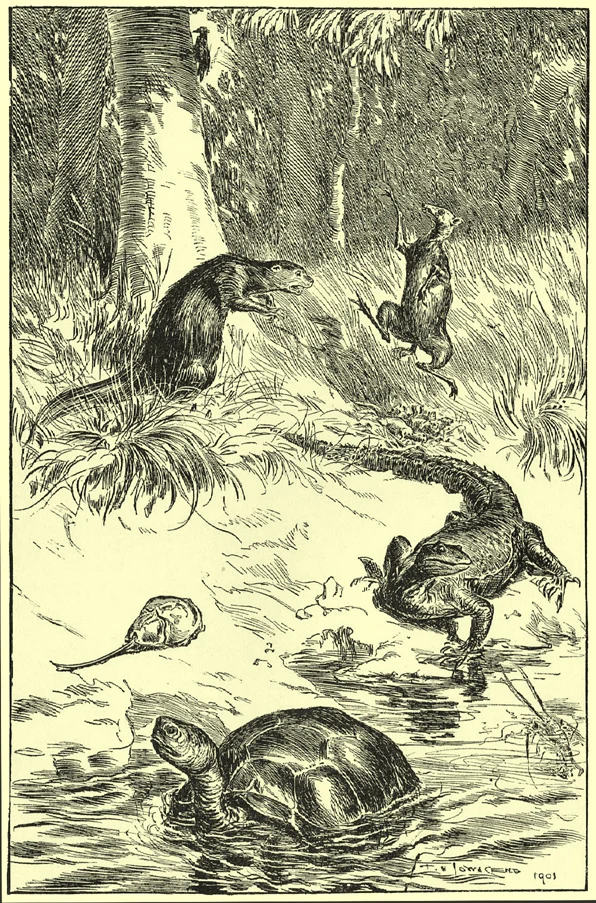
Townsend’s animal ensemble for the otter’s trial, with otter, mouse-deer, lizard, turtle and king-crab
Townsend brings several of the story’s animal witnesses together in one woodland scene. The bodily weapons discussed in the tale are narrative comparisons; this illustration does not show Solomon’s final judgment or authenticate the tale’s rule of justice.
Overview
The mouse-deer minds an otter’s children but crushes them during a war-dance prompted by a woodpecker’s alarm. Solomon’s inquiry follows the alarm through a monitor lizard, tortoise, king-crab and crayfish, whose military equipment is explained in the notes as tails, shell and related bodily features. The crayfish armed itself because the otter was coming to eat its young, so the king rejects the otter’s complaint. This outcome is the fable’s judgment rather than an endorsed rule of justice. Skeat supplied the king-crab link from a Kedah retelling because Che Busu could not recall it; he also admits that the Malay word for offspring does not establish singular or plural here. The crayfish/prawn translation remains uncertain.
Origins & earliest records
Malay Peninsula; Che Busu’s Malay telling supplemented from a Kedah retelling
Records & interpretation
Complete relevant tale and attached scholarly notes directly read.
In the literature
“you, Otter, are the guilty party”
IV Who Killed the Otter’s Babies?, printed 12 · Walter William Skeat
An otter leaves its children with the mouse-deer while it fishes. Hearing the woodpecker’s war gong, the mouse-deer dances and accidentally crushes them. The otter complains to Solomon, who questions each participant. The woodpecker signalled because a monitor lizard wore a sword; the lizard responded to an armoured tortoise; the tortoise to a king-crab’s pike; the crab to a crayfish’s lance. The crayfish armed itself because the otter approached to eat its children. Solomon assigns responsibility to the otter and dismisses its accusation against the mouse-deer. Skeat credits Che Busu but admits restoring the king-crab link from another Kedah telling.
Selected bibliography
Documented works and useful reading. This is not a list of every appearance.
- 01
Fables & Folk-Tales from an Eastern Forest
IV, Who Killed the Otter’s Babies?, pp. 9–12; notes pp. 75–76
- 02
Fables & Folk-Tales from an Eastern Forest — IV Who Killed the Otter’s Babies?
Fables & Folk-Tales from an Eastern Forest, collected and translated Walter Skeat, Cambridge: University Press,1901. Original title leaf13 visually checked; selected complete tales and all accompanying notes read from historical transcription. Introduction states1899 Cambridge expedition collection and limitation of phraseology, not verbatim unedited speech. Original quoted folios visually checked in Archive fablesfolktalesf00skearich; IIIF canvas positions omit initial leaves, so exact original leaf number matched from image identifier, not array index.
Family & connections
A source-supported family tree or inspiration record has not yet been compiled for this profile. Related reading below indicates a connection in subject matter, not a proven lineage or creative influence.
Primary records and illustrations
Walter Skeat, Fables & Folk-Tales from an Eastern Forest (Cambridge: University Press, 1901)
IV, Who Killed the Otter’s Babies?. IV, Who Killed the Otter’s Babies?, pp. 9–12; notes pp. 75–76
Complete tale and associated notes directly read. Regional spellings and differing accounts retained; commentary does not establish present-day practice or biological facts. Individual teller not named here.
Located primary passages
Specific passages supporting details in this entry, grouped by their published witness.
Fables & Folk-Tales from an Eastern Forest
Fables & Folk-Tales from an Eastern Forest, collected and translated Walter Skeat, Cambridge: University Press,1901. Original title leaf13 visually checked; selected complete tales and all accompanying notes read from historical transcription. Introduction states1899 Cambridge expedition collection and limitation of phraseology, not verbatim unedited speech. Original quoted folios visually checked in Archive fablesfolktalesf00skearich; IIIF canvas positions omit initial leaves, so exact original leaf number matched from image identifier, not array index.
- An otter leaves its children with the mouse-deer while it fishes. Hearing the woodpecker’s war gong, the mouse-deer dances and accidentally crushes them. The otter complains to Solomon, who questions each participant. The woodpecker signalled because a monitor lizard wore a sword; the lizard responded to an armoured tortoise; the tortoise to a king-crab’s pike; the crab to a crayfish’s lance. The crayfish armed itself because the otter approached to eat its children. Solomon assigns responsibility to the otter and dismisses its accusation against the mouse-deer. Skeat credits Che Busu but admits restoring the king-crab link from another Kedah telling.
IV Who Killed the Otter’s Babies?, complete printed 9–12; notes75–76
CompleteIV9–12 and all notes75–76 read. Number of children is translation choice: Skeat says anak could be singular or plural. Restored link is collector’s composite intervention, not solely Che Busu’s remembered sequence. Sword, armour and weapons are metaphors for animal features in notes. Crayfish/prawn identification explicitly uncertain, not modern taxonomic fact.
References
Sources supporting this profile. Linked pages have their own scope and editorial standards.
- Historical collected narrative with locality and editorial notesSkeat, Fables & Folk-Tales (Cambridge University Press, 1901), IV, Who Killed the Otter’s Babies?, pp. 9–12; notes pp. 75–76Research access: 2026-10-05
Image credits
Historical illustrationTownsend’s animal ensemble for the otter’s trial, with otter, mouse-deer, lizard, turtle and king-crab
Townsend brings several of the story’s animal witnesses together in one woodland scene. The bodily weapons discussed in the tale are narrative comparisons; this illustration does not show Solomon’s final judgment or authenticate the tale’s rule of justice.