
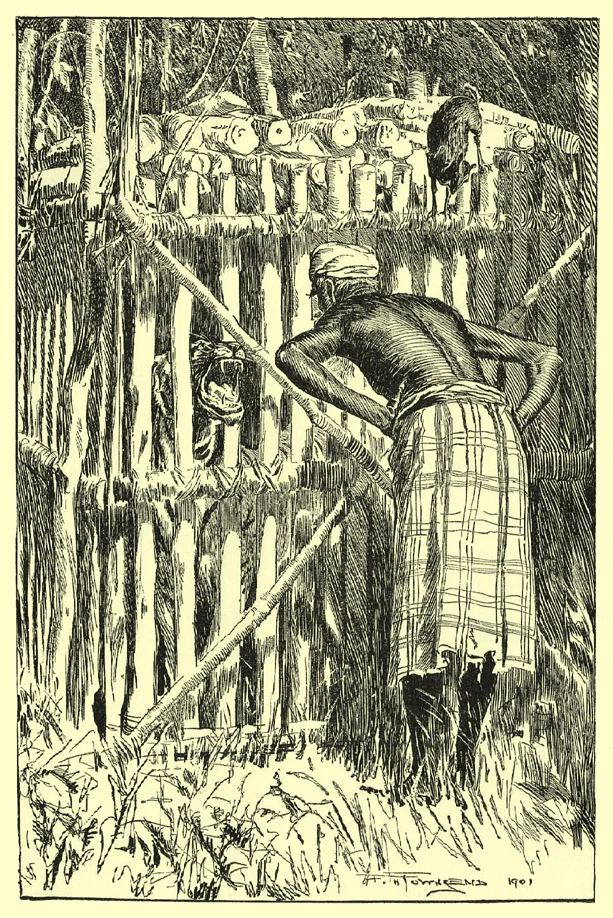
Townsend’s mouse-deer above a wooden trap holding the tiger while a man stands outside
The mouse-deer appears above the trap as the tiger is confined again. The man standing outside belongs to this reenactment of the release; the tale identifies the mouse-deer as the judge who shuts the door. No binding spell is shown or claimed.
Overview
A man frees a trapped tiger after obtaining a promise of safety, but the tiger immediately seizes him. They consult a road and a tree, both of which complain that humans repay their service with damage. The mouse-deer asks to examine the case at the original trap and gets the tiger to enter it. It shuts the door, condemns the broken promise and calls neighbours who kill the tiger. The ending is an actual killing in the tale, not merely a suggested punishment. The road and tree speak without a described resident spirit, and the judge is not said to cast a binding spell.
Origins & earliest records
Malay Peninsula; Ulu Kedah, Siong
Records & interpretation
Complete relevant tale and attached scholarly notes directly read.
Selected bibliography
Documented works and useful reading. This is not a list of every appearance.
- 01
Fables & Folk-Tales from an Eastern Forest
VIII, The Tiger gets his Deserts, pp. 20–21; note p. 78
- 02
Fables & Folk-Tales from an Eastern Forest — VIII The Tiger Gets His Deserts
Fables & Folk-Tales from an Eastern Forest, collected and translated Walter Skeat, Cambridge: University Press,1901. Original title leaf13 visually checked; selected complete tales and all accompanying notes read from historical transcription. Introduction states1899 Cambridge expedition collection and limitation of phraseology, not verbatim unedited speech. Original quoted folios visually checked in Archive fablesfolktalesf00skearich; IIIF canvas positions omit initial leaves, so exact original leaf number matched from image identifier, not array index.
Family & connections
A source-supported family tree or inspiration record has not yet been compiled for this profile. Related reading below indicates a connection in subject matter, not a proven lineage or creative influence.
Primary records and illustrations
Walter Skeat, Fables & Folk-Tales from an Eastern Forest (Cambridge: University Press, 1901)
VIII, The Tiger gets his Deserts. VIII, The Tiger gets his Deserts, pp. 20–21; note p. 78
Complete tale and associated notes directly read. Regional spellings and differing accounts retained; commentary does not establish present-day practice or biological facts. Individual teller not named here.
Located primary passages
Specific passages supporting details in this entry, grouped by their published witness.
Fables & Folk-Tales from an Eastern Forest
Fables & Folk-Tales from an Eastern Forest, collected and translated Walter Skeat, Cambridge: University Press,1901. Original title leaf13 visually checked; selected complete tales and all accompanying notes read from historical transcription. Introduction states1899 Cambridge expedition collection and limitation of phraseology, not verbatim unedited speech. Original quoted folios visually checked in Archive fablesfolktalesf00skearich; IIIF canvas positions omit initial leaves, so exact original leaf number matched from image identifier, not array index. These four tales’ host page labels have not been individually scan-collated; original title and other selected folios checked separately.
- A trapped tiger promises not to attack the man who releases it, then immediately seizes him. The man secures a pause to investigate their agreement’s justice. A road and tree answer that people repay their services with damage. The mouse-deer insists on reconstructing the circumstances at the trap. It invites the tiger back inside, shuts the door and condemns its ingratitude. It then summons neighbours, who kill the tiger. Skeat locates the collection at Siong in Ulu Kedah and records Wilkinson’s comparison with Hikayat Gul Bakhtiyar.
VIII The Tiger Gets His Deserts, complete hosted printed-page labels 20–21; note78
CompleteVIII20–21 and note78 read. Final killing follows recapture, not mere indefinite imprisonment. Speaking road/tree are contextual participants, not independent natural-species descriptions. Hikayat comparison reported through Wilkinson, not independently read. Neither Solomon nor a formal universal animal court appears in this tale.
References
Sources supporting this profile. Linked pages have their own scope and editorial standards.
- Historical collected narrative with locality and editorial notesSkeat, Fables & Folk-Tales (Cambridge University Press, 1901), VIII, The Tiger gets his Deserts, pp. 20–21; note p. 78Research access: 2026-10-05
Image credits
Historical illustrationTownsend’s mouse-deer above a wooden trap holding the tiger while a man stands outside
The mouse-deer appears above the trap as the tiger is confined again. The man standing outside belongs to this reenactment of the release; the tale identifies the mouse-deer as the judge who shuts the door. No binding spell is shown or claimed.