
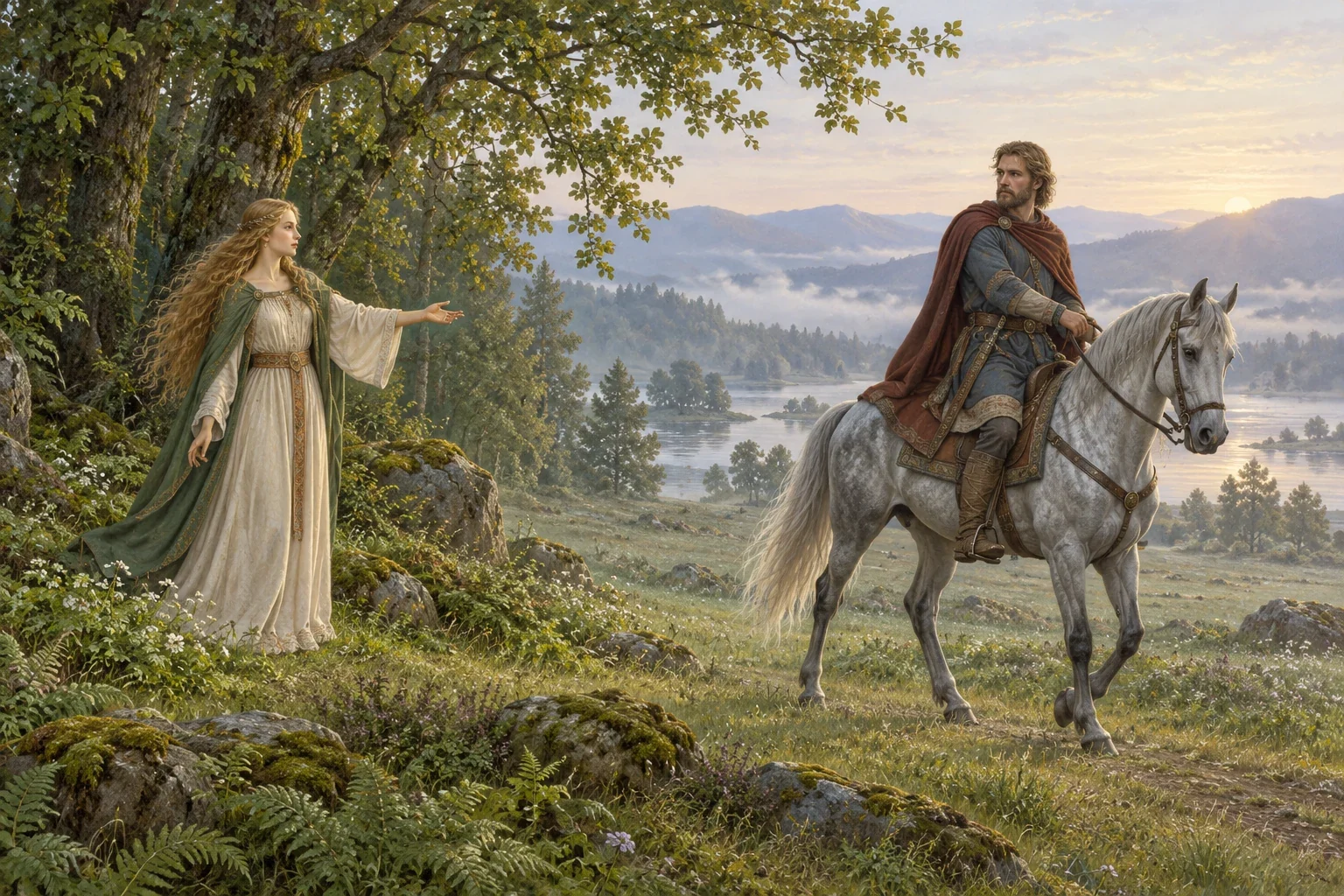
AI-generated interpretation of the second Sir Olof ballad: the Elve-king’s daughter extends her hand while the rider turns away. Flowing hair, invitation, horse and leafy setting follow that version; faces, dress, horse colour and exact landscape are imagined. This does not combine the first ballad’s elf family or funeral ending into the depicted meeting.
AI-generated interpretation of the second Sir Olof ballad: the Elve-king’s daughter extends her hand while the rider turns away. Flowing hair, invitation, horse and leafy setting follow that version; faces, dress, horse colour and exact landscape are imagined. This does not combine the first ballad’s elf family or funeral ending into the depicted meeting.
Overview
Keightley prints two Sir Olof ballads together in his discussion of elves. They share a meeting with a supernatural dance company before the man’s wedding, but they do not supply identical events or endings. His notes place one Swedish witness in Upland and East Gothland and identify the other with a manuscript in the Royal Library. He connects both with the Danish ballad Elveskud and mentions a further Swedish variation without printing it here. The present account preserves the two inspected versions together, without counting each family member or alternate stanza as a separate being.
In Sir Olof in the Elve-Dance, Olof rides out early and encounters the dance. An Elve-father extends a white hand and invites him to join. Olof refuses because the next day is his wedding day. The Elve-mother and Elve-sister repeat the invitation, and each receives the same answer. This sequence gives the company a family structure, but does not establish that every elf gathering has those three offices. Nor does the ballad describe a weapon, a blow or an explicit death-producing spell during the meeting.
The narrative then moves to the bride and her companions. She asks why the bells are ringing. A reassuring explanation about the island’s wedding custom gives way to the announcement that Olof lies dead. By the next morning his house contains three bodies: Olof, his bride and his mother. The mother’s death is explicitly linked to sorrow. The poem does not give equally detailed causes for each death or describe the intervening events. Its abrupt transition from refused invitation to funeral makes the danger clear while leaving the mechanism unstated.
The Elf-woman and Sir Olof gives the threatening speaker a more specific position. At a dance near Borgya, the Elve-king’s daughter, with flowing hair, reaches out her hand. Olof declines, invoking both his bride’s prohibition and the approaching wedding. She threatens an evil consequence if he will not dance. As he turns his horse away, sickness and plague follow him home in the ballad’s own language. Asked by his mother why he looks pale, he instead says that he struck an oak while riding. The account thus gives his family an explanation different from the supernatural meeting the audience has just heard.
Olof asks his sister to prepare his bed, his brother to take his horse to pasture, his mother to brush his hair and his father to make his bier. His mother protests that tomorrow is his wedding day, but he answers that he will never reach his bride. This version ends with that declaration. The three-body conclusion belongs to the preceding ballad and should not be silently appended to it. The repeated refrains, seasonal landscape and family exchanges are part of Keightley’s translated ballad form, while the selected text does not fix pointed ears, wings, stature, dress or a zoological species for the company.
Origins & earliest records
Thomas Keightley, The Fairy Mythology, George Bell & Sons,1892: Sir Olof in the Elve-Dance and The Elf-woman and Sir Olof, pp82–86; immediate framing and notes136–138.
Records & interpretation
Both complete printed ballads, endings and attached notes read. Svenska Visor and the named Royal Library manuscript are attributions through Keightley, not independently collated witnesses.
Selected bibliography
Documented works and useful reading. This is not a list of every appearance.
- 01
Keightley1892 pp82–86, both SirOlof ballads and notes136–138
Complete selected historical English unit and attached notes; upstream witnesses not independently collated.
Family & connections
A source-supported family tree or inspiration record has not yet been compiled for this profile. Related reading below indicates a connection in subject matter, not a proven lineage or creative influence.
References
Sources supporting this profile. Linked pages have their own scope and editorial standards.
- Historical English literary compilationKeightley1892 pp82–86, both SirOlof ballads and notes136–138Research access: 2026-10-27
Image credits
AI-generated illustrationAI-generated interpretation of the second Sir Olof ballad: the Elve-king’s daughter extends her hand while the rider turns away. Flowing hair, invitation, horse and leafy setting follow that version; faces, dress, horse colour and exact landscape are imagined. This does not combine the first ballad’s elf family or funeral ending into the depicted meeting.
AI-generated interpretation of the second Sir Olof ballad: the Elve-king’s daughter extends her hand while the rider turns away. Flowing hair, invitation, horse and leafy setting follow that version; faces, dress, horse colour and exact landscape are imagined. This does not combine the first ballad’s elf family or funeral ending into the depicted meeting.