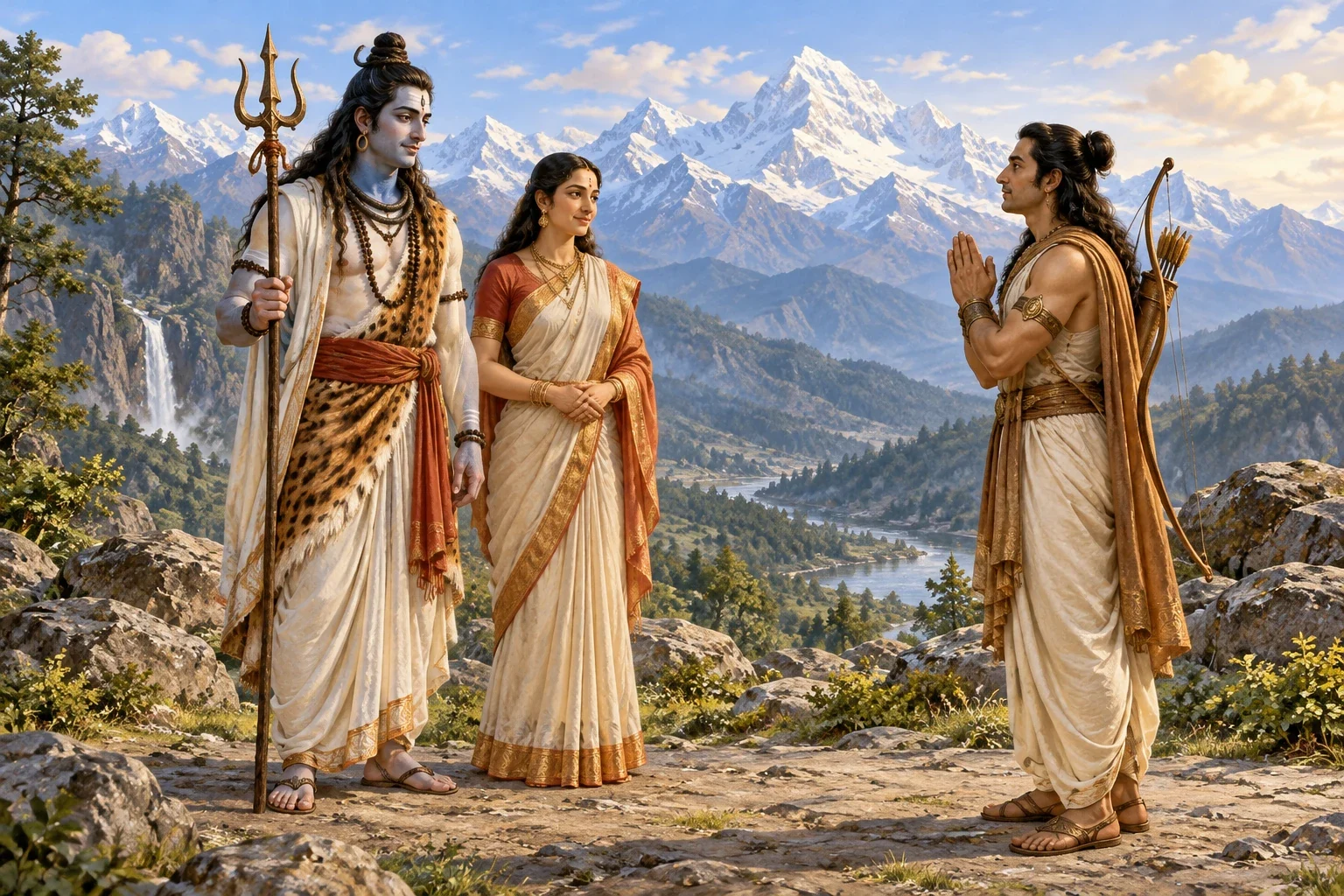
AI-generated interpretation of the selected recognition scene; undescribed visible details are imagined.
Faces, robes, two-arm presentation, jewellery, skin colour beyond the attested blue throat, animal-patterned clothing, poses and scenery are imagined. Not an authenticated sacred icon or a reconstruction of a contemporary Kirata community. Full frame retained; WebP compression only.
Overview
In the selected Mahabharata encounter, Shiva descends upon Himavat in the form of a Kirata, accompanied by Uma in a corresponding guise and a varied company of attendants. The narrative introduces him through divine titles, including Hara and Sankara, while Arjuna initially treats him as another hunter. A threatening being named Muka approaches in a boar’s form. Arjuna and the disguised deity strike it simultaneously, after which each claims priority over the quarry. Their dispute turns the hunt into a confrontation between the warrior and the god he does not yet recognize.
Arjuna’s arrows fail to wound the stranger, and his apparent enemy remains cheerful under the attack. When the arrows are exhausted, the warrior tries his bow, sword, trees, stones and finally his own strength. The deity takes the bow from him, withstands the blows and overcomes him in their physical struggle. The episode does not present this as an ordinary hunter’s victory. Arjuna himself begins to suspect a divine opponent before the combat ends, wondering who could endure the force of his weapons.
After recovering consciousness, Arjuna makes and worships a clay image of the deity. He sees the offered garland adorning the Kirata instead, recognizes the encounter’s significance and prostrates himself. The god praises his courage and endurance and grants him the ability to perceive his revealed form beside Uma. Arjuna’s prayer addresses the same figure as Mahadeva, Siva and Rudra, with a blue throat, matted hair and a forehead eye. These names and features belong to this sacred passage; they are not a catalogue of every regional representation or a licence to merge different religious accounts.
Shiva forgives the warrior and identifies Arjuna as Nara in a former life. Arjuna requests a formidable divine weapon, and the god grants the weapon called Pasuputa in this transcription, teaching both its release and withdrawal. The gift carries a warning: using it without adequate cause against a weak opponent could destroy the universe. The deity’s role therefore includes restraint and instruction as well as overwhelming strength. He restores the Gandiva bow, directs Arjuna toward heaven and departs with Uma. This profile follows that complete encounter rather than turning it into a comprehensive biography of Shiva or a genealogy for a later game character.
Origins & earliest records
Mahabharata, Vana Parva, sections XXXIX–XL, in Kisari Mohan Ganguli’s historical English translation. The encounter is a source-specific sacred narrative concerning Shiva, not a generic creature account or an assertion of uniform present-day Hindu practice.
Records & interpretation
Complete continuous sections XXXIX and XL inspected from the deity’s Kirata appearance and Muka’s attack through recognition, forgiveness, weapon instruction, restoration of Gandiva and departure with Uma. Arjuna explicitly addresses the revealed figure as Siva, Mahadeva and Rudra in XXXIX.
Selected bibliography
Documented works and useful reading. This is not a list of every appearance.
- 01
Mahabharata, Vana Parva, sections XXXIX–XL
Complete selected encounter, historical translation. Names and the hosted Pasuputa spelling retained; no independent Sanskrit critical collation claimed.
Family, evolution & connections
Shiva (Final Fantasy)
Ganguli’s selected sacred narrative describes Siva, also addressed as Mahadeva and Rudra, meeting Arjuna in a Kirata guise and granting a weapon with a warning. The Shiva name permits comparison with the separately catalogued fictional subject. The religious figure and fictional identity remain distinct; no specific creator source is established.
References
Sources supporting this profile. Linked pages have their own scope and editorial standards.
- Historical primary sacred-text translationGanguli: Vana Parva XXXIX, Kirata encounter and recognitionResearch access: 2026-10-24
- Historical primary sacred-text translationGanguli: Vana Parva XL, weapon instruction and departureResearch access: 2026-10-24
Image credits
AI-generated sacred-narrative interpretationAI-generated interpretation of the selected recognition scene; undescribed visible details are imagined.
Faces, robes, two-arm presentation, jewellery, skin colour beyond the attested blue throat, animal-patterned clothing, poses and scenery are imagined. Not an authenticated sacred icon or a reconstruction of a contemporary Kirata community. Full frame retained; WebP compression only.