
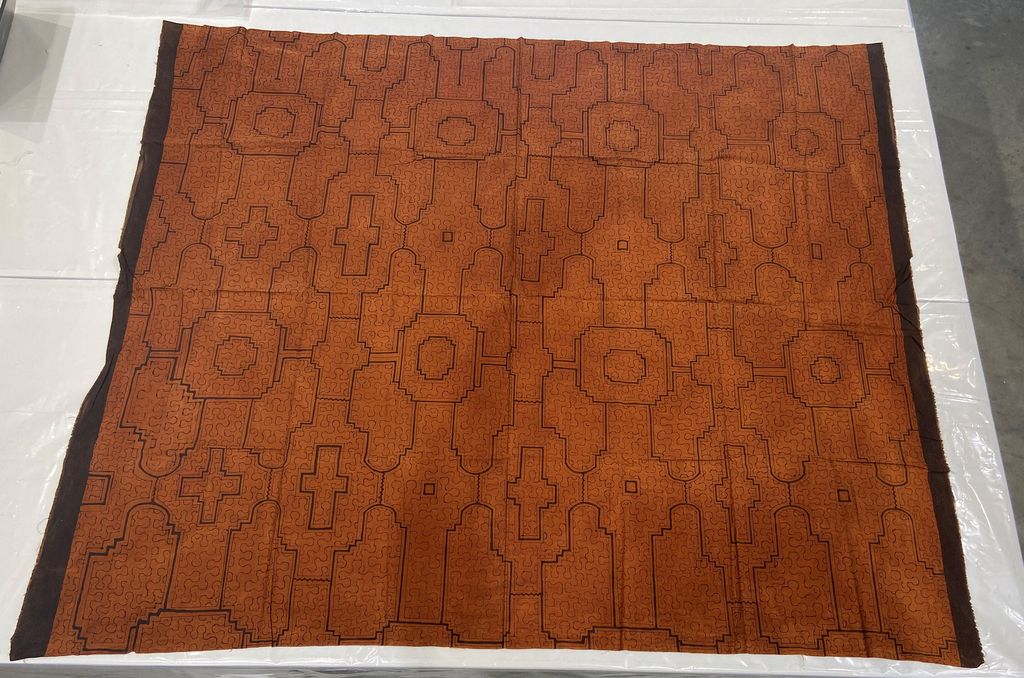
Twentieth-century Shipibo-Conibo textile with dark geometric lines on a reddish-brown ground, Princeton University Art Museum TC2022.65.3
This twentieth-century textile is catalogued by Princeton University Art Museum as Shipibo-Conibo. Its geometric pattern is shown as a particular cultural object, rather than a portrait of the community or a universal design. The museum records its dimensions as 144.5 by 171.4 centimetres; an individual maker is not named.
Overview
The Shipibo-Konibo are a living Indigenous people of Peru, with communities along the Ucayali and its tributaries as well as settlements elsewhere, including Lima. Peru’s Indigenous-peoples database identifies communities in Ucayali, Loreto, Madre de Dios and Huánuco, and highlights Cantagallo as an important urban settlement. Its language entry places Shipibo-Konibo within the Pano family. Language affiliation describes a linguistic relationship, not biological descent or a uniform measure of individual identity.
The database’s 2018 language classification distinguishes regional varieties named shipibo, konibo, shetebo and piskibo. Its account also recognizes the importance of kené design, whose national cultural-heritage designation dates to 2008. These institutional classifications provide documentation of language and artistic recognition; they do not make every community’s practice identical. Riverine and urban experiences both belong in an account of the living people rather than assigning modern city residents to a supposedly less authentic category.
COSHIKOX describes itself as an elected representative council of the Shipibo-Konibo-Xetebo nation. Its statement connects territorial self-government with environmental care and collective cultural knowledge. It presents autonomy as compatible with technology, productivity and innovation, as well as the renewal of ancestral knowledge. This is an organization’s account of its commitments and political project; the statement alone does not establish that every territorial aspiration has been legally realized or that all local voices are identical.
Shipibo Joi’s Non Jói project description records a language initiative led by the Shipibo-Konibo Language Empowerment Committee. Members began a proposal in 2014 to revise the 1993 Shipibo–Spanish dictionary, reassessing its content and developing a multilingual interactive resource. The emphasis is on a language actively used and interpreted by its speakers. The page describes an ongoing project, so it should not be read as proof of a completed dictionary or an evaluation of all its entries.
Individual artistic authorship is visible in Chonon Bensho’s Jone Jonibo exhibition, presented by Museo Central in 2024 under Giuliana Vidarte’s curatorship. The museum describes drawings, paintings, embroidery and sculpture created between 2018 and 2024, relating family knowledge to contemporary ecological concerns. It also identifies Inin Niwe y el mundo puro de los seres eternos as a poetic novel by Pedro Favaron with Bensho’s illustrations. This is an attributed artistic and literary interpretation, not a universal statement of what every Shipibo-Konibo person believes.
History & identity
Selected official identity documentation, community organization and language-project statements, and a named museum curator’s account.
Sources & representation
BDPI introduction and complete selected language sections; complete COSHIKOX statement, Non Jói body and Vidarte exhibition essay. No linked dictionary, novel, catalogue PDF, films or audio reviewed.
Selected bibliography
Documented works and useful reading. This is not a list of every appearance.
- 01
Jone Jonibo: Los seres espirituales de Chonon Bensho
Complete museum web essay; catalogue PDF not read.
Language & cultural connections
Source-supported language and cultural connections have not yet been compiled for this profile.
References
Sources supporting this profile. Linked pages have their own scope and editorial standards.
- Community or institutional primary sourceBDPI Shipibo-KoniboResearch access: 2026-10-05
- Community or institutional primary sourceCOSHIKOX self-descriptionResearch access: 2026-10-05
- Community or institutional primary sourceNon Jói projectResearch access: 2026-10-05
- Community or institutional primary sourceMuseo Central exhibitionResearch access: 2026-10-05
Image credits
Contextual cultural textile photographTwentieth-century Shipibo-Conibo textile with dark geometric lines on a reddish-brown ground, Princeton University Art Museum TC2022.65.3
This twentieth-century textile is catalogued by Princeton University Art Museum as Shipibo-Conibo. Its geometric pattern is shown as a particular cultural object, rather than a portrait of the community or a universal design. The museum records its dimensions as 144.5 by 171.4 centimetres; an individual maker is not named.