
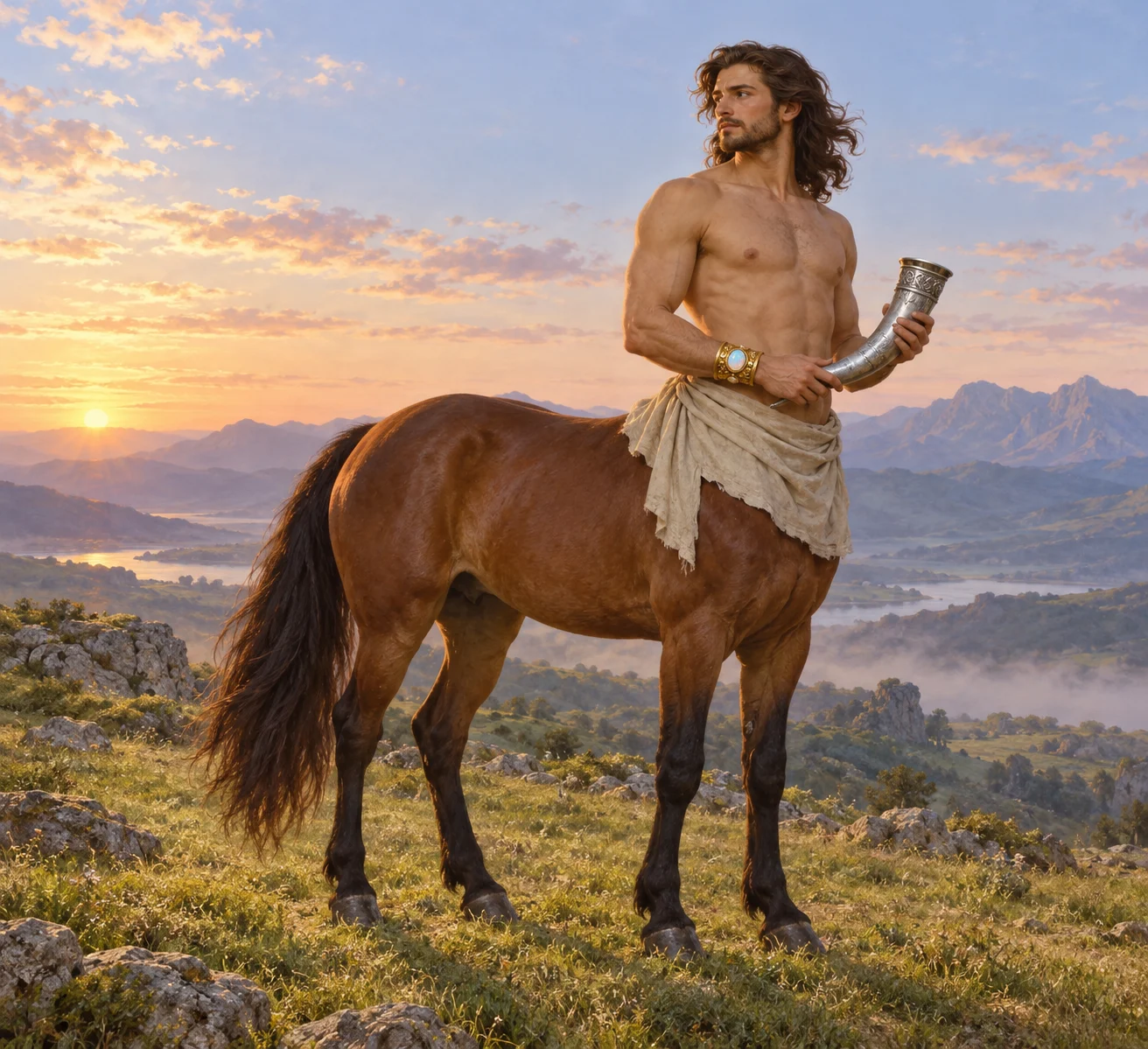
An imagined complete centaur with an opal-set gold wrist amulet and silver horn.
Overview
Shepperalk leaves his mother’s mountain cavern in the morning of his two hundred and fiftieth year. He puts on the wrist amulet that his father Jyshak fashioned from mountain gold and set with opals obtained from gnomes, then takes the centaurs’ silver horn. The horn carries a history of sieges and of an unsuccessful war against the gods, but his own departure is driven by desire and exhilarating movement rather than an announced military campaign. Calling himself a man-horse, he gallops out of the Athraminaurian mountains toward Zretazoola, where Sombelenë lives. The narrator admits uncertainty about how rumours of her beauty reached him. His journey across rivers, kingdoms and cities becomes a sustained celebration of swiftness: children recognize his joy while adults fear that the old centaur wars may return.
At night Shepperalk rests in marsh reeds or forest, then drinks from rivers and greets the sunrise with his horn. Near Zretazoola he passes back into legendary country and approaches the temple beside the lake, opposite Sombelenë’s prepared tomb. Her divine ancestry and extraordinary beauty do not make her immortal. He enters the city, plunges through the water and rushes up the temple steps with his eyes half shut. Seizing her by the hair, he carries her over the chasm where the lake drains out of the world; their destination remains unknown. The narrator then describes him as becoming her slave for the centuries allotted to his race, and makes three blasts of the inherited horn their wedding bells. The abrupt reversal does not erase the force of the abduction or establish a consensual courtship. This is Dunsany’s individual literary centaur, not a uniform account of every centaur tradition.
First appearances & development
Lord Dunsany’s authored English fantasy in The Book of Wonder. The retained title and complete selected tale establish authorship and narrative scope; the consulted electronic body does not identify its exact historical print edition.
Canon & continuity
The complete eighteen-paragraph tale establishes the departure, journey, abduction, unknown destination and final declaration of service. The narrative’s references to songs and legend form part of its fiction, rather than documenting an independent collected tradition.
Selected bibliography
Documented works and useful reading. This is not a list of every appearance.
- 01
Family & connections
A source-supported family tree or inspiration record has not yet been compiled for this profile. Related reading below indicates a connection in subject matter, not a proven lineage or creative influence.
References
Sources supporting this profile. Linked pages have their own scope and editorial standards.
- Primary historical authored fictionThe Book of Wonder — complete selected tale and framingResearch access: 2026-10-18
- Bibliographic search evidence onlyNational Library of Ireland catalogue search witness; direct record access heldResearch access: 2026-10-18
Image credits
AI-generatedAn imagined complete centaur with an opal-set gold wrist amulet and silver horn.