
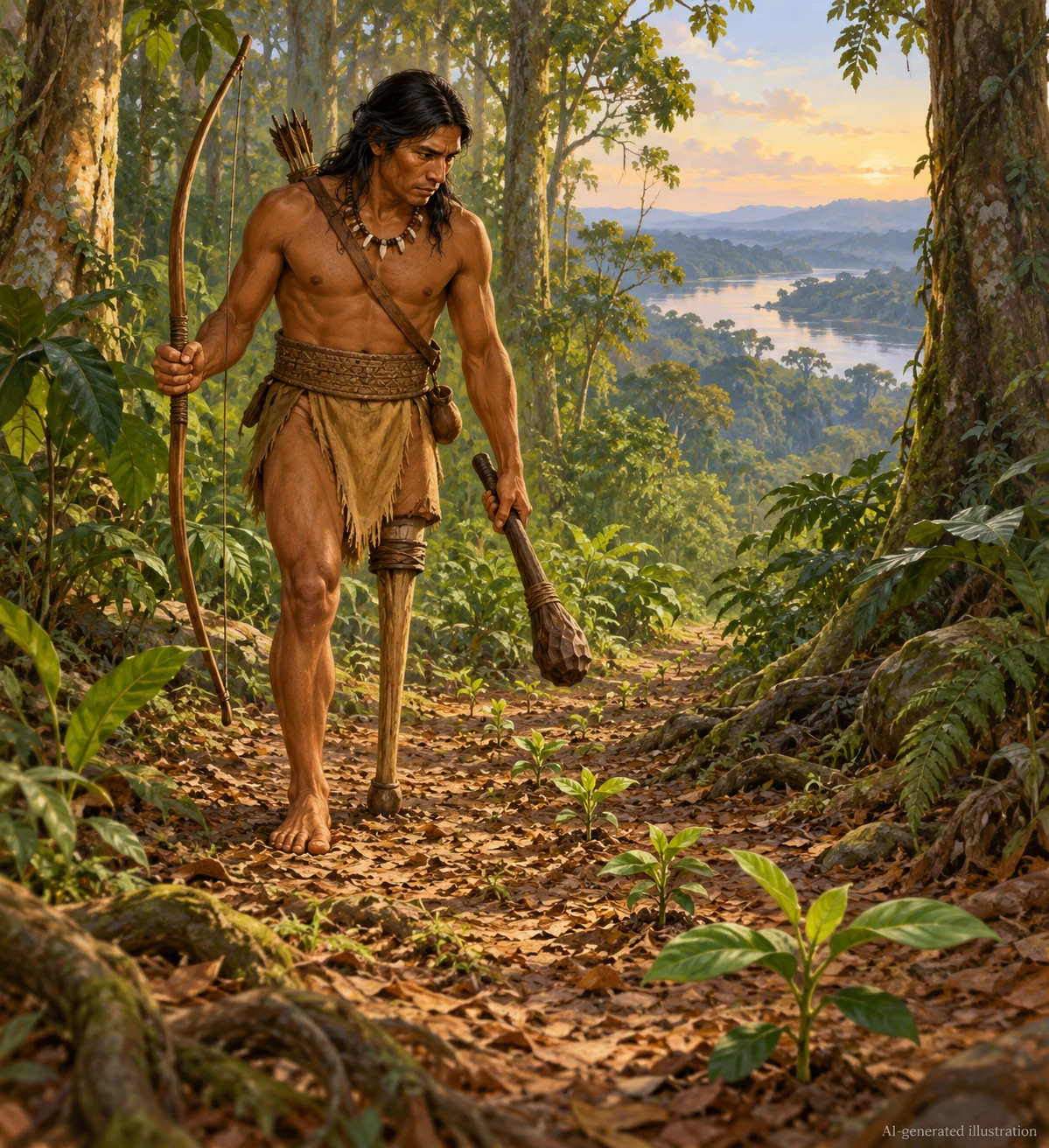
An imagined Serikoai follows avocado seedlings with a bow, club and wooden support beside his surviving leg.
Serikoai — an imagined scene from Brett’s historical verse retelling. Human appearance, garments and setting are explicitly imagined narrative choices, not authenticated anatomy, costume or ethnographic reconstruction.
Overview
In Brett’s complete verse narrative, Serikoai is Wawaiya’s husband. During his hunting absences she meets Wailya, an enchanter appearing as a young tapir, who promises a home in human form where earth meets sky. Wailya charms her axe. Serikoai dismisses the threatening sound she hears while sharpening it, and later, while he climbs an avocado tree, she strikes off his leg and leaves with the tapir. The poem’s judgments about wives and fidelity are part of Brett’s literary telling; they do not establish a general Indigenous moral doctrine.
A kindly spirit revives the abandoned hunter. He plucks an eyelash bearing a tear and blows it into a small brightly coloured bird. Its first attempt to summon his mother fails because it can only call his name; after returning to him it learns the fuller message, and the mother comes through the forest. Spirit-assisted balsams and her care save him. Once recovered, he travels with a wooden prop supporting the missing limb, carrying a bow and club. Rain has removed the fugitives’ footprints, but he recognizes avocado seedlings grown from fruit his wife ate and follows their line.
When their tracks become visible again, Serikoai shoots Wailya before the enchanter changes form and cuts off his head. The dead tapir’s shadow nevertheless continues after Wawaiya. She flees across a gulf at the earth’s edge into the sky; lover and husband follow, continuing the pursuit. Brett’s notes identify Wawaiya as the Pleiades, the tapir’s head as the Hyades with Aldebaran its red eye, and Serikoai as Orion. His shoulders, belt and sound limb shine clearly while the wooden support is fainter; Rigel marks the upper part of the surviving leg. These are this witness’s constellation glosses, not an imposed equivalence for every Guianan star tradition.
Origins & earliest records
Brett’s 1880 publication preserves the complete five-part Legend of Serikoai on pages191–200, introduced by a note on divergent constellation interpretations. The publication date is a witness date, not the origin of the narrative.
Records & interpretation
Complete original English verse episode, all five movements and astronomical endnotes read continuously. Brett’s preface says he adopted metrical form; this is an edited missionary-era English retelling, not a verbatim transcript. No secure named narrator or specific community is supplied for this story. Existing Wailya profile concerns the separate tapir-shaped adversary.
Selected bibliography
Documented works and useful reading. This is not a list of every appearance.
- 01
Legends and Myths of the Aboriginal Indians of British Guiana
Complete Legend of Serikoai, pp191–200, with introduction and notes pp190,199–200; complete preface.
Family & connections
A source-supported family tree or inspiration record has not yet been compiled for this profile. Related reading below indicates a connection in subject matter, not a proven lineage or creative influence.
References
Sources supporting this profile. Linked pages have their own scope and editorial standards.
- Primary historical literary witnessBrett1880: complete Serikoai narrative and astronomical notesResearch access: 2026-10-17
Image credits
Original literary interpretation; human appearance, garments and setting are imagined rather than authenticated ethnographic reconstruction.An imagined Serikoai follows avocado seedlings with a bow, club and wooden support beside his surviving leg.
Serikoai — an imagined scene from Brett’s historical verse retelling. Human appearance, garments and setting are explicitly imagined narrative choices, not authenticated anatomy, costume or ethnographic reconstruction.