
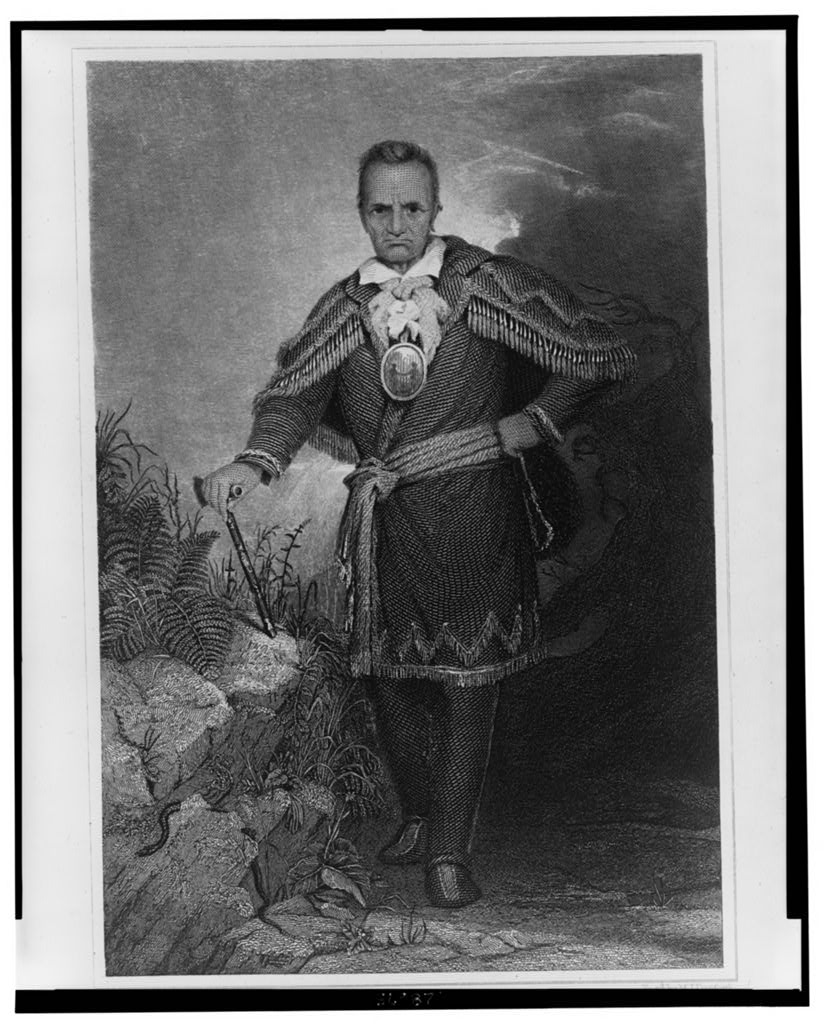
Historical engraved full-length portrait of Seneca leader Red Jacket, wearing a fringed coat and medal and holding a tomahawk beside rocks; black-and-white reproduction.
Red Jacket in an engraving by M. J. Danforth after Robert Walter Weir, published between1830 and1880. This historical portrait represents one Seneca leader through the artists’ interpretation, not the appearance of present-day citizens.
Overview
The Seneca Nation’s historical account connects Seneca life with the Finger Lakes and Genesee Valley and identifies Allegany, Cattaraugus and Oil Spring as its western New York territories. It explains the name Great Hill People and the Seneca position as Keeper of the Western Door within the Six Nations. Agriculture, fishing, hunting, diplomacy and oratory appear together in that account. This profile concerns the particular nation and institutions represented by these sources; it does not make its government interchangeable with every Seneca community or with the wider Haudenosaunee Confederacy.
Its language services comprise several approaches rather than a single uniform course. The Allegany teacher-support programme connects community access with professional development, certification support and resources for learners both on and off territory. Cattaraugus emphasizes interaction across generations and practical speaking ability. The immersion programme specifies a limited range of conversational situations and distinguishes understanding everyday actions from mastering their expression. These are stated educational aims, not measurements of every participant’s proficiency. The FaithKeepers Montessori language nest provides another named setting, combining childhood learning with Seneca teachings. The department’s quoted 2001 vision remains a historical aspiration rather than evidence that universal daily use has already been achieved.
The Seneca-Iroquois National Museum and Seneca Nation Archives preserve documents, publications, family photographs and other historical materials alongside collections of made objects. Their home, the Onöhsagwë:de’ Cultural Center, honors language and culture teacher Richard Johnny-John through a name connected with his nickname and the idea of a house opening. The museum presents Seneca culture through historical and contemporary work, with a wider Iroquois scope explicitly acknowledged. Its public institutional account establishes that mission; it does not give this profile access to the underlying family records, collections or ceremonial knowledge.
An account by Creatives Rebuild New York documents a particular arts collaboration with the Stanley “Sully” Huff Heritage Center on Cattaraugus Territory. It names Mary Jacobs, Samantha Jacobs, Peter Jones and Darelyn Spruce. Mary and Samantha taught beadwork in educational and community settings, including graduation outfits, while the account describes some participants marketing their work. It also identifies the Catt Rez Beaders, an elder women’s group meeting for shared making. These examples locate cultural transmission in specific teachers, institutions and participants. They are reported activities of that collaboration, not proof that every Seneca person follows the same artistic practice or earns income from it.
History & identity
Nation and institution self-descriptions, supplemented by a named arts-programme collaboration account.
Sources & representation
Complete selected history, language-programme, museum About and arts-collaboration written bodies read; linked records, media and classes not inspected.
Selected bibliography
Documented works and useful reading. This is not a list of every appearance.
- 01
Seneca Nation: History
Community history
Language & cultural connections
These connections link languages or specific cultural works and institutions; they do not establish biological ancestry or ethnic identity.
Seneca-Iroquois National Museum
The museum and Seneca Nation Archives Department preserve historical documents and cultural collections.
References
Sources supporting this profile. Linked pages have their own scope and editorial standards.
- Community educationSeneca Language DepartmentsResearch access: 2026-10-06
- Community museumOnöhsagwë:de’ Cultural Center: AboutResearch access: 2026-10-06
- Programme collaboration accountSeneca Nation of Indians – Stanley “Sully” Huff Heritage CenterResearch access: 2026-10-06
Image credits
Historical engraved portrait of a named individual, reproduced from a film copy negativeHistorical engraved full-length portrait of Seneca leader Red Jacket, wearing a fringed coat and medal and holding a tomahawk beside rocks; black-and-white reproduction.
Red Jacket in an engraving by M. J. Danforth after Robert Walter Weir, published between1830 and1880. This historical portrait represents one Seneca leader through the artists’ interpretation, not the appearance of present-day citizens.