
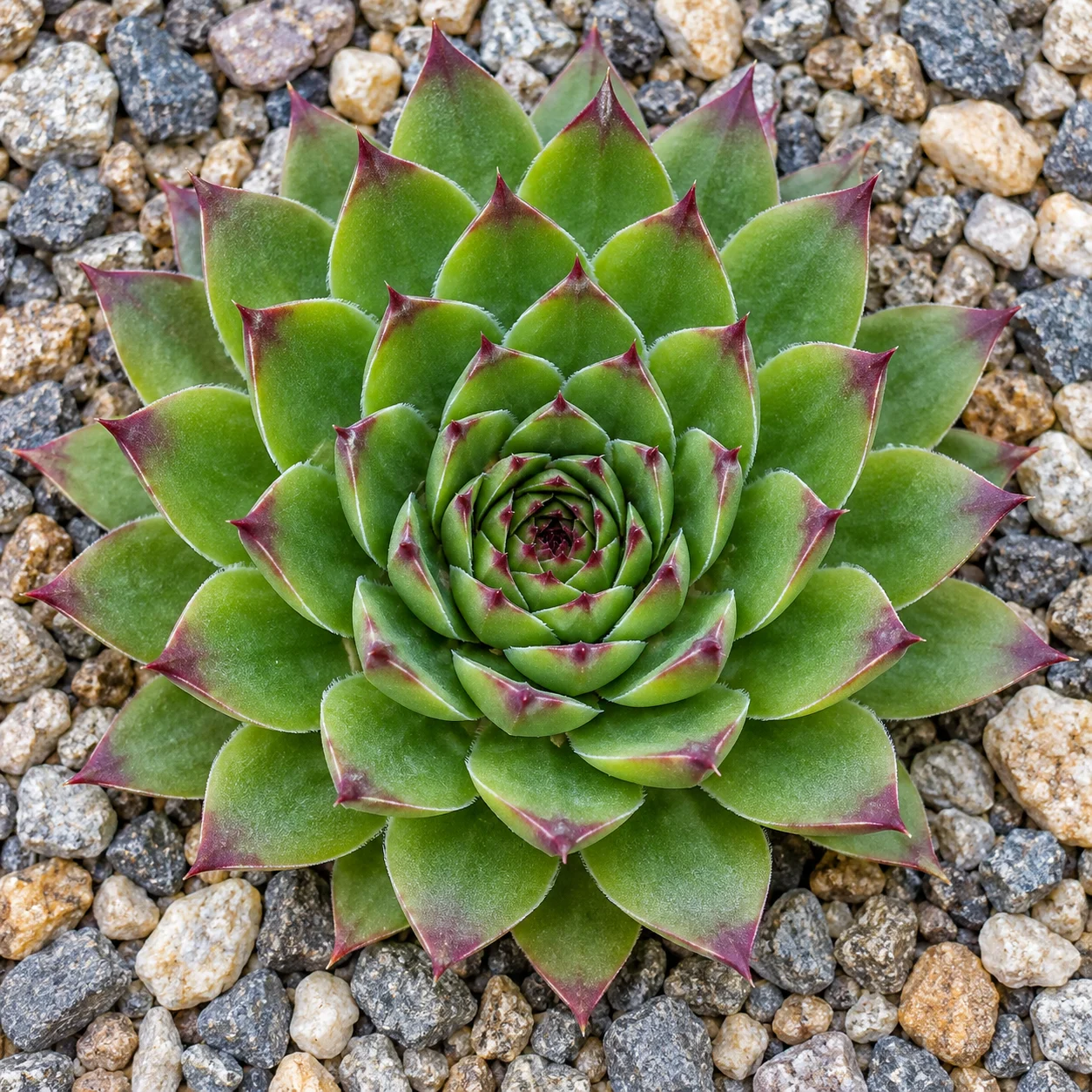
AI-generated vegetative rosette study.
Interpretation; not an exact specimen.
Overview
Common houseleek is a perennial succulent from the mountains of southern Europe. Thick, fleshy, pointed leaves form compact rosettes, sometimes with purple tips. A larger parent rosette produces smaller offsets, creating spreading colonies. These interconnected generations account for the familiar gardening name, hens and chicks.
Flowering changes the parent rosette’s fate: thick stalks carry star-shaped flowers above the foliage, and that rosette dies after blooming. The offsets continue the colony. In cultivation, houseleeks favour sharply drained, sandy or gravelly soils and tolerate some drought. They are often planted in rock crevices, walls and containers.
Origins & earliest records
Mountain habitats
Evidence & interpretation
Published account.
Selected bibliography
Documented works and useful reading. This is not a list of every appearance.
- 01
Family & connections
A source-supported family tree or inspiration record has not yet been compiled for this profile. Related reading below indicates a connection in subject matter, not a proven lineage or creative influence.
Look for a taxonomic record and classified relativesReferences
Sources supporting this profile. Linked pages have their own scope and editorial standards.
- Institutional accountSempervivum tectorumResearch access: 2026-10-18
Image credits
AI-generated illustrationAI-generated vegetative rosette study.
Interpretation; not an exact specimen.