
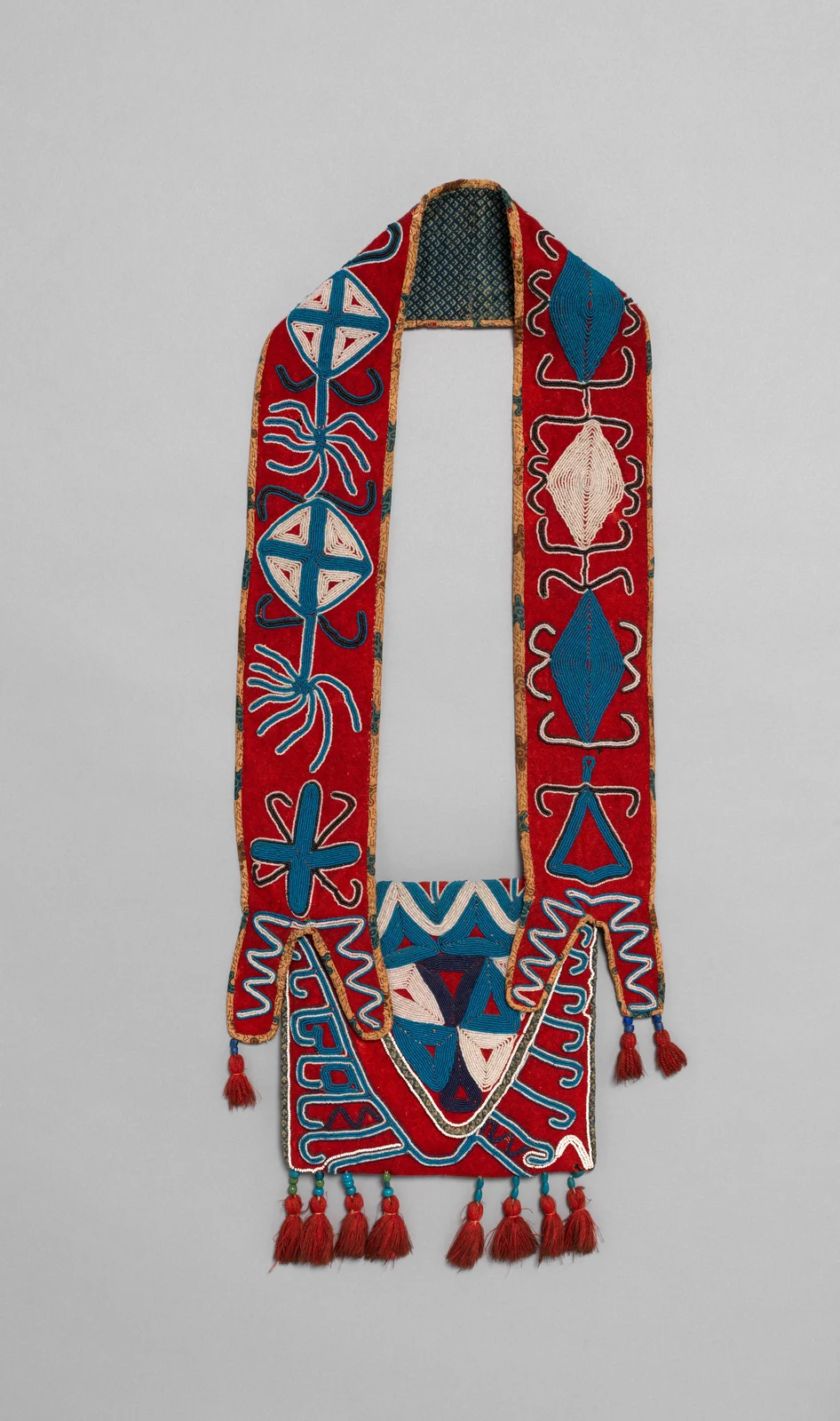
Red shoulder bag with a broad asymmetrically patterned strap, blue and white beadwork and red tassels; Seminole, Florida, circa1830.
Seminole shoulder bag made in Florida, circa1830. Wool and cotton cloth, wool yarn, glass beads and silk ribbon. This historical object predates the contemporary Seminole Tribe of Florida government and does not depict its present membership.
Overview
The Seminole Tribe of Florida presents its history as one of survival, adaptation and continued self-government. Its introductory account describes people gathering across what became Florida, Georgia and Alabama, resisting removal and maintaining communities in Florida under leaders including Abiaka. Later encounters with settlers and travelers involved trade, crafts and changing livelihoods. This is the Tribe's own historical framing; its modern political organization should not be mistaken for the beginning of the people or their relationships to the region.
The Tribe's Department of Anthropology and Genealogy explicitly distinguishes the political entity created in 1957 from the broader cultural history. Its language discussion names Maskókî and Mikisúkî, rather than a single language simply called Seminole. Language use is therefore not a sufficient definition of political citizenship. This entry concerns the Florida tribal institution and its documented activities, without treating every community associated with Seminole history as one government.
The Ah-Tah-Thi-Ki Museum at Big Cypress opened on 21 August 1997 after planning that began in 1989. Its institutional history identifies Billy L. Cypress, a tribal member, as a formative executive director. The museum brings preservation and public interpretation together through collections, exhibits and educational surroundings. Its description of boardwalk signs in English, Mikasuki and Creek is a concrete example of multilingual interpretation; the historical museum page does not establish the condition of every sign today.
The collections program includes newspapers, manuscripts, clothing, baskets and other materials. It gives the Seminole community special archival access and describes interviewing both tribal members and members of the wider public. Recordings are preserved for appropriate audiences, while only portions of the collections are available online. Those distinctions matter: a museum catalogue is not permission to circulate every account, and an interview collection need not contain only community members' voices.
Authored journalism also forms part of this record. In the April 2017 Seminole Tribune, museum research coordinator Mary Beth Rosebrough reflects on Betty Mae Jumper's columns while cataloguing earlier issues. She describes writing about family, road safety, responsibility and community loss. Her article identifies the columns as Jumper's individual public voice, situated within a newspaper also reporting ordinary community events. The selected retrospective article was read; it does not substitute for reading all of Jumper's original columns or her books.
History & identity
The Tribe’s historical self-account and modern organizational date are kept distinct.
Sources & representation
Complete institutional history and collections bodies, complete tribal introduction and selected political-origin/language FAQ answers, and complete selected Rosebrough article on printed8A of April2017 Tribune; no whole issue or oral-recording inspection.
Selected bibliography
Documented works and useful reading. This is not a list of every appearance.
- 01
The wisdom of Betty Mae Jumper: Columns from The Seminole Tribune
Selected complete retrospective on printed8A, April28 issue; original columns and books not read.
Language & cultural connections
These connections link languages or specific cultural works and institutions; they do not establish biological ancestry or ethnic identity.
Ah-Tah-Thi-Ki Museum
The Museum’s history records its 1997 opening at Big Cypress and its conservation facilities and community loans. This institutional history does not date the Tribe’s origins.
References
Sources supporting this profile. Linked pages have their own scope and editorial standards.
- Community-authoredTribal historical introductionResearch access: 2026-10-05
- Community-authoredAnthropology and Genealogy FAQResearch access: 2026-10-05
- Community-authoredAh-Tah-Thi-Ki museum historyResearch access: 2026-10-05
- Community-authoredMuseum collections and accessResearch access: 2026-10-05
- Community-authoredSeminole Tribune, April 2017Research access: 2026-10-05
Image credits
Contextual cultural object photographRed shoulder bag with a broad asymmetrically patterned strap, blue and white beadwork and red tassels; Seminole, Florida, circa1830.
Seminole shoulder bag made in Florida, circa1830. Wool and cotton cloth, wool yarn, glass beads and silk ribbon. This historical object predates the contemporary Seminole Tribe of Florida government and does not depict its present membership.