
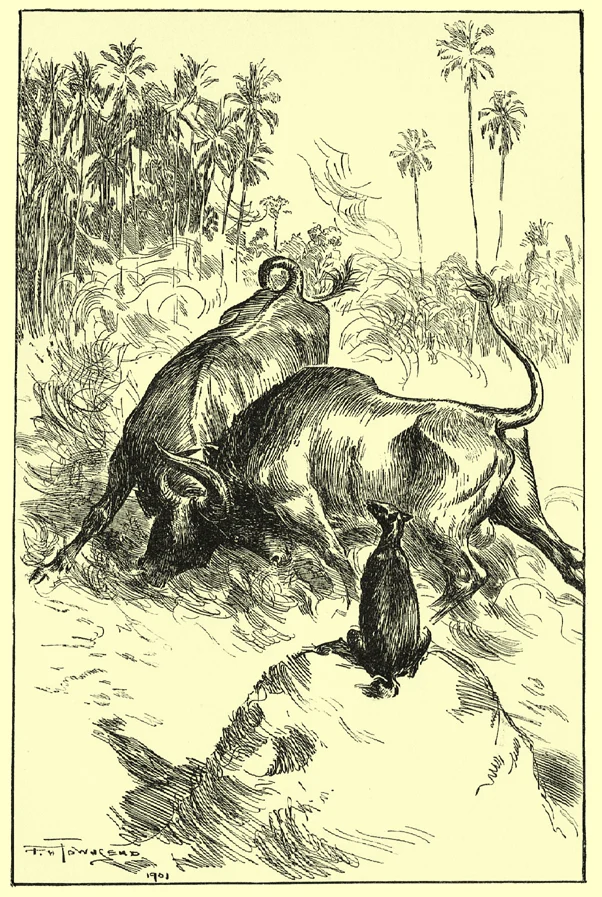
Townsend’s rival wild bulls fighting while P’lando’ watches from an ant-hill
The two named bulls fight at the boundary of clearing and young bush while the mouse-deer urges them on. Townsend shows the conflict; the tale supplies which bull is killed, so their identities are not assigned individually by position in the image.
Overview
P’lando’ tells the Bull of the Clearing, Sĕladang Chĕrang, and the Bull of the Young Bush, Sĕladang B’lūkar, that each has insulted the other. They fight at their territorial boundary while the mouse-deer encourages them from an ant-hill. The Clearing bull kills its rival, then frees the instigator from the ants’ burrows by scattering the mound with its horns. It flees the ants, leaving the mouse-deer the carcass. In the continuation P’lando’ frightens away a tiger and keeps the meat. The bulls’ habitat titles distinguish two individual opponents, not supernatural cattle species; the trickster’s claims of their hostility are initially lies.
Origins & earliest records
Malay Peninsula; Told by an unnamed Kelantan Malay
Records & interpretation
Complete relevant tale and attached scholarly notes directly read.
Selected bibliography
Documented works and useful reading. This is not a list of every appearance.
- 01
Fables & Folk-Tales from an Eastern Forest
XIII, Wit wins the day, pp. 30–32; note p. 80
- 02
Fables & Folk-Tales from an Eastern Forest — XIII Wit Wins the Day
Fables & Folk-Tales from an Eastern Forest, collected and translated by Walter Skeat; Cambridge: University Press, 1901. Original title leaf13 visually checked. Complete selected named tale, conclusion, footnotes and corresponding source notes read from Elfinspell historical transcription; individual page ranges in this batch are host body labels, not independently scan-collated. Introduction states collection during1899 expedition with some limitation of original phraseology; no unedited original-language transcript claimed.
Family & connections
A source-supported family tree or inspiration record has not yet been compiled for this profile. Related reading below indicates a connection in subject matter, not a proven lineage or creative influence.
Primary records and illustrations
Walter Skeat, Fables & Folk-Tales from an Eastern Forest (Cambridge: University Press, 1901)
XIII, Wit wins the day. XIII, Wit wins the day, pp. 30–32; note p. 80
Complete tale and associated notes directly read. Regional spellings and differing accounts retained; commentary does not establish present-day practice or biological facts. Individual teller not named here.
Located primary passages
Specific passages supporting details in this entry, grouped by their published witness.
Fables & Folk-Tales from an Eastern Forest
Fables & Folk-Tales from an Eastern Forest, collected and translated by Walter Skeat; Cambridge: University Press, 1901. Original title leaf13 visually checked. Complete selected named tale, conclusion, footnotes and corresponding source notes read from Elfinspell historical transcription; individual page ranges in this batch are host body labels, not independently scan-collated. Introduction states collection during1899 expedition with some limitation of original phraseology; no unedited original-language transcript claimed.
- P’lando’ tells the bulls of the clearing and young bush that each has insulted the other, inducing a fight. The clearing bull kills the bush bull while the mouse-deer cheers from a termite mound. Termites immobilise the mouse-deer, so it asks the survivor to break the mound; released, it prepares the dead bull. A tiger asks to share the meat. P’lando’ sends it for prickly shelter branches, which scratch it as it struggles on a slippery river landing. Asked why he shivers, the mouse-deer claims fierce anticipation. The tiger fears becoming prey and escapes into the river, leaving the meat. Skeat credits an unnamed Kelantan Malay.
XIII Wit Wins the Day, complete hosted page labels 30–32; note80
CompleteXIII30–32 and note80 read. Clearing bull wins and leaves alive. Termites prevent immediate movement; bull assistance is needed. Tiger’s blood comes from thorny branches, not an actual mouse-deer attack. Death of the fleeing tiger is not narrated. No slaughter formula copied.
References
Sources supporting this profile. Linked pages have their own scope and editorial standards.
- Historical collected narrative with locality and editorial notesSkeat, Fables & Folk-Tales (Cambridge University Press, 1901), XIII, Wit wins the day, pp. 30–32; note p. 80Research access: 2026-10-05
Image credits
Historical illustrationTownsend’s rival wild bulls fighting while P’lando’ watches from an ant-hill
The two named bulls fight at the boundary of clearing and young bush while the mouse-deer urges them on. Townsend shows the conflict; the tale supplies which bull is killed, so their identities are not assigned individually by position in the image.