
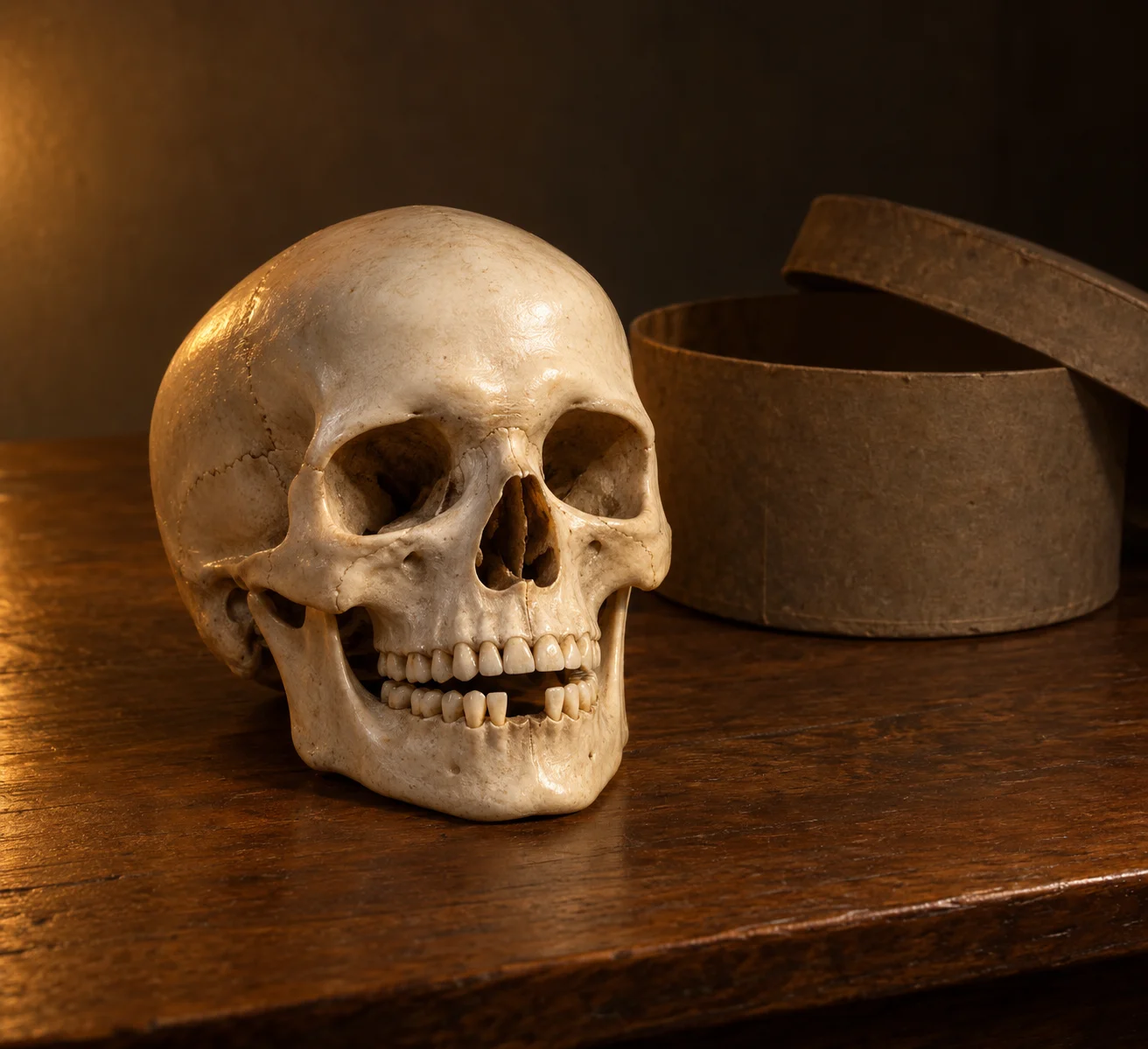
AI-generated interpretation of Crawford’s fictional skull after its lower jaw is fitted; box, lighting and precise bone contours are reconstructed.
The missing lower front pair follows the tale and its fictional newspaper ending; no real skull or historical illustration is used as a visual reference.
Overview
The Screaming Skull is presented through a retired sea captain’s uneasy conversation with an old friend. Captain Charles Braddock has inherited the house of his cousin, Dr Luke Pratt. After Pratt’s unexplained death on the beach, a small, beautifully shaped white skull was found beside him and an open cardboard bandbox that had belonged to his wife. The skull’s upper teeth are perfect, but its lower jaw is initially absent. It is kept in the box in a bedroom cupboard. Braddock hears a rising scream which he associates with Mrs Pratt’s voice, yet repeatedly insists on ordinary explanations. His account also circles around a dinner story about a concealed murder and his suspicion that Pratt killed his wife. The skull’s identity as Mrs Pratt is a conclusion he fears and speculates about, not an established identification.
Removing the skull does not bring Braddock peace. After he throws its box outside, cries seem to approach the house, hollow knocks sound at the door and the skull rolls against his foot. The gardener later finds a lower jaw in old lime while digging an asparagus bed. It lacks two front teeth, perhaps broken out by his spade, and Braddock says it fits the skull exactly. When he puts the bones together, the teeth close on his finger; he immediately explains that he must have pressed the jaws with his other hand. During the narrated evening, a sealed bandbox is opened and found empty, though a lump of lead subsequently falls from it. Further knocks bring the skull sliding into the room. His guest’s finger bleeds after handling it, and a drop appears on an upper canine. These incidents make the object increasingly threatening while leaving the captain’s defensive explanations audible.
An appended fictional newspaper report supplies the ending which Braddock cannot narrate himself. He is found dead in bed with his windpipe crushed and human tooth marks on his throat. The apparent assailant lacks the two lower middle incisors, matching the skull’s distinctive missing front pair. No entry or struggle is explained, and the inquest attributes his death to an unknown person. The story strongly invites a connection without presenting an eyewitness to the final attack. Crawford’s closing note names legends about a skull at Bettiscombe Manor as its foundation, while qualifying his recollection of the location. This literary skull and the fictional deaths are not a documentary account of the real house, its remains or a verified haunting.
First appearances & development
F. Marion Crawford’s authored English ghost story in the dated 1911 Macmillan collection Wandering Ghosts. Its closing note acknowledges a legendary foundation; the one-sided conversation and fictional newspaper ending are the consulted literary version.
Canon & continuity
The complete story, newspaper ending and author’s note were read, along with the historical title, copyright page and contents. The historical frontispiece was not viewed or used. The collection’s pooled copyright dates do not establish this tale’s individual first publication.
Selected bibliography
Documented works and useful reading. This is not a list of every appearance.
- 01
Wandering Ghosts — The Screaming Skull
New York: The Macmillan Company; title and copyright page state Published March, 1911. The consulted narrative begins on page 43.
Family & connections
A source-supported family tree or inspiration record has not yet been compiled for this profile. Related reading below indicates a connection in subject matter, not a proven lineage or creative influence.
References
Sources supporting this profile. Linked pages have their own scope and editorial standards.
- Primary historical authored fictionWandering Ghosts — historical title and complete Screaming Skull with ending and noteResearch access: 2026-10-18
Image credits
AI-generatedAI-generated interpretation of Crawford’s fictional skull after its lower jaw is fitted; box, lighting and precise bone contours are reconstructed.
The missing lower front pair follows the tale and its fictional newspaper ending; no real skull or historical illustration is used as a visual reference.