
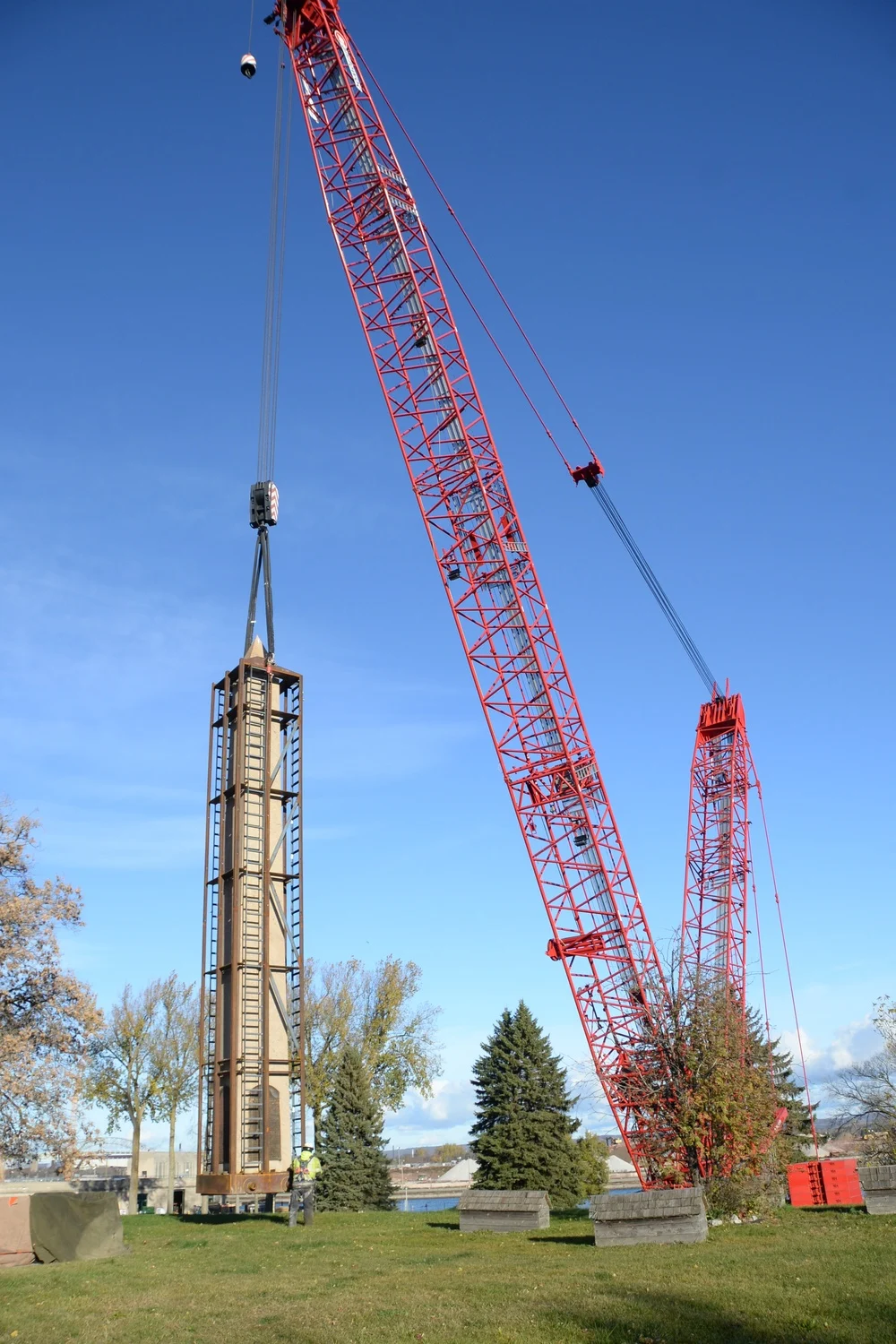
A crane lifts the Soo Locks anniversary obelisk from Brady Park in November 2025 following consultation with the Sault Tribe and Bay Mills Indian Community
The Corps of Engineers removed the Soo Locks anniversary obelisk from an Indigenous burial site at Brady Park, Sault Ste. Marie, in November 2025, following consultation with tribal nations including the Sault Tribe and Bay Mills Indian Community. The photograph documents that particular restoration action; it is not a portrait of tribal members. The appearance of U.S. Department of War (DoW) visual information does not imply or constitute DoW endorsement.
Overview
The Sault Ste. Marie Tribe of Chippewa Indians is a distinct Indigenous nation based along the St. Marys River in Michigan, between Lakes Superior and Huron. Its public history places the community within the wider Anishinaabe world of the Great Lakes. That connection is not a claim that every Anishinaabe community belongs to the same government. The Tribe’s name identifies a particular political community, while its cultural institutions use Anishinaabemowin and Ojibwe language terminology.
The Tribe’s historical narrative traces modern organizing to Sugar Island residents’ meetings in the 1940s. It describes archival and genealogical research used in a prolonged recognition campaign, culminating in federal recognition in 1972, land taken into trust in 1974 and adoption of a constitution in 1975. These are institutional milestones rather than the beginning of the people’s history. The account also explains why residents sought recognition separately from Bay Mills. Its description of the campaign gives community organizing and material needs a place alongside treaty history; the underlying treaties and recognition files have not been independently read here.
The Language and Culture Division’s public statement identifies administration, historic preservation and repatriation, language work, the culture camp and the Ojibwe Learning Center and Library as connected responsibilities. It addresses tribal members and interested community members, so participating in a public programme does not establish political membership. This organizational description shows several routes through which community knowledge is supported. It does not imply that every citizen takes part in the same activities or shares one individual level of language proficiency.
The Mary Murray Culture Camp gives one undertaking a named origin. The Tribe credits elder Mary Murray with donating forty acres on Sugar Island in 1975 for cultural continuity and children’s learning. Its account describes learning through activities on the land, seasonal camps and workshops, as well as space for gatherings and retreats. It also welcomes ideas for future workshops. The camp therefore appears as a place shaped by community use and contribution, rather than an inventory of practices required of all members.
The Ojibwe Learning Center and Library separately describes a collection of books, cultural objects and educational media, together with space for language classes, meetings and events. Its February 2024 page states that the library welcomes everyone. Books and objects are presented within an educational setting, not as detached specimens of a vanished culture. The inspected page establishes the institution’s stated purpose; it does not substitute for reading its books, viewing its recordings or checking a present opening schedule.
History & identity
Great Lakes community history distinguished from federal-recognition chronology.
Sources & representation
Complete selected tribal history, division, camp and library bodies read; linked treaties, books and media unexamined.
Selected bibliography
Documented works and useful reading. This is not a list of every appearance.
- 01
Sault Tribe: Story of Our People
Tribal community source
Language & cultural connections
Source-supported language and cultural connections have not yet been compiled for this profile.
References
Sources supporting this profile. Linked pages have their own scope and editorial standards.
- Tribal community sourceSault Tribe: History & CultureResearch access: 2026-10-06
- Tribal community sourceSault Tribe: Language & CultureResearch access: 2026-10-06
- Tribal community sourceMary Murray Culture CampResearch access: 2026-10-06
- Tribal community sourceOjibwe Learning Center and LibraryResearch access: 2026-10-06
Image credits
Contextual community heritage-site restoration photographA crane lifts the Soo Locks anniversary obelisk from Brady Park in November 2025 following consultation with the Sault Tribe and Bay Mills Indian Community
The Corps of Engineers removed the Soo Locks anniversary obelisk from an Indigenous burial site at Brady Park, Sault Ste. Marie, in November 2025, following consultation with tribal nations including the Sault Tribe and Bay Mills Indian Community. The photograph documents that particular restoration action; it is not a portrait of tribal members. The appearance of U.S. Department of War (DoW) visual information does not imply or constitute DoW endorsement.