
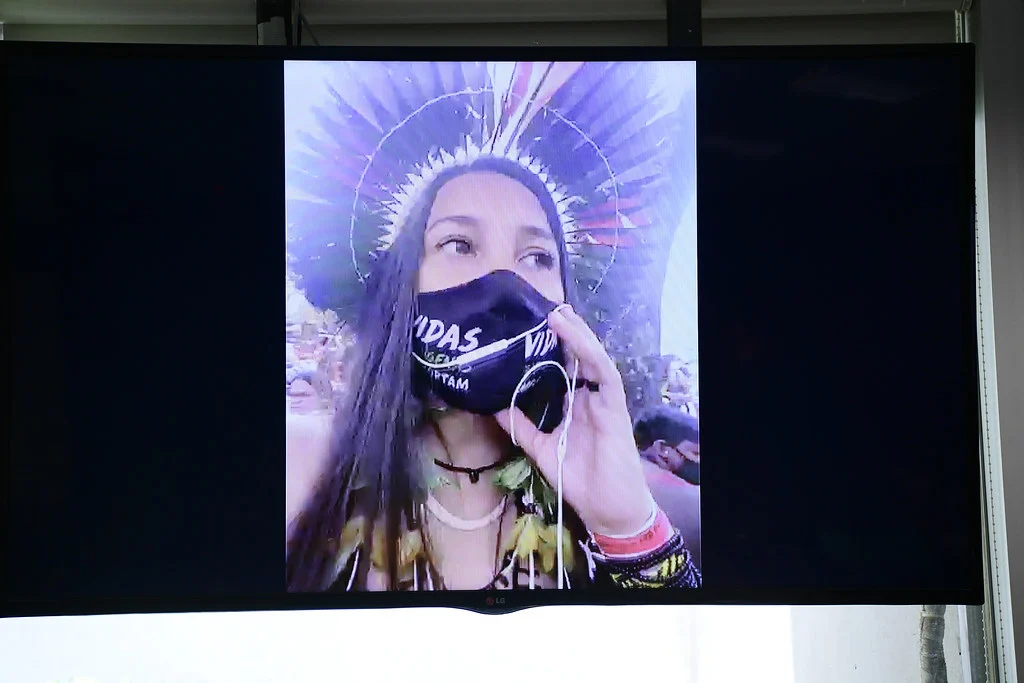
A Senate display shows Samela Sateré Mawé speaking remotely, wearing a dark face mask and feather headdress and holding an earbud microphone; the full monitor and surrounding room remain visible.
Samela Sateré Mawé speaks by videoconference at a Brazilian Senate climate debate on 10 September 2021. Pedro França’s photograph records this individual public appearance, not a representative appearance or political position of all Sateré-Mawé people.
Overview
The Sateré-Mawé are a living Indigenous people of the middle Amazon region in Brazil. Instituto Socioambiental identifies Andirá-Marau, on the Amazonas–Pará border, as a principal homeland, alongside a smaller presence in Coatá-Laranjal. It also records residents in Manaus, Parintins, Maués, Barreirinha and Nova Olinda do Norte. Its account identifies Sateré-Mawé as a self-designation and places the language within the Tupi stock. Village residence, urban residence and language classification describe different aspects of community life; none alone should be treated as a complete test of identity.
The Consórcio dos Produtores Sateré-Mawé presents itself as an autonomous auxiliary organization of the Conselho Geral da Tribo Sateré-Mawé. Its public statement connects production of native waraná, or guaraná, with forest stewardship and economic autonomy. Collective organization is intended to strengthen producers when dealing with commercial intermediaries and to protect the community’s name and accumulated work from appropriation. These are the consortium’s stated aims. They do not imply that all Sateré-Mawé belong to it, that every producer has the same experience, or that commercial participation has resolved all economic difficulties.
In a February 2019 Slow Food interview, Sérgio Garcia, identified then as consortium president, discusses the relationship between cultural transmission and viable livelihoods. He recalls meetings with producers and community leaders and describes honey production as an additional activity linked to local ecological knowledge. He also identifies a tension: young people leave for education in cities while the community wants opportunities for them to continue learning production skills. His concern is the transmission of practical expertise acquired through experience. The interview records his assessment and hopes in 2019, rather than an independently measured outcome for every family.
Literary expression is represented by Yaguarê Yamã’s April 2020 interview with Julie Dorrico. The introduction identifies his mother’s people as Maraguá and his father’s as Sateré-Mawé; his affiliations should remain distinct rather than making the two peoples synonymous. He describes storytelling as a motive for writing, literature as a means of resistance, and children as an important readership. He also recalls participating in the formation of the Indigenous writers’ network NEARIN and returning from São Paulo to the Amazon. These are one author’s reflections on his work and choices, not a universal cultural prescription.
History & identity
Selected Indigenous-peoples documentation, producer organization self-description and two named interviews.
Sources & representation
Complete selected ISA identity/language/location sections, consortium main statement, full Garcia2019 and Yamã2020 interviews. No linked books, rituals, recordings or product-health claims adopted.
Selected bibliography
Documented works and useful reading. This is not a list of every appearance.
- 01
Yaguarê Yamã interview
Complete written interview, 15 April; books not read.
Language & cultural connections
Source-supported language and cultural connections have not yet been compiled for this profile.
References
Sources supporting this profile. Linked pages have their own scope and editorial standards.
- Community, first-person or specialist sourceISA Sateré-Mawé profileResearch access: 2026-10-05
- Community, first-person or specialist sourceProducer consortium statementResearch access: 2026-10-05
- Community, first-person or specialist sourceSérgio Garcia interview,2019Research access: 2026-10-05
- Community, first-person or specialist sourceYamã and Dorrico interview,2020Research access: 2026-10-05
Image credits
Documentary photograph of a named participant shown by videoconference at a public institutional eventA Senate display shows Samela Sateré Mawé speaking remotely, wearing a dark face mask and feather headdress and holding an earbud microphone; the full monitor and surrounding room remain visible.
Samela Sateré Mawé speaks by videoconference at a Brazilian Senate climate debate on 10 September 2021. Pedro França’s photograph records this individual public appearance, not a representative appearance or political position of all Sateré-Mawé people.