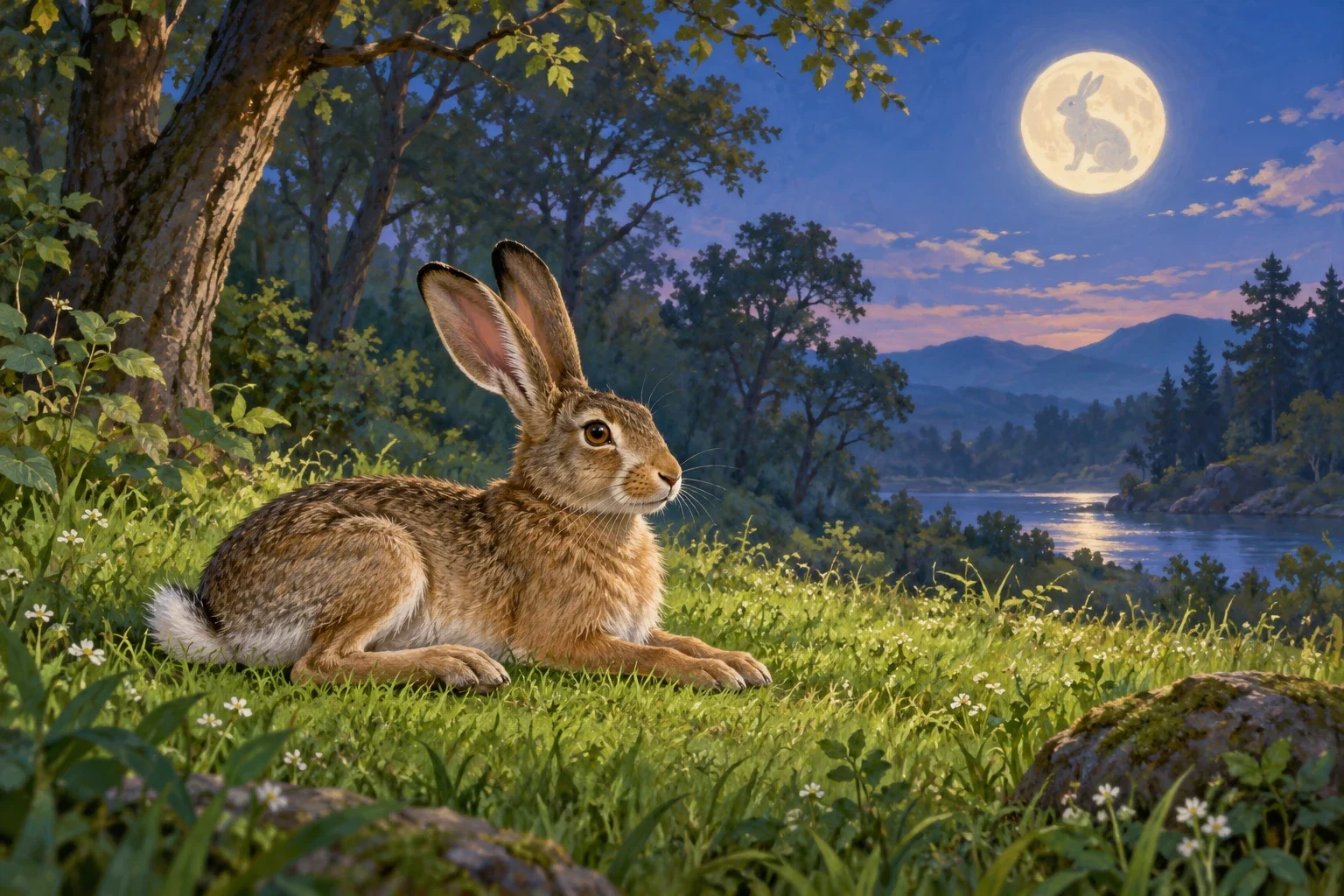
AI-generated interpretation of the living hare after Sakka’s test; the moonmark and undescribed details are imagined.
Fur pattern, species-like appearance, grass and other vegetation, terrain, lighting, moon phase and hare-mark design are imagined. The living animal remains in the forest; the moonmark is a commemorative image, not a lunar resident. Not an authenticated sacred image or zoological reference. Full frame preserved; WebP compression only.
Overview
The selected Sasa-Jātaka begins with a landowner at Sāvatthi entertaining the Buddha and his community for a week and presenting the requisites of their religious life. In response, the Teacher recounts an earlier act of giving. The past-life narrative places the Bodhisatta as a young hare in a wood bordered by a mountain, a river and a village. His companions are an otter, a jackal and a monkey. He encourages them to give alms, observe the moral law and keep holy days, then recognizes from the moon that a fast-day approaches.
The companions prepare different gifts. The otter takes seven fish hidden by a fisherman, the jackal takes food from a field-watcher’s hut and the monkey gathers mangoes. Their offers appear in separate verses; the jackal’s English stanza expressly admits theft. The hare, whose ordinary food is grass, has no suitable meal for a human beggar and resolves to offer his own body. This determination heats Sakka’s throne, prompting the deity to investigate. Disguised as a brahmin, Sakka visits the friends in turn and hears what each is prepared to give.
When he reaches the hare, the Bodhisatta welcomes the opportunity to fulfil his promise. Before entering the miraculous coals Sakka produces, he shakes himself so that any insects in his coat can escape. The coals do not even heat his hair, and he remains unharmed. His puzzled question leads Sakka to reveal that the encounter has been a test. The narrative thus distinguishes the hare’s willingness to give from an actual death; no cooked body is consumed, and his concern for the small creatures on him remains part of the act.
Sakka commemorates that resolve by drawing a hare on the moon with essence extracted from a mountain. He then places the living hare back on young kuça grass in the same wood and returns to heaven. The four friends continue living harmoniously and observing the moral law. In the closing identification, the Teacher names Ānanda as the former otter, Moggallāna as the jackal, Sāriputta as the monkey and himself as the hare. The moon therefore carries a sign of the hare, while the animal returns to the forest; this account does not relocate him to a lunar settlement.
Origins & earliest records
Sasa-Jātaka No. 316, The Jātaka, Volume III, translated by H. T. Francis and R. A. Neil under E. B. Cowell’s editorship. The title material states first publication by Cambridge University Press in 1897; the hosted Pali Text Society/Luzac reprint also carries an anniversary line, without a confirmed reprint year here.
Records & interpretation
Complete selected No. 316 read, including the present-time gift framing, past-life account, all four gift verses, Sakka’s revelation and moon-marking, return of the unharmed hare, closing spiritual outcome and identification of the Birth. Title and preface attribution independently read within the same volume.
Selected bibliography
Documented works and useful reading. This is not a list of every appearance.
- 01
The Jātaka, Volume III, No. 316: Sasa-Jātaka, pp. 34–37
Historical translation, complete narrative with framing, verses and identification. Rouse is not the Volume III translator. The hosted title’s reprint wording is distinguished from original publication.
Family, evolution & connections
Loporrit (Final Fantasy)
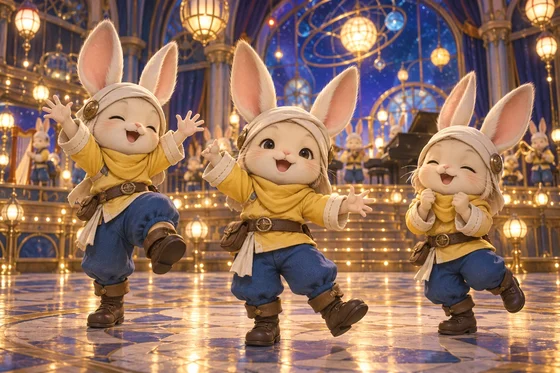
In the Sasa-Jātaka, Sakka commemorates the unharmed hare with a hare image on the moon and returns the living animal to its forest. The moon-linked hare motif permits a bounded comparison with the separately catalogued fictional subject. The religious narrative and fictional identity remain distinct; no specific creator source is established.
References
Sources supporting this profile. Linked pages have their own scope and editorial standards.
- Historical primary Buddhist narrative translationSasa-Jātaka No. 316: complete selected narrativeResearch access: 2026-10-24
- Historical edition front matterThe Jātaka Volume III: title page and prefaceResearch access: 2026-10-24
Image credits
AI-generated Buddhist-narrative interpretationAI-generated interpretation of the living hare after Sakka’s test; the moonmark and undescribed details are imagined.
Fur pattern, species-like appearance, grass and other vegetation, terrain, lighting, moon phase and hare-mark design are imagined. The living animal remains in the forest; the moonmark is a commemorative image, not a lunar resident. Not an authenticated sacred image or zoological reference. Full frame preserved; WebP compression only.