
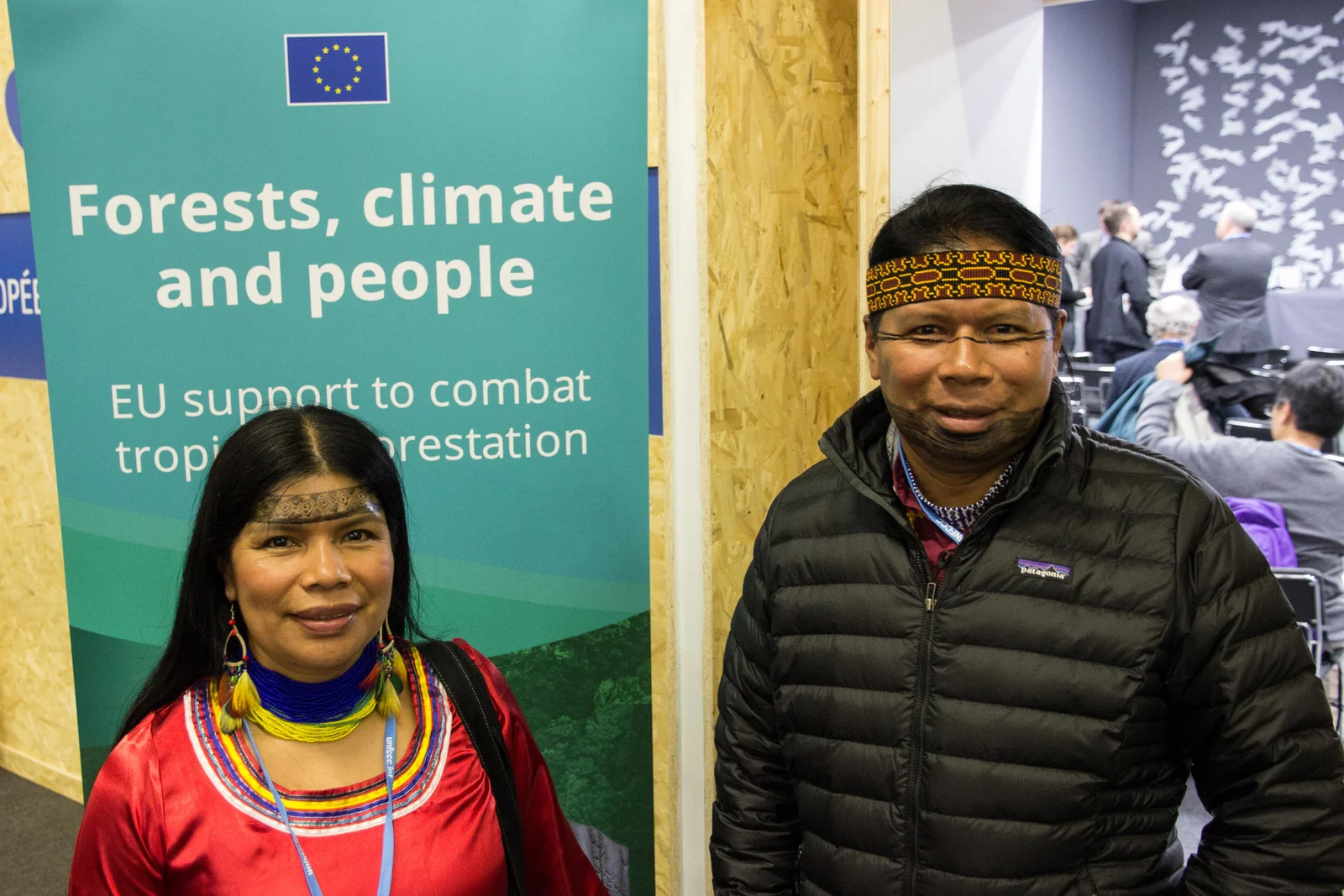
Patricia and José Gualinga stand beside a green Forests, climate and people display at COP21, with a meeting area visible behind them.
Patricia and José Gualinga from Sarayaku at COP21 in 2015, photographed by Climate Alliance Org. This records two named participants at a climate gathering, not a representative appearance or uniform political position of all Sarayaku residents.
Overview
Sarayaku is a Kichwa people in the middle Bobonaza basin of Ecuador’s Amazonian province of Pastaza. Its current community website describes seven community centres and presents forest, rivers and land as interconnected dimensions of the territory. The account links sustainable use with Sumak Kawsay, life in harmony, and the continuity of Kawsak Sacha, the living forest. This profile concerns Sarayaku specifically. Its institutions and explanations should not be made into a description of every Kichwa community or of all peoples who speak languages in the wider Quechuan family.
A community article first published in March 2022 describes the minga as reciprocal collective work that also creates opportunities for learning, visiting and celebration. It distinguishes family arrangements from larger community work coordinated by the government council and local kuragas. Clearing paths, the central square or the cemetery are examples of shared tasks. Preparation and hospitality are part of the work, including food and chicha shared with helpers. The article describes responsibilities of household partners and community authorities in that setting; it does not establish a universal rule for every family or an unchanging division of labour.
The Kawsak Sacha proposal brings territorial administration, cultural knowledge and collective wellbeing into one public argument. Its English presentation describes the chakra as both a food-producing place and a setting where children learn about plants and daily needs. It presents forest beings and relationships with them as integral to Sarayaku’s understanding of territory. Those statements are attributed cultural and philosophical claims, not substituted for biological classification. The proposal calls for recognition and protection against extractive development. The older presentation still anticipates the 2012 court judgment and uses an earlier community count, so its descriptions are not all treated as current administrative facts.
Public communication is itself a community activity. A June 2022 appeal describes Waktachik as a team of young people working with Tayjasaruta, the government council, to explain territorial defence, proposals and everyday events through the website and social media. The appeal sought equipment and transport support while preparing for a planned gathering. It documents the team’s stated aims at that date, without proving the later completion of every activity. Together, these written sources show cultural transmission through work, land-based learning and contemporary media. No linked film or recorded oral narrative was viewed or listened to for this profile.
History & identity
Territorial community histories are distinguished from dates of websites, communications projects and political proposals.
Sources & representation
Current homepage identity introduction; complete2022 minga and Waktachik bodies; English proposal sections through declaration plus closing historical court discussion read. Current homepage and older proposal have different community counts.
Selected bibliography
Documented works and useful reading. This is not a list of every appearance.
- 01
Kawsak Sacha proposal
English public presentation read; closing court discussion is from before the2012 judgment, not current case status.
- 02
La minga en el pueblo de Sarayaku
Complete written account read; later webpage update distinguished from first publication.
Language & cultural connections
These connections link languages or specific cultural works and institutions; they do not establish biological ancestry or ethnic identity.
Waktachik and Tayjasaruta
A June 2022 appeal describes Waktachik’s young communication team coordinating with Tayjasaruta. It does not establish present staffing or successful completion of the fundraising.
References
Sources supporting this profile. Linked pages have their own scope and editorial standards.
- Community publicationSarayaku: community introductionResearch access: 2026-10-05
- Community publicationSarayaku: minga accountResearch access: 2026-10-05
- Community publicationSarayaku: Kawsak Sacha proposalResearch access: 2026-10-05
- Community publicationSarayaku: Waktachik appealResearch access: 2026-10-05
Image credits
Documentary event photograph of two named Sarayaku representativesPatricia and José Gualinga stand beside a green Forests, climate and people display at COP21, with a meeting area visible behind them.
Patricia and José Gualinga from Sarayaku at COP21 in 2015, photographed by Climate Alliance Org. This records two named participants at a climate gathering, not a representative appearance or uniform political position of all Sarayaku residents.