
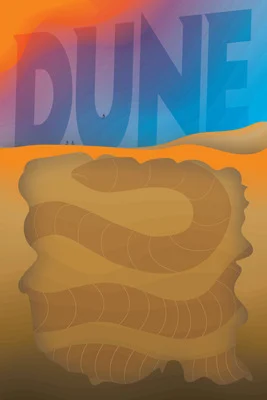
Joseph Haley’s orange and blue Dune poster shows a brown segmented sandworm coiled beneath the word DUNE, with orange desert dunes behind it.
Joseph Haley’s Sandy Worm, a student poster inspired by Dune. Source record dates its start2023 and cites publication2024. CC BY4.0; not official franchise art.
Overview
In Dune, a sandworm moves beneath open desert and responds to regular vibration. Harvesters, footsteps and deliberately placed thumpers can draw it toward a location, making the apparently empty landscape hazardous. Fremen knowledge turns that danger into controlled transport: hooks lift the edge of a body segment, exposing tissue that the worm protects by remaining above the sand. A rider then manages the animal's movement rather than taming it as an ordinary domestic mount. Worm teeth become crysknives, connecting the creature's body with ritual, material culture and the handling of sacred objects.
The adult's survival belongs to a life cycle in which sandtrout sequester water and participate in the formation of spice-producing material. Arrakis can therefore become greener while losing the ecological conditions that sustain its most powerful desert animals. Children of Dune makes that conflict central to Leto II's decisions, and God Emperor of Dune develops the consequences of a human-worm hybrid whose political control outlasts ordinary human lives. These novels make the creature consequential at the scale of food webs, religious authority and imperial movement. The 2021 film adds a specific design language: animation supervisor Robyn Luckham describes the worm as moving through sand with the force and grace of a whale, with a circular baleen-like mouth and musculature constructed for the required performance. That production analogy explains a particular adaptation's movement and design; it does not make the fictional animal a biological whale.
First appearances & development
Dune's 1965 book publication establishes the sandworm as both a desert danger and a foundation of Fremen life. Children of Dune in 1976 and God Emperor of Dune in 1981 expand its ecological and transformative roles. Denis Villeneuve's 2021 adaptation develops a distinct visual form with DNEG, while later films and games have their own presentation requirements.
Canon & continuity
The named novels provide the riding, crysknife and ecological baseline, checked here through the linked reference guide and chapter-based reread. The inspected DNEG interview supplies direct testimony about whale-like movement, circular baleen and the articulated mouth. Its production details are confined to the 2021 film; no single body length or rigid anatomy is imposed on all versions.
Selected bibliography
Documented works and useful reading. This is not a list of every appearance.
- 01
Dune
Thumpers, maker-hook riding, crysknives and the original Arrakis ecology.
- 02
Children of Dune
Declining worm habitat under ecological change and Leto II's sandtrout transformation.
- 03
God Emperor of Dune
Leto II's human-worm body, spice monopoly and the return of a modified life cycle.
- 04
Dune
The 2021 sandworm appearance, movement and harvester attack.
Family, evolution & connections
Whale motion and circular baleen (Dune 2021 film)
Luckham describes whale-like motion and circular baleen for the 2021 film. This production reference does not establish Herbert’s inspiration or fictional ancestry.
Human mouth muscle references (Dune 2021 rig)
Luckham identifies human mouth-muscle logic for opening and curling the 2021 sandworm’s mouth; this concerns animation, not human ancestry.
Beatboxer larynx footage (Dune 2021 animation)
The animators studied a beatboxer’s larynx for throat motion. Luckham’s account applies to the 2021 adaptation, not Herbert’s original creature design.
Encyclopedia background
An additional attributed reference, separate from the editorial profile above.
Read the open encyclopedia overview
A sandworm is a fictional extraterrestrial creature that appears in the Dune novels written by Frank Herbert, first introduced in Dune (1965).
Sandworms are colossal, worm-like creatures that live on the desert planet Arrakis. Their larvae produce a drug called melange (known colloquially as "the spice"), the most essential and valuable commodity in the universe because it makes safe and accurate interstellar travel possible. Melange deposits are found in the sand seas of Arrakis, where the sandworms live and hunt, and harvesting the spice from the sand is a dangerous activity because sandworms are aggressive and territorial. Harvesting vehicles must be airlifted in and out of the sand sea in order to evade sandworm attacks. The struggle over the production and supply of melange is a central theme of the Dune saga. The sandworms are reverently called Shai-Hulud by the planet's indigenous Fremen, who worship them as agents of God whose actions are a form of divine intervention. The name is derived from the Arabic شيء خلود (šayʾ khulūd, "thing of immortality").
Text from Wikipedia contributors, “Sandworm (Dune)”. CC BY-SA 4.0. Extracted introduction; formatting changed. Retrieved 5 October 2026. The source article may have changed since retrieval.
References
Sources supporting this profile. Linked pages have their own scope and editorial standards.
- ReferenceSandworm (Dune) — independent reference synthesisResearch access: 2026-10-05
- ReferenceChildren of Dune reread, part one — habitat changeResearch access: 2026-10-05
- Primary workDune — DNEG artists discuss worm motion and mouth designResearch access: 2026-10-05
Image credits
Original student fan-art poster; whole custodial medium-resolution display renditionJoseph Haley’s orange and blue Dune poster shows a brown segmented sandworm coiled beneath the word DUNE, with orange desert dunes behind it.
Joseph Haley’s Sandy Worm, a student poster inspired by Dune. Source record dates its start2023 and cites publication2024. CC BY4.0; not official franchise art.